


Request Quote
(Ships tomorrow)
CD2425D3VH Equivalent & Substitute Parts
Part Overview
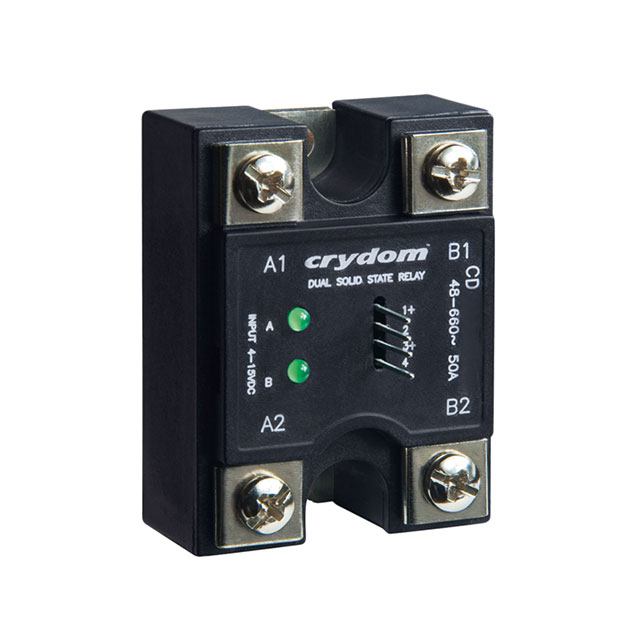
The CD2425D3VH is a solid state relay (SSR) manufactured by Sensata-Crydom, classified as a SPST-NO (Single Pole Single Throw - Normally Open) configuration with dual output channels in a hockey puck package. This component is rated for 25A load current with input voltage range of 4–15VDC and load voltage range of 24–280V AC with zero-cross switching capability. The CD2425D3VH is currently listed as obsolete. Identifying equivalent substitute parts is necessary to maintain system functionality and ensure continued availability for applications requiring this relay specification.
Substiute Parts
Key Parameters
| Parameter | Value |
|---|---|
| Manufacturer | Sensata-Crydom |
| Circuit Configuration | SPST-NO (1 Form A) x 2 |
| Output Type | AC, Zero Cross |
| Voltage - Input | 4 ~ 15VDC |
| Voltage - Load | 24 V ~ 280 V |
| Load Current | 25 A |
| Mounting Type | Chassis Mount |
| Termination Style | Screw Terminal |
| Package / Case | Hockey Puck |
| Series | Evolution Dual |
Substitute Part Grouping Explanation
Substitution of the CD2425D3VH is based on electrical and mechanical parameter equivalence within the Sensata-Crydom Evolution Dual series. The following parameters define acceptable substitutes:
- Circuit configuration: SPST-NO (1 Form A) x 2 (dual channel)
- Output type: AC with zero-cross switching
- Input voltage range: 4 ~ 15VDC
- Load voltage range: 24 V ~ 280 V
- Load current rating: 25 A
- Mounting type: Chassis Mount
- Termination style: Screw Terminal
- Package type: Hockey Puck
The CD2425D4VH meets all these criteria and is identified as a direct substitute.
Parameter Comparison
| Parameter | CD2425D3VH | CD2425D4VH |
|---|---|---|
| Manufacturer | Sensata-Crydom | Sensata-Crydom |
| Series | Evolution Dual | Evolution Dual |
| Circuit Configuration | SPST-NO (1 Form A) x 2 | SPST-NO (1 Form A) x 2 |
| Output Type | AC, Zero Cross | AC, Zero Cross |
| Voltage - Input | 4 ~ 15VDC | 4 ~ 15VDC |
| Voltage - Load | 24 V ~ 280 V | 24 V ~ 280 V |
| Load Current | 25 A | 25 A |
| Mounting Type | Chassis Mount | Chassis Mount |
| Termination Style | Screw Terminal | Screw Terminal |
| Package / Case | Hockey Puck | Hockey Puck |
| Product Status | Obsolete | Active |
| RoHS Status | Not specified | RoHS Compliant |
Engineering Selection Recommendations
The CD2425D4VH is the direct substitute for the CD2425D3VH. Both components share identical electrical specifications and mechanical form factors. The primary distinction is product status: the CD2425D3VH is obsolete while the CD2425D4VH is active. The CD2425D4VH carries RoHS Compliant certification, meeting current environmental compliance requirements. Both components are classified under ECCN EAR99 and HTSUS 8536.41.0060. Selection of the CD2425D4VH ensures access to an actively supported component with equivalent performance characteristics.
Frequently Asked Questions (FAQ)
Q: Can the CD2425D4VH directly replace the CD2425D3VH in existing applications?
A: Yes. The CD2425D4VH is electrically and mechanically equivalent to the CD2425D3VH. Both components feature identical input voltage range (4–15VDC), load voltage range (24–280V), load current rating (25A), circuit configuration (dual SPST-NO), output type (AC zero-cross), mounting type (chassis mount), termination style (screw terminal), and package type (hockey puck).
Q: What is the primary reason for substitution?
A: The CD2425D3VH is obsolete. The CD2425D4VH is the active equivalent from the same manufacturer and series, ensuring continued component availability and supply chain continuity.
Q: Are there any compliance differences between these parts?
A: The CD2425D4VH is RoHS Compliant, while RoHS status is not specified for the CD2425D3VH. Both components share the same ECCN (EAR99) and HTSUS (8536.41.0060) classifications.
Q: Will the hockey puck package dimensions remain the same?
A: Yes. Both the CD2425D3VH and CD2425D4VH use the hockey puck package type with chassis mount configuration, ensuring mechanical compatibility in existing installations.
Q: Are the screw terminal connections identical?
A: Yes. Both components use screw terminal termination style, maintaining electrical connection compatibility.
Alternative Parts

SJ6012L2TP
Littelfuse Inc.
6 Alternative Parts

JMK107BBJ476MA-RE
Taiyo Yuden
10 Alternative Parts

GMK107BBJ475MA-T
Taiyo Yuden
5 Alternative Parts
SJ6020N2ARP
Littelfuse Inc.
3 Alternative Parts
SJ6025R2ATP
Littelfuse Inc.
4 Alternative Parts

2474-05L
API Delevan Inc.
1 Alternative Parts

4590R-684K
API Delevan Inc.
1 Alternative Parts

CM6560R-334
API Delevan Inc.
1 Alternative Parts

CM6460-104
API Delevan Inc.
1 Alternative Parts

5526-12
API Delevan Inc.
1 Alternative Parts