



Request Quote
(Ships tomorrow)
BUL45D2 Equivalent & Substitute Parts
Part Overview
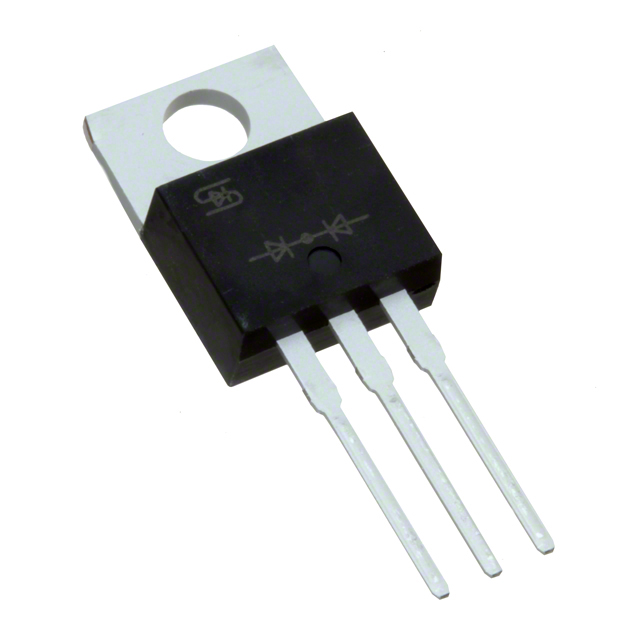
The BUL45D2 is an NPN bipolar junction transistor manufactured by onsemi, rated for 400 V collector-emitter breakdown voltage and 5 A maximum collector current in a TO-220-3 through-hole package. This device is classified as obsolete, which necessitates identification of equivalent and substitute components for ongoing design support and production requirements. The BUL45D2 delivers 75 W maximum power dissipation with a 13 MHz transition frequency, suitable for high-voltage switching applications requiring moderate current handling.
Substiute Parts
Key Parameters
| Parameter | Value | Unit |
|---|---|---|
| Transistor Type | NPN | — |
| Voltage - Collector Emitter Breakdown (Max) | 400 | V |
| Current - Collector (Ic) (Max) | 5 | A |
| Power - Max | 75 | W |
| Frequency - Transition | 13 | MHz |
| Operating Temperature Range | -65 to 150 | °C (TJ) |
| Package / Case | TO-220-3 | — |
| Mounting Type | Through Hole | — |
Substitute Part Grouping Explanation
Substitution of the BUL45D2 is determined by electrical and mechanical compatibility across the following critical parameters:
Electrical Compatibility Criteria:
- Transistor type must be NPN
- Collector-emitter breakdown voltage must equal or exceed 400 V
- Maximum collector current must equal or exceed 5 A
- Maximum power dissipation must equal or exceed 75 W
- Operating temperature range must encompass -65°C to 150°C
Mechanical Compatibility Criteria:
- Package type must be TO-220-3
- Mounting type must be Through Hole
Substitute parts are classified into two categories:
Direct Equivalents: Parts with identical electrical specifications and active product status, suitable for direct replacement without circuit modification.
Similar Substitutes: Parts with equal or superior electrical ratings that maintain functional compatibility within the specified parameter ranges, though minor performance characteristics may differ.
Parameter Comparison
| Part Number | Manufacturer | Vce Breakdown (V) | Ic Max (A) | Power Max (W) | Frequency (MHz) | Product Status | RoHS Compliance |
|---|---|---|---|---|---|---|---|
| BUL45D2 | onsemi | 400 | 5 | 75 | 13 | Obsolete | Non-compliant |
| BUL45D2G | onsemi | 400 | 5 | 75 | 13 | Active | ROHS3 Compliant |
| TSC742CZ C0G | Taiwan Semiconductor Corporation | 420 | 5 | 70 | — | Active | ROHS3 Compliant |
| BUL38D | STMicroelectronics | 450 | 5 | 80 | — | Active | ROHS3 Compliant |
| BUL49D | STMicroelectronics | 450 | 5 | 80 | — | Active | ROHS3 Compliant |
| BUL742C | STMicroelectronics | 400 | 4 | 70 | — | Active | ROHS3 Compliant |
| ST13005 | STMicroelectronics | 400 | 4 | 75 | — | Active | ROHS3 Compliant |
Engineering Selection Recommendations
Direct Equivalent (Recommended Primary Substitute):
The BUL45D2G is the optimal replacement for the obsolete BUL45D2. This part is manufactured by onsemi under the same base product number (BUL45) and maintains identical electrical specifications: 400 V breakdown voltage, 5 A collector current, 75 W power dissipation, and 13 MHz transition frequency. The BUL45D2G is in active production status with ROHS3 compliance and superior inventory availability (2000 pcs). The only difference is packaging format (Tube vs. unspecified for the original), which does not affect electrical or mechanical compatibility. This substitution requires no circuit redesign.
Alternative Substitutes (Higher Voltage/Power Rating):
The BUL38D and BUL49D, both manufactured by STMicroelectronics, provide enhanced electrical performance with 450 V breakdown voltage and 80 W power dissipation while maintaining 5 A collector current capability. These parts are suitable for applications where increased voltage margin or thermal headroom is beneficial. Both are in active production with ROHS3 compliance and high inventory levels.
Reduced Current Substitutes (Not Recommended for Direct Replacement):
The BUL742C and ST13005 are rated for 4 A maximum collector current, which is below the BUL45D2 specification of 5 A. These parts are suitable only for applications where the actual operating current does not exceed 4 A. Both maintain 400 V breakdown voltage and are in active production with ROHS3 compliance.
Alternative Manufacturer Option:
The TSC742CZ C0G, manufactured by Taiwan Semiconductor Corporation, provides 420 V breakdown voltage and 5 A collector current with 70 W power dissipation. This part is in active production with ROHS3 compliance but has not specified transition frequency data. This option is suitable where voltage margin above 400 V is acceptable and transition frequency is not a critical design parameter.
Frequently Asked Questions (FAQ)
Q: Can the BUL45D2G be used as a direct replacement for the BUL45D2?
A: Yes. The BUL45D2G is a direct equivalent with identical electrical specifications (400 V, 5 A, 75 W, 13 MHz) and is manufactured by the same supplier (onsemi) under the same base product number. The only difference is packaging format (Tube), which does not affect circuit compatibility. The BUL45D2G is in active production and ROHS3 compliant.
Q: What is the difference between "Direct Equivalent" and "Similar Substitute" parts?
A: Direct equivalents maintain identical electrical ratings and are suitable for direct replacement without any circuit modification. Similar substitutes have equal or superior electrical ratings but may differ in specific performance characteristics such as transition frequency or saturation voltage. Similar substitutes are compatible but may require application verification if the design relies on specific performance parameters.
Q: Can I use BUL742C or ST13005 as replacements?
A: These parts are suitable only if your application operates at 4 A collector current or below. Both are rated for maximum 4 A, which is 1 A less than the BUL45D2 specification of 5 A. If your circuit requires the full 5 A capability, these parts are not appropriate substitutes.
Q: Why should I choose BUL38D or BUL49D over BUL45D2G?
A: BUL38D and BUL49D offer higher voltage (450 V vs. 400 V) and power (80 W vs. 75 W) ratings, providing additional design margin for high-voltage switching applications. These parts are suitable if your application benefits from increased voltage headroom or thermal capacity. However, if the BUL45D2 specifications are sufficient for your design, the BUL45D2G is the preferred choice due to identical ratings and onsemi manufacturing continuity.
Q: Are all substitute parts ROHS3 compliant?
A: All substitute parts listed are ROHS3 compliant. The original BUL45D2 is RoHS non-compliant. If RoHS compliance is a requirement for your application or supply chain, any of the listed substitutes satisfy this requirement.
Q: What is the significance of the TO-220-3 package?
A: The TO-220-3 package is a through-hole component with three leads (Base, Collector, Emitter) and a metal mounting tab for heat dissipation. All listed substitute parts use the same TO-220-3 package, ensuring mechanical and thermal compatibility with existing PCB layouts and heat sink mounting arrangements. No PCB redesign is required.
Q: Does transition frequency matter for my application?
A: Transition frequency (fT) indicates the frequency at which the transistor's current gain drops to unity. The BUL45D2 specifies 13 MHz. If your application operates at frequencies approaching or exceeding this value, transition frequency is a critical parameter. BUL45D2G maintains this specification. Other substitutes do not specify transition frequency; verify this parameter with the manufacturer if high-frequency switching is required.
Q: Can I use TSC742CZ C0G as a substitute?
A: Yes, TSC742CZ C0G is compatible if your application does not require specified transition frequency data. This part provides 420 V breakdown voltage (exceeding the 400 V requirement) and 5 A collector current. However, transition frequency is not specified for this part. Use this substitute only if transition frequency is not a design-critical parameter.
Alternative Parts

SJ6012L2TP
Littelfuse Inc.
6 Alternative Parts

JMK107BBJ476MA-RE
Taiyo Yuden
10 Alternative Parts

GMK107BBJ475MA-T
Taiyo Yuden
5 Alternative Parts
SJ6020N2ARP
Littelfuse Inc.
3 Alternative Parts
SJ6025R2ATP
Littelfuse Inc.
4 Alternative Parts

2474-05L
API Delevan Inc.
1 Alternative Parts

4590R-684K
API Delevan Inc.
1 Alternative Parts

CM6560R-334
API Delevan Inc.
1 Alternative Parts

CM6460-104
API Delevan Inc.
1 Alternative Parts

5526-12
API Delevan Inc.
1 Alternative Parts