



Request Quote
(Ships tomorrow)
BMA250E Equivalent & Substitute Parts
Part Overview
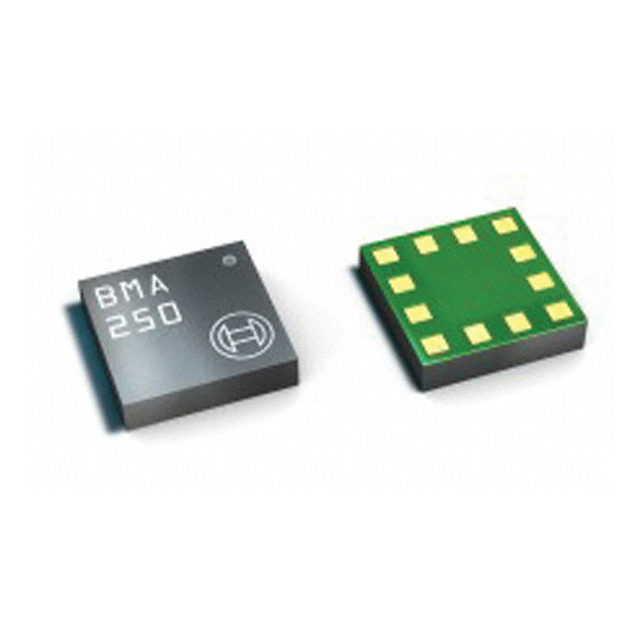
The BMA250E is a digital accelerometer manufactured by Bosch Sensortec, designed for motion sensing applications requiring multi-axis acceleration measurement. The device measures acceleration along X, Y, and Z axes with selectable ranges of ±2g, ±4g, ±8g, and ±16g, and communicates via I2C or SPI interfaces. The BMA250E is currently classified as obsolete, making it necessary to identify substitute components that maintain functional equivalence for ongoing design support and production continuity.
Substiute Parts
Key Parameters
| Parameter | BMA250E Specification |
|---|---|
| Manufacturer | Bosch Sensortec |
| Category | Motion Sensors |
| Type | Digital Accelerometer |
| Axis Configuration | X, Y, Z (3-axis) |
| Acceleration Range | ±2g, 4g, 8g, 16g |
| Output Interfaces | I2C, SPI |
| Bandwidth | 8Hz ~ 1kHz |
| Supply Voltage | 1.62V ~ 3.6V |
| Package Type | 12-VFLGA (2x2 mm) |
| Operating Temperature Range | -40°C ~ 85°C |
| Key Features | Adjustable Bandwidth, Selectable Scale, Sleep Mode, Temperature Sensor |
| Product Status | Obsolete |
Substitute Part Grouping Explanation
The IIS2DHTR from STMicroelectronics qualifies as a functional substitute for the BMA250E based on alignment of critical electrical and mechanical parameters. Both devices share the following key compatibility criteria:
Matching Parameters:
- 3-axis acceleration measurement (X, Y, Z axes)
- Identical acceleration range options (±2g, 4g, 8g, 16g)
- Same communication interfaces (I2C, SPI)
- Equivalent package format (12-VFLGA, 2x2 mm)
- Identical mounting type (Surface Mount)
- Same operating temperature range (-40°C ~ 85°C)
- Shared feature set (Adjustable Bandwidth, Selectable Scale, Sleep Mode, Temperature Sensor)
Substitution Feasibility: The IIS2DHTR maintains pin-compatible packaging and functional interface equivalence with the BMA250E, allowing direct substitution in designs where the specified parameter ranges are met.
Parameter Comparison
| Parameter | BMA250E (Bosch) | IIS2DHTR (STMicroelectronics) |
|---|---|---|
| Manufacturer | Bosch Sensortec | STMicroelectronics |
| Product Status | Obsolete | Active |
| Axis Configuration | X, Y, Z | X, Y, Z |
| Acceleration Range | ±2g, 4g, 8g, 16g | ±2g, 4g, 8g, 16g |
| Sensitivity (LSB/g) | 256 (±2g) ~ 16 (±16g) | 255 (±2g) ~ 21 (±16g) |
| Bandwidth Range | 8Hz ~ 1kHz | 1Hz ~ 5.3kHz |
| Output Interfaces | I2C, SPI | I2C, SPI |
| Supply Voltage Range | 1.62V ~ 3.6V | 1.71V ~ 3.6V |
| Package / Case | 12-VFLGA | 12-VFLGA |
| Mounting Type | Surface Mount | Surface Mount |
| Operating Temperature | -40°C ~ 85°C | -40°C ~ 85°C |
| Features | Adjustable Bandwidth, Selectable Scale, Sleep Mode, Temperature Sensor | Adjustable Bandwidth, Selectable Scale, Sleep Mode, Temperature Sensor |
| Packaging Option | Not specified | Cut Tape (CT) & Digi-Reel |
| RoHS Status | Not specified | ROHS3 Compliant |
| MSL Rating | 1 (Unlimited) | 3 (168 Hours) |
| REACH Status | Not specified | REACH Unaffected |
Engineering Selection Recommendations
Status-Based Consideration: The BMA250E is classified as obsolete, while the IIS2DHTR maintains active production status. For new designs or production continuity, the IIS2DHTR is the appropriate selection.
Compliance Advantages: The IIS2DHTR provides explicit RoHS3 compliance certification and REACH unaffected status, supporting regulatory requirements in regulated industries. The BMA250E compliance information is not provided.
Availability and Supply Chain: The IIS2DHTR demonstrates significantly higher stock availability (1,000,300 pcs) compared to legacy inventory levels, ensuring long-term sourcing reliability.
Parameter Compatibility: Both devices share identical electrical interfaces, acceleration measurement capabilities, and mechanical package specifications. The IIS2DHTR extends bandwidth capabilities (1Hz ~ 5.3kHz vs. 8Hz ~ 1kHz), providing additional operational flexibility.
Frequently Asked Questions (FAQ)
Q: Are the BMA250E and IIS2DHTR pin-compatible?
A: Yes. Both devices utilize the 12-VFLGA (2x2 mm) package format with equivalent Surface Mount configurations, enabling direct substitution at the PCB layout level.
Q: What are the key differences between these accelerometers?
A: The primary differences are product status (BMA250E is obsolete; IIS2DHTR is active), bandwidth range (IIS2DHTR supports 1Hz ~ 5.3kHz vs. BMA250E's 8Hz ~ 1kHz), sensitivity specifications (slight variation in LSB/g at ±16g), and supply voltage minimum (IIS2DHTR: 1.71V vs. BMA250E: 1.62V). Both maintain identical acceleration ranges, interfaces, and core feature sets.
Q: Can the IIS2DHTR replace the BMA250E in existing designs?
A: The IIS2DHTR is a functional substitute for the BMA250E in applications where the extended bandwidth capability does not introduce design complications. Interface compatibility and package equivalence ensure straightforward substitution for most accelerometer applications.
Q: What is the MSL difference, and does it affect substitution?
A: The BMA250E carries MSL 1 (unlimited moisture exposure tolerance), while the IIS2DHTR carries MSL 3 (168-hour moisture exposure tolerance). This difference impacts storage and handling procedures but does not affect electrical substitution capability.
Q: Are both devices suitable for the -40°C to 85°C operating range?
A: Yes. Both the BMA250E and IIS2DHTR are rated for identical operating temperature ranges of -40°C to 85°C, supporting deployment in industrial and consumer applications within this specification.
Q: What interfaces does the IIS2DHTR support?
A: The IIS2DHTR supports both I2C and SPI communication protocols, matching the BMA250E interface options and ensuring firmware compatibility without protocol modification.
Alternative Parts

SJ6012L2TP
Littelfuse Inc.
6 Alternative Parts

JMK107BBJ476MA-RE
Taiyo Yuden
10 Alternative Parts

GMK107BBJ475MA-T
Taiyo Yuden
5 Alternative Parts
SJ6020N2ARP
Littelfuse Inc.
3 Alternative Parts
SJ6025R2ATP
Littelfuse Inc.
4 Alternative Parts

2474-05L
API Delevan Inc.
1 Alternative Parts

4590R-684K
API Delevan Inc.
1 Alternative Parts

CM6560R-334
API Delevan Inc.
1 Alternative Parts

CM6460-104
API Delevan Inc.
1 Alternative Parts

5526-12
API Delevan Inc.
1 Alternative Parts