


Request Quote
(Ships tomorrow)
BF393 Equivalent & Substitute Parts
Part Overview
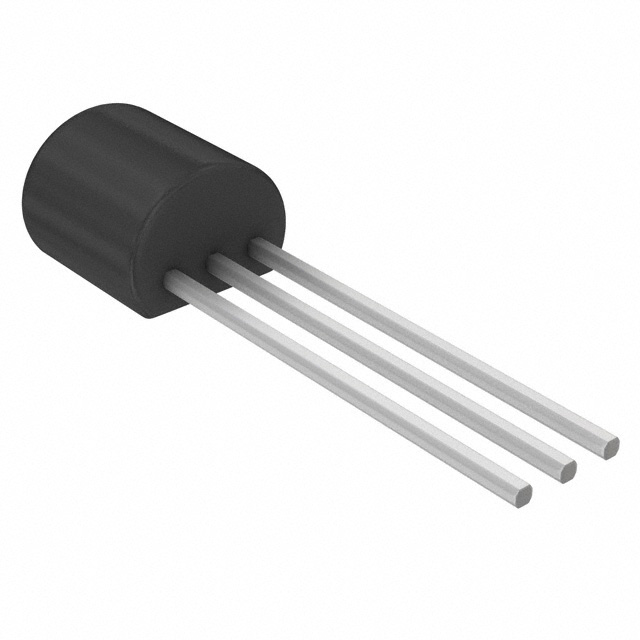
The BF393 is an NPN bipolar junction transistor manufactured by onsemi, housed in a TO-92 through-hole package. This device is rated for 300 V collector-emitter breakdown voltage and 500 mA maximum collector current, with a maximum power dissipation of 625 mW. The BF393 is classified as obsolete, which necessitates identification of functionally equivalent active alternatives for new designs and ongoing production requirements. Substitute parts must maintain electrical and mechanical compatibility within the specified parameter ranges.
Substiute Parts
Key Parameters
| Parameter | BF393 | Unit |
|---|---|---|
| Transistor Type | NPN | — |
| Voltage - Collector Emitter Breakdown (Max) | 300 | V |
| Current - Collector (Ic) (Max) | 500 | mA |
| Power - Max | 625 | mW |
| Frequency - Transition | 50 | MHz |
| DC Current Gain (hFE) (Min) @ Ic, Vce | 40 @ 10mA, 10V | — |
| Vce Saturation (Max) @ Ib, Ic | 2V @ 2mA, 20mA | — |
| Operating Temperature Range | -55 to 150 | °C |
| Mounting Type | Through Hole | — |
| Package / Case | TO-92-3 (TO-226) | — |
| Product Status | Obsolete | — |
Substitute Part Grouping Explanation
Substitute parts for the BF393 are identified based on strict electrical and mechanical parameter compatibility. The primary substitution criteria are:
Electrical Compatibility Requirements:
- Transistor type must be NPN
- Collector-emitter breakdown voltage must equal or exceed the application requirement (300 V for BF393)
- Maximum collector current must equal or exceed the application requirement (500 mA for BF393)
- Maximum power dissipation must equal or exceed the application requirement (625 mW for BF393)
- Operating temperature range must encompass the application range (-55°C to 150°C for BF393)
Mechanical Compatibility Requirements:
- Mounting type must be Through Hole
- Package must be TO-92-3 (TO-226) configuration
Identified Substitutes:
The parts 2N3904BU and 2N4401BU are listed as substitutes for the BF393. However, both substitute parts have a maximum collector-emitter breakdown voltage of 40 V, which is significantly lower than the BF393 specification of 300 V. This represents a critical electrical parameter mismatch. These substitutes are suitable only for applications where the actual operating voltage requirement is 40 V or lower, not for applications requiring the full 300 V rating of the BF393.
Both substitute parts share the following compatible parameters with the BF393:
- NPN transistor type
- TO-92-3 through-hole package
- 625 mW maximum power dissipation
- -55°C to 150°C operating temperature range
- Active product status (both 2N3904BU and 2N4401BU are active, versus BF393 obsolete status)
Parameter Comparison
| Parameter | BF393 | 2N3904BU | 2N4401BU | Unit |
|---|---|---|---|---|
| Transistor Type | NPN | NPN | NPN | — |
| Voltage - Collector Emitter Breakdown (Max) | 300 | 40 | 40 | V |
| Current - Collector (Ic) (Max) | 500 | 200 | 600 | mA |
| Power - Max | 625 | 625 | 625 | mW |
| Frequency - Transition | 50 | 300 | 250 | MHz |
| Operating Temperature Range | -55 to 150 | -55 to 150 | -55 to 150 | °C |
| Mounting Type | Through Hole | Through Hole | Through Hole | — |
| Package / Case | TO-92-3 | TO-92-3 | TO-92-3 | — |
| Product Status | Obsolete | Active | Active | — |
| RoHS Status | Non-compliant | ROHS3 Compliant | ROHS3 Compliant | — |
Engineering Selection Recommendations
For applications operating at 300 V collector-emitter voltage:
No direct substitute exists among the provided alternatives. The 2N3904BU and 2N4401BU are rated for maximum 40 V operation and cannot replace the BF393 in high-voltage applications. Alternative high-voltage NPN transistors outside the provided substitute list must be evaluated.
For applications operating at 40 V or lower collector-emitter voltage:
Both 2N3904BU and 2N4401BU are suitable substitutes, provided the collector current requirement does not exceed the respective device ratings:
-
2N3904BU: Maximum 200 mA collector current. Select this device for applications requiring collector currents up to 200 mA at 40 V or lower.
-
2N4401BU: Maximum 600 mA collector current. Select this device for applications requiring collector currents up to 600 mA at 40 V or lower.
Compliance Advantages:
Both 2N3904BU and 2N4401BU are ROHS3 compliant and carry active product status, providing supply chain continuity and regulatory compliance advantages over the obsolete, non-compliant BF393.
Frequency Considerations:
Both substitute parts offer higher transition frequencies (300 MHz for 2N3904BU, 250 MHz for 2N4401BU) compared to the BF393 (50 MHz), enabling operation in higher-frequency applications.
Frequently Asked Questions (FAQ)
Q: Can the 2N3904BU or 2N4401BU directly replace the BF393 in all applications?
A: No. Both substitute parts are rated for 40 V maximum collector-emitter breakdown voltage, while the BF393 is rated for 300 V. Direct substitution is only valid for applications where the actual operating voltage does not exceed 40 V. For applications requiring 300 V operation, alternative high-voltage transistors must be selected.
Q: What is the primary difference between the 2N3904BU and 2N4401BU substitutes?
A: The 2N3904BU is rated for maximum 200 mA collector current, while the 2N4401BU is rated for maximum 600 mA collector current. Both operate at 40 V maximum. Select based on the collector current requirement of the application.
Q: Are the substitute parts pin-compatible with the BF393?
A: Yes. All three devices use the TO-92-3 (TO-226) through-hole package with identical pin configuration (Base, Collector, Emitter).
Q: What compliance advantages do the substitute parts offer?
A: Both 2N3904BU and 2N4401BU are ROHS3 compliant and carry active product status. The BF393 is non-compliant and obsolete. For new designs and production requiring regulatory compliance, the substitute parts are preferred.
Q: Can the substitute parts operate across the same temperature range as the BF393?
A: Yes. All three devices are rated for -55°C to 150°C operating temperature range.
Q: Why do the substitute parts have higher transition frequencies than the BF393?
A: The 2N3904BU (300 MHz) and 2N4401BU (250 MHz) are designed for higher-frequency applications compared to the BF393 (50 MHz). This characteristic does not prevent substitution in lower-frequency applications but enables use in faster switching circuits.
Q: What is the saturation voltage difference between the BF393 and substitute parts?
A: The BF393 has a saturation voltage of 2 V at 2 mA base current and 20 mA collector current. The 2N3904BU has 300 mV saturation at 5 mA base current and 50 mA collector current. The 2N4401BU has 750 mV saturation at 50 mA base current and 500 mA collector current. Saturation voltage varies with operating point and must be evaluated for specific circuit requirements.
Alternative Parts

SJ6012L2TP
Littelfuse Inc.
6 Alternative Parts

JMK107BBJ476MA-RE
Taiyo Yuden
10 Alternative Parts

GMK107BBJ475MA-T
Taiyo Yuden
5 Alternative Parts
SJ6020N2ARP
Littelfuse Inc.
3 Alternative Parts
SJ6025R2ATP
Littelfuse Inc.
4 Alternative Parts

2474-05L
API Delevan Inc.
1 Alternative Parts

4590R-684K
API Delevan Inc.
1 Alternative Parts

CM6560R-334
API Delevan Inc.
1 Alternative Parts

CM6460-104
API Delevan Inc.
1 Alternative Parts

5526-12
API Delevan Inc.
1 Alternative Parts