


Request Quote
(Ships tomorrow)
BDV64B Equivalent & Substitute Parts
Part Overview
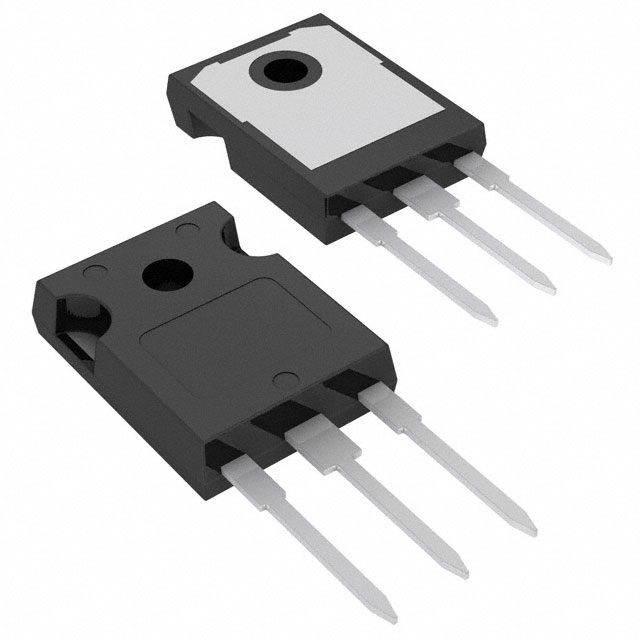
The BDV64B is a PNP bipolar junction transistor manufactured by Central Semiconductor Corp, rated for 100 V collector-emitter breakdown voltage and 12 A maximum collector current in a TO-218 through-hole package. This component is classified as obsolete, making identification of suitable substitute parts essential for ongoing design support and production continuity. The BDV64B delivers 125 W maximum power dissipation with a transition frequency of 60 MHz and minimum DC current gain of 1000 at 5 A collector current and 4 V collector-emitter voltage.
Substiute Parts
Key Parameters
| Parameter | Value | Unit |
|---|---|---|
| Transistor Type | PNP | — |
| Voltage - Collector Emitter Breakdown (Max) | 100 | V |
| Current - Collector (Ic) (Max) | 12 | A |
| Power - Max | 125 | W |
| DC Current Gain (hFE) (Min) @ Ic, Vce | 1000 @ 5A, 4V | — |
| Frequency - Transition | 60 | MHz |
| Mounting Type | Through Hole | — |
| Package / Case | TO-218-3 | — |
| Product Status | Obsolete | — |
Substitute Part Grouping Explanation
The BDV64BG, manufactured by onsemi, is identified as a manufacturer-recommended substitute for the BDV64B. Substitution eligibility is determined by the following critical parameters:
Voltage Rating Compatibility: Both the BDV64B and BDV64BG maintain identical maximum collector-emitter breakdown voltage of 100 V, ensuring equivalent voltage stress capability in circuit applications.
Power Dissipation: Both parts are rated for 125 W maximum power dissipation, supporting equivalent thermal performance requirements.
DC Current Gain: Both parts specify minimum DC current gain of 1000 at 5 A collector current and 4 V collector-emitter voltage, ensuring comparable amplification characteristics.
Transistor Configuration: The BDV64B is a standard PNP transistor, while the BDV64BG is a PNP Darlington configuration. This represents a functional topology difference within the PNP family.
Current Rating Difference: The BDV64B supports 12 A maximum collector current, while the BDV64BG supports 10 A maximum collector current. This represents a 2 A reduction in current capacity.
Package Difference: The BDV64B uses TO-218-3 packaging, while the BDV64BG uses TO-247-3 packaging. Both are through-hole packages with different mechanical footprints and thermal characteristics.
Parameter Comparison
| Parameter | BDV64B (Main Part) | BDV64BG (Substitute) | Match Status |
|---|---|---|---|
| Manufacturer | Central Semiconductor Corp | onsemi | Different |
| Transistor Type | PNP | PNP - Darlington | Different Configuration |
| Voltage - Collector Emitter Breakdown (Max) | 100 V | 100 V | Match |
| Current - Collector (Ic) (Max) | 12 A | 10 A | Reduced |
| Power - Max | 125 W | 125 W | Match |
| DC Current Gain (hFE) (Min) @ Ic, Vce | 1000 @ 5A, 4V | 1000 @ 5A, 4V | Match |
| Frequency - Transition | 60 MHz | Not Specified | Not Comparable |
| Package / Case | TO-218-3 | TO-247-3 | Different |
| Product Status | Obsolete | Active | Different |
| RoHS Status | RoHS non-compliant | ROHS3 Compliant | Different |
Engineering Selection Recommendations
Product Status Consideration: The BDV64B is classified as obsolete, while the BDV64BG is active. Selection of the BDV64BG provides access to an actively manufactured component with ongoing supply availability.
Compliance Status: The BDV64BG is ROHS3 compliant, whereas the BDV64B is RoHS non-compliant. Applications subject to RoHS regulatory requirements must use the BDV64BG.
Current Rating Verification: Circuit designs operating at collector currents exceeding 10 A cannot use the BDV64BG as a direct substitute due to its reduced maximum current rating of 10 A compared to the BDV64B's 12 A rating.
Package Footprint: PCB layout modifications are required when transitioning from TO-218-3 to TO-247-3 packaging. Thermal management characteristics differ between these packages and must be evaluated for the specific application.
Darlington Configuration: The BDV64BG employs Darlington topology, which affects base-emitter voltage characteristics and switching behavior compared to the standard PNP configuration of the BDV64B.
Frequently Asked Questions (FAQ)
Q: Can the BDV64BG directly replace the BDV64B in all applications?
A: The BDV64BG is suitable for applications where collector current does not exceed 10 A. Applications requiring the full 12 A capability of the BDV64B require alternative solutions. PCB layout modifications are necessary due to different package types (TO-218-3 versus TO-247-3).
Q: What is the significance of the Darlington configuration in the BDV64BG?
A: The BDV64BG uses Darlington topology, which consists of two transistor stages internally connected. This configuration provides higher current gain but affects base-emitter voltage saturation characteristics. The specified DC current gain of 1000 at 5 A and 4 V remains equivalent to the BDV64B.
Q: Are there compliance differences between these parts?
A: Yes. The BDV64B is RoHS non-compliant, while the BDV64BG is ROHS3 compliant. Applications subject to RoHS directives must use the BDV64BG.
Q: What thermal considerations apply when switching from TO-218-3 to TO-247-3 packaging?
A: Both packages are through-hole designs with different mechanical footprints and thermal interface characteristics. The TO-247-3 package typically provides different thermal resistance values. Thermal analysis specific to the application circuit is required.
Q: Is the 2 A reduction in maximum collector current a critical limitation?
A: This depends on circuit design requirements. If the application operates at or near 12 A, the BDV64BG cannot be used. If maximum operating current is 10 A or below, this parameter does not restrict substitution.
Q: What is the availability status of these parts?
A: The BDV64B is obsolete with 3786 pieces in stock. The BDV64BG is active with 1120 pieces in stock, providing ongoing supply continuity.
Alternative Parts

SJ6012L2TP
Littelfuse Inc.
6 Alternative Parts

JMK107BBJ476MA-RE
Taiyo Yuden
10 Alternative Parts

GMK107BBJ475MA-T
Taiyo Yuden
5 Alternative Parts
SJ6020N2ARP
Littelfuse Inc.
3 Alternative Parts
SJ6025R2ATP
Littelfuse Inc.
4 Alternative Parts

2474-05L
API Delevan Inc.
1 Alternative Parts

4590R-684K
API Delevan Inc.
1 Alternative Parts

CM6560R-334
API Delevan Inc.
1 Alternative Parts

CM6460-104
API Delevan Inc.
1 Alternative Parts

5526-12
API Delevan Inc.
1 Alternative Parts