



Request Quote
(Ships tomorrow)
BC549CG Equivalent & Substitute Parts
Part Overview
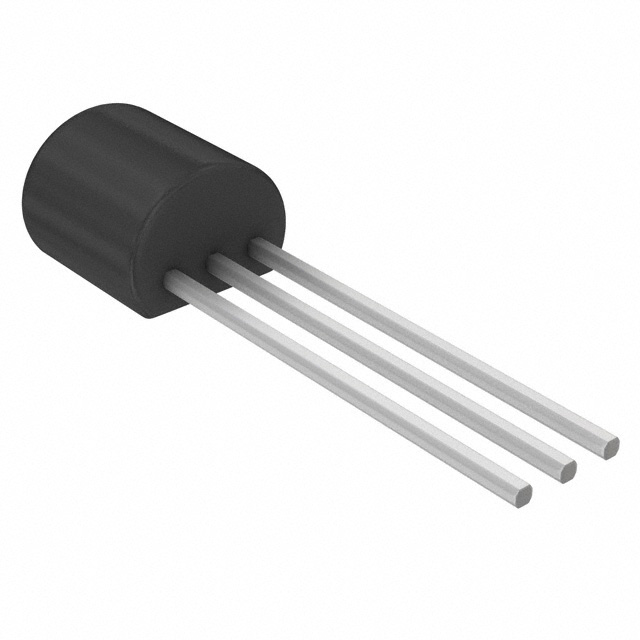
The BC549CG is an NPN bipolar junction transistor manufactured by onsemi, designed for general-purpose switching and amplification applications. It features a 30 V collector-emitter breakdown voltage, 100 mA maximum collector current, and 625 mW power dissipation in a Through Hole TO-92 package. The BC549CG is classified as obsolete, making identification of suitable substitute components necessary for ongoing design support and procurement continuity.
Substiute Parts
Key Parameters
| Parameter | Value |
|---|---|
| Transistor Type | NPN |
| Voltage - Collector Emitter Breakdown (Max) | 30 V |
| Current - Collector (Ic) (Max) | 100 mA |
| Power - Max | 625 mW |
| Frequency - Transition | 250 MHz |
| DC Current Gain (hFE) (Min) @ Ic, Vce | 200 @ 2mA, 5V |
| Vce Saturation (Max) @ Ib, Ic | 600mV @ 5mA, 100mA |
| Current - Collector Cutoff (Max) | 15nA (ICBO) |
| Operating Temperature | -55°C ~ 150°C (TJ) |
| Mounting Type | Through Hole |
| Package / Case | TO-92-3 |
Substitute Part Grouping Explanation
Substitution of the BC549CG is determined by equivalence across the following critical electrical and mechanical parameters:
Electrical Equivalence Criteria:
- Transistor type must be NPN
- Voltage - Collector Emitter Breakdown rating must be 30 V or greater
- Current - Collector (Ic) maximum must be 100 mA or greater
- DC Current Gain (hFE) minimum must be 200 @ 2mA, 5V or greater
- Vce Saturation must be 600mV @ 5mA, 100mA or lower
- Current - Collector Cutoff (ICBO) must be 15nA or lower
Mechanical Equivalence Criteria:
- Mounting type must be Through Hole
- Package must be TO-92-3 compatible
The BC549BTA meets all electrical and mechanical substitution criteria for the BC549CG, with the exception of reduced maximum power dissipation (500 mW versus 625 mW) and increased transition frequency (300 MHz versus 250 MHz). These differences represent performance enhancements or neutral variations that do not restrict substitution in applications designed for the BC549CG.
Parameter Comparison
| Parameter | BC549CG | BC549BTA |
|---|---|---|
| Manufacturer | onsemi | onsemi |
| Product Status | Obsolete | Active |
| Transistor Type | NPN | NPN |
| Voltage - Collector Emitter Breakdown (Max) | 30 V | 30 V |
| Current - Collector (Ic) (Max) | 100 mA | 100 mA |
| Power - Max | 625 mW | 500 mW |
| Frequency - Transition | 250 MHz | 300 MHz |
| DC Current Gain (hFE) (Min) @ Ic, Vce | 200 @ 2mA, 5V | 200 @ 2mA, 5V |
| Vce Saturation (Max) @ Ib, Ic | 600mV @ 5mA, 100mA | 600mV @ 5mA, 100mA |
| Current - Collector Cutoff (Max) | 15nA (ICBO) | 15nA (ICBO) |
| Operating Temperature | -55°C ~ 150°C (TJ) | -55°C ~ 150°C (TJ) |
| Mounting Type | Through Hole | Through Hole |
| Package / Case | TO-92-3 | TO-92-3 |
| REACH Status | REACH Unaffected | REACH Unaffected |
| ECCN | EAR99 | EAR99 |
Engineering Selection Recommendations
The BC549BTA is a direct substitute for the BC549CG based on electrical and mechanical parameter equivalence. The BC549BTA holds Active product status, ensuring continued availability and supply chain support, whereas the BC549CG is classified as Obsolete. The BC549BTA is RoHS3 Compliant, providing enhanced environmental and regulatory compliance compared to the BC549CG.
The BC549BTA exhibits a 20% reduction in maximum power dissipation (500 mW versus 625 mW). Applications requiring thermal margins approaching the 625 mW specification of the BC549CG must account for this difference in power budget calculations. The BC549BTA provides a 50 MHz increase in transition frequency (300 MHz versus 250 MHz), which represents improved high-frequency performance and does not restrict substitution in existing designs.
Both components share identical electrical characteristics for collector-emitter breakdown voltage, maximum collector current, DC current gain, saturation voltage, and cutoff current. Both are rated for the same operating temperature range (-55°C to 150°C). Both utilize Through Hole mounting in TO-92-3 packages and carry identical REACH and ECCN classifications.
Frequently Asked Questions (FAQ)
Q: Can the BC549BTA replace the BC549CG in all applications?
A: The BC549BTA meets all electrical and mechanical substitution criteria for the BC549CG. Applications must verify that the 500 mW maximum power dissipation of the BC549BTA is sufficient for the intended circuit. If the design operates near the 625 mW specification of the BC549CG, thermal analysis is required to confirm adequate margin with the BC549BTA.
Q: What is the difference in packaging between these parts?
A: Both the BC549CG and BC549BTA use Through Hole TO-92-3 packages. The BC549CG is supplied in standard TO-92 packaging, while the BC549BTA is supplied in TO-92-3 with formed leads. Both packages are mechanically compatible with standard TO-92 footprints and mounting hardware.
Q: Why is the BC549CG classified as Obsolete?
A: The BC549CG is listed as Obsolete by the manufacturer. The BC549BTA is the Active equivalent, ensuring continued manufacturing and supply availability. Designs using the BC549CG should transition to the BC549BTA for long-term procurement stability.
Q: Are there compliance differences between the BC549CG and BC549BTA?
A: The BC549BTA is RoHS3 Compliant, while the BC549CG does not carry this certification. Both components are REACH Unaffected and classified as EAR99 for export control purposes. Applications requiring RoHS3 compliance must use the BC549BTA.
Q: What is the impact of the 50 MHz frequency difference?
A: The BC549BTA provides 300 MHz transition frequency compared to 250 MHz for the BC549CG. This represents improved high-frequency performance and does not restrict substitution. Applications designed for the BC549CG will operate within specification with the BC549BTA.
Q: Are the electrical characteristics identical between these parts?
A: The BC549CG and BC549BTA share identical specifications for collector-emitter breakdown voltage (30 V), maximum collector current (100 mA), DC current gain (200 @ 2mA, 5V), saturation voltage (600mV @ 5mA, 100mA), and cutoff current (15nA ICBO). The primary differences are maximum power dissipation and transition frequency.
Alternative Parts

SJ6012L2TP
Littelfuse Inc.
6 Alternative Parts

JMK107BBJ476MA-RE
Taiyo Yuden
10 Alternative Parts

GMK107BBJ475MA-T
Taiyo Yuden
5 Alternative Parts
SJ6020N2ARP
Littelfuse Inc.
3 Alternative Parts
SJ6025R2ATP
Littelfuse Inc.
4 Alternative Parts

2474-05L
API Delevan Inc.
1 Alternative Parts

4590R-684K
API Delevan Inc.
1 Alternative Parts

CM6560R-334
API Delevan Inc.
1 Alternative Parts

CM6460-104
API Delevan Inc.
1 Alternative Parts

5526-12
API Delevan Inc.
1 Alternative Parts