



Request Quote
(Ships tomorrow)
B106-BU Equivalent & Substitute Parts
Part Overview
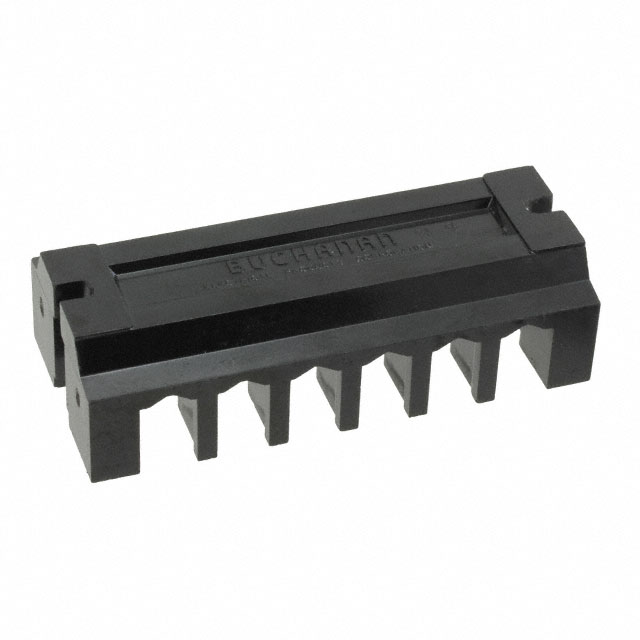
The B106-BU is a 6-circuit barrier block connector manufactured by TE Connectivity AMP Connectors. This component is classified as obsolete, necessitating identification of equivalent substitute parts for ongoing applications requiring barrier strip terminal blocks with 0.630" pitch spacing and dual-wall barrier construction. The B106-BU operates at 600V with a 50A current rating and accommodates wire gauges from 8-18 AWG using screw-type top termination.
Substiute Parts
Key Parameters
| Parameter | B106-BU Specification |
|---|---|
| Terminal Block Type | Barrier Block |
| Number of Circuits | 6 |
| Pitch | 0.630" (16.00mm) |
| Number of Rows | 2 |
| Current Rating | 50A |
| Voltage Rating | 600V |
| Wire Gauge | 8-18 AWG |
| Top Termination | Screws |
| Bottom Termination | Closed |
| Barrier Type | 2 Wall (Dual) |
| Mounting Type | Chassis, Panel |
| Operating Temperature | 150°C |
| Material - Insulation | Phenol Formaldehyde (Phenolic), Glass Filled |
| Flammability Rating | UL94 V-1 |
| RoHS Status | ROHS3 Compliant |
Substitute Part Grouping Explanation
Substitution of the B106-BU is determined by the following critical parameters:
Mandatory Compatibility Parameters:
- Terminal Block Type: Barrier Block
- Number of Circuits: 6
- Number of Rows: 2
- Top Termination: Screws
- Bottom Termination: Closed
- Barrier Type: 2 Wall (Dual)
- Voltage Rating: 600V
- Mounting Type: Chassis, Panel
Allowable Variation Parameters:
- Pitch: Tolerance of ±0.022" (0.56mm) from 0.630" baseline
- Current Rating: Equal to or greater than 50A
- Wire Gauge: Must accommodate minimum 8 AWG and maximum 18 AWG
- Operating Temperature: Equal to or greater than 150°C
- Flammability Rating: UL94 V-1 or higher (V-0)
- RoHS Compliance: ROHS3 Compliant
The H-6 manufactured by Curtis Industries meets all mandatory compatibility parameters and operates within allowable variation ranges for pitch, current rating, and flammability certification.
Parameter Comparison
| Parameter | B106-BU (TE Connectivity) | H-6 (Curtis Industries) | Compatibility Status |
|---|---|---|---|
| Terminal Block Type | Barrier Block | Barrier Block | Compatible |
| Number of Circuits | 6 | 6 | Compatible |
| Number of Wire Entries | 12 | 12 | Compatible |
| Pitch | 0.630" (16.00mm) | 0.652" (16.56mm) | Within Tolerance |
| Number of Rows | 2 | 2 | Compatible |
| Current Rating (Amps) | 50A | 75A | Compatible (Exceeds) |
| Voltage Rating | 600V | 600V | Compatible |
| Wire Gauge | 8-18 AWG | 4-16 AWG | Partial Overlap |
| Top Termination | Screws | Screws | Compatible |
| Bottom Termination | Closed | Closed | Compatible |
| Barrier Type | 2 Wall (Dual) | 2 Wall (Dual) | Compatible |
| Mounting Type | Chassis, Panel | Chassis, Panel | Compatible |
| Operating Temperature | 150°C | 130°C | Reduced Capability |
| Material - Insulation | Phenol Formaldehyde (Phenolic), Glass Filled | Polyester Thermoplastic | Different Material |
| Flammability Rating | UL94 V-1 | UL94 V-0 | Compatible (Enhanced) |
| RoHS Status | ROHS3 Compliant | ROHS3 Compliant | Compatible |
| Product Status | Obsolete | Active | Substitution Justified |
Engineering Selection Recommendations
The H-6 barrier block connector from Curtis Industries serves as a functional substitute for the obsolete B106-BU. Selection of the H-6 is supported by the following engineering factors:
Product Status Justification: The B106-BU is classified as obsolete, making the H-6 an active alternative with current manufacturing support and inventory availability (1160 pieces in stock versus 908 pieces for the B106-BU).
Electrical Compatibility: Both components maintain 600V voltage rating and dual-wall barrier construction. The H-6 provides 75A current capacity, exceeding the B106-BU specification of 50A, ensuring adequate performance margin in existing applications.
Compliance and Certification: Both parts achieve ROHS3 compliance. The H-6 attains UL94 V-0 flammability rating, which exceeds the B106-BU's UL94 V-1 rating, providing enhanced fire safety performance.
Mechanical Considerations: Pitch spacing differs by 0.022" (0.652" versus 0.630"), representing a 3.5% variation. This difference requires physical layout verification to confirm PCB or panel mounting hole compatibility. Wire gauge accommodation differs: the H-6 accepts 4-16 AWG while the B106-BU accepts 8-18 AWG. Applications using 17-18 AWG wire require confirmation that the H-6 termination design accommodates these gauges within acceptable contact pressure parameters.
Temperature Derating: The H-6 operates to 130°C maximum, compared to the B106-BU's 150°C rating. Applications requiring sustained operation above 130°C require alternative component selection.
Frequently Asked Questions (FAQ)
Q: Can the H-6 directly replace the B106-BU in existing installations?
A: Direct replacement requires verification of three factors: (1) mounting hole spacing compatibility due to 0.022" pitch difference, (2) wire gauge suitability for applications using 17-18 AWG conductors, and (3) operating temperature requirements not exceeding 130°C. If all three conditions are satisfied, the H-6 provides functional equivalence.
Q: What is the significance of the pitch difference between 0.630" and 0.652"?
A: The 0.022" pitch difference affects physical mounting hole spacing on panels or PCBs. Existing mounting hardware and hole patterns designed for the B106-BU may not align with H-6 mounting points. Physical layout verification is required before installation.
Q: Why does the H-6 accept 4-16 AWG while the B106-BU accepts 8-18 AWG?
A: Wire gauge range reflects terminal contact design and screw clamping force specifications. The H-6 does not accommodate 17-18 AWG conductors. Applications using these larger gauges must either select alternative components or confirm that the H-6 termination design provides acceptable contact pressure for these wire sizes through direct measurement.
Q: Is the lower operating temperature of the H-6 (130°C versus 150°C) a limitation?
A: The 20°C temperature difference represents a functional limitation for applications requiring sustained operation above 130°C. Standard industrial applications operating at or below 130°C are unaffected. High-temperature applications must select alternative components rated to 150°C or higher.
Q: What does the enhanced UL94 V-0 rating on the H-6 provide compared to the B106-BU's V-1 rating?
A: UL94 V-0 represents a higher flammability classification than V-1, indicating superior flame resistance and self-extinguishing properties. This enhancement provides increased safety margin in applications subject to flame exposure or fire safety regulations.
Q: Are both components RoHS compliant?
A: Yes. Both the B106-BU and H-6 achieve ROHS3 compliance, confirming absence of restricted substances (lead, cadmium, hexavalent chromium, polybrominated biphenyls, polybrominated diphenyl ethers, and bis(2-ethylhexyl) phthalate).
Q: What is the difference in insulation material between the two components?
A: The B106-BU uses phenol formaldehyde (phenolic) with glass filler, while the H-6 uses polyester thermoplastic. Both materials meet UL94 flammability requirements. Material selection affects mechanical properties, moisture absorption, and chemical resistance. Application-specific environmental conditions determine material suitability.
Alternative Parts

SJ6012L2TP
Littelfuse Inc.
6 Alternative Parts

JMK107BBJ476MA-RE
Taiyo Yuden
10 Alternative Parts

GMK107BBJ475MA-T
Taiyo Yuden
5 Alternative Parts
SJ6020N2ARP
Littelfuse Inc.
3 Alternative Parts
SJ6025R2ATP
Littelfuse Inc.
4 Alternative Parts

2474-05L
API Delevan Inc.
1 Alternative Parts

4590R-684K
API Delevan Inc.
1 Alternative Parts

CM6560R-334
API Delevan Inc.
1 Alternative Parts

CM6460-104
API Delevan Inc.
1 Alternative Parts

5526-12
API Delevan Inc.
1 Alternative Parts