



Request Quote
(Ships tomorrow)
Honeywell A43100 Potentiometer: Equivalent & Substitute Parts
Part Overview
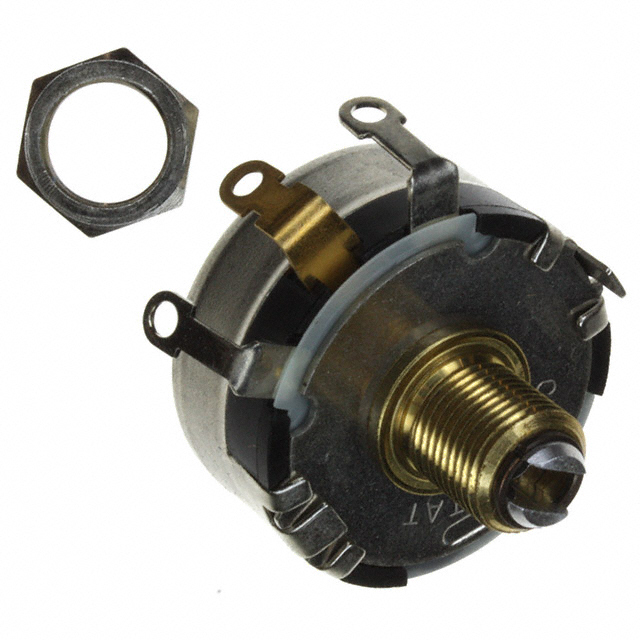
The Honeywell A43100 is a 100 Ohm, 2W wirewound linear potentiometer designed for panel mount applications with solder lug termination. This component is classified as obsolete, making identification of functionally equivalent substitute parts essential for ongoing system maintenance and new design implementations where legacy specifications must be maintained.
The A43100 operates as a single-gang, user-adjustable linear taper potentiometer with a 300° rotation range and slotted actuator interface. Its wirewound resistive element provides stable performance in applications requiring precise resistance adjustment and moderate power dissipation.
Substiute Parts
Key Parameters
| Parameter | Value | Significance for Substitution |
|---|---|---|
| Resistance Value | 100 Ohm | Critical - must match exactly |
| Power Rating | 2W | Critical - determines thermal capability |
| Taper Type | Linear | Critical - defines resistance vs. rotation relationship |
| Number of Turns | 1 | Critical - affects adjustment resolution |
| Termination Style | Solder Lug | Critical - determines circuit connection method |
| Mounting Type | Panel Mount | Critical - defines installation interface |
| Bushing Thread | 3/8-32 | Critical - ensures mechanical fit |
| Tolerance | ±10% | Important - defines accuracy class |
| Actuator Diameter | 0.250" (6.35mm) | Important - affects control interface compatibility |
| Body Diameter | Round - 1.125" Dia (28.58mm) | Important - determines panel cutout requirements |
| Rotation Range | 300° | Important - affects usable adjustment range |
| Resistive Material | Wirewound | Important - influences noise and stability characteristics |
Substitute Part Grouping Explanation
Substitute parts for the Honeywell A43100 must satisfy the following mandatory electrical and mechanical criteria:
Electrical Requirements:
- Resistance value: 100 Ohm (exact match)
- Power rating: 2W (minimum)
- Taper: Linear
- Tolerance: ±10% (or tighter)
- Number of turns: 1
Mechanical Requirements:
- Termination style: Solder Lug
- Mounting type: Panel Mount
- Bushing thread: 3/8-32
- Actuator type: Slotted
- Actuator diameter: 0.250" ±0.001" (6.35mm ±0.025mm)
- Body diameter: Approximately 1.120" to 1.125" (28.45mm to 28.58mm)
Compliance Requirements:
- RoHS compliance (RoHS3 or equivalent)
- REACH unaffected status
- ECCN: EAR99
Substitutes may vary in resistive material composition (wirewound or carbon film), rotation range (300° to 314°), and actuator length, provided all critical parameters remain within specified tolerances.
Parameter Comparison
| Parameter | Honeywell A43100 (Main Part) | Precision Electronics RV4NAYSJ101A (Substitute) | Compatibility Notes |
|---|---|---|---|
| Resistance (Ohms) | 100 | 100 | Exact match |
| Power Rating (Watts) | 2W | 2W | Exact match |
| Tolerance | ±10% | ±10% | Exact match |
| Taper | Linear | Linear | Exact match |
| Number of Turns | 1 | 1 | Exact match |
| Number of Gangs | 1 | 1 | Exact match |
| Termination Style | Solder Lug | Solder Lug | Exact match |
| Actuator Type | Slotted | Slotted | Exact match |
| Actuator Diameter | 0.250" (6.35mm) | 0.249" (6.32mm) | Within tolerance (±0.001") |
| Bushing Thread | 3/8-32 | 3/8-32 | Exact match |
| Mounting Type | Panel Mount | Panel Mount | Exact match |
| Body Diameter | Round - 1.125" Dia (28.58mm) | Round - 1.120" Dia (28.45mm) | Within tolerance (±0.005") |
| Rotation Range | 300° | 314° | Substitute provides extended range |
| Resistive Material | Wirewound | Carbon | Different material; verify application requirements |
| Actuator Length | Not specified | 2.000" (50.80mm) | Substitute provides longer actuator |
| RoHS Status | RoHS Compliant | ROHS3 Compliant | Both compliant |
| REACH Status | REACH Unaffected | REACH Unaffected | Exact match |
| ECCN | EAR99 | EAR99 | Exact match |
| Product Status | Obsolete | Active | Substitute is currently manufactured |
Engineering Selection Recommendations
The Precision Electronics Corporation RV4NAYSJ101A qualifies as a functional substitute for the Honeywell A43100 based on matching electrical specifications (100 Ohm, 2W, linear taper, ±10% tolerance) and compatible mechanical interfaces (3/8-32 bushing thread, panel mount, solder lug termination, slotted actuator).
Compliance Alignment: Both parts maintain RoHS3 compliance and REACH unaffected status, satisfying current regulatory requirements. The substitute's active product status ensures ongoing availability and supply chain continuity, addressing the obsolescence limitation of the original A43100.
Material Composition Consideration: The primary technical difference is resistive material: the A43100 uses wirewound construction while the RV4NAYSJ101A employs carbon film. This distinction affects noise characteristics and frequency response but does not alter DC resistance accuracy or power handling capability at the specified 2W rating.
Mechanical Fit: Actuator diameter and body diameter measurements fall within acceptable tolerances (±0.001" and ±0.005" respectively). The substitute's extended actuator length (2.000" versus unspecified for the original) and slightly increased rotation range (314° versus 300°) provide operational advantages without compromising compatibility.
Selection Basis: Choose the RV4NAYSJ101A when supply of the obsolete A43100 is unavailable and application requirements do not mandate wirewound resistive elements. Verify that carbon film noise characteristics are acceptable for the specific circuit application before final selection.
Frequently Asked Questions (FAQ)
Q: Can the Precision Electronics RV4NAYSJ101A directly replace the Honeywell A43100 in existing assemblies?
A: Yes, provided the application does not require wirewound-specific performance characteristics. Both parts share identical electrical ratings (100 Ohm, 2W, linear, ±10%), termination style (solder lug), mounting interface (panel mount, 3/8-32 bushing), and actuator configuration (slotted, 0.249"-0.250" diameter). Mechanical fit is compatible within standard tolerances.
Q: What is the significance of the resistive material difference between wirewound and carbon?
A: Wirewound potentiometers (A43100) typically exhibit lower noise and superior frequency response characteristics. Carbon film potentiometers (RV4NAYSJ101A) provide adequate performance for DC and low-frequency applications. For audio circuits or precision measurement applications requiring minimal noise, the wirewound construction may be preferred. For general-purpose adjustment and control applications, carbon film performance is equivalent.
Q: Does the extended rotation range (314° versus 300°) affect compatibility?
A: No. The substitute's 314° rotation range is a superset of the original 300° specification. This provides additional adjustment range without compromising existing circuit designs. Mechanical stops and adjustment mechanisms will function identically within the original 300° operating window.
Q: Are panel cutout dimensions identical between these parts?
A: The body diameters are nearly identical (1.125" versus 1.120"), falling within standard machining tolerances. Existing panel cutouts designed for the A43100 will accommodate the RV4NAYSJ101A without modification. The 3/8-32 bushing thread is identical on both parts.
Q: What compliance certifications apply to the substitute part?
A: The RV4NAYSJ101A carries ROHS3 compliance and REACH unaffected status, matching the regulatory framework of the original A43100. Both parts are classified as EAR99 for export control purposes. No additional compliance verification is required for direct substitution in existing applications.
Q: Is the substitute part currently available?
A: Yes. The RV4NAYSJ101A maintains active product status with 752 units in stock, ensuring supply continuity. The original A43100 is classified as obsolete, making the substitute the recommended choice for new procurement and long-term system support.
Q: Can I use the substitute in applications requiring high-frequency response?
A: Carbon film construction (RV4NAYSJ101A) exhibits higher frequency limitations compared to wirewound design (A43100). For applications operating above 100 kHz or requiring minimal frequency-dependent impedance variation, the original wirewound specification may be necessary. Verify frequency response requirements against component datasheets before final selection.
Alternative Parts

SJ6012L2TP
Littelfuse Inc.
6 Alternative Parts

JMK107BBJ476MA-RE
Taiyo Yuden
10 Alternative Parts

GMK107BBJ475MA-T
Taiyo Yuden
5 Alternative Parts
SJ6020N2ARP
Littelfuse Inc.
3 Alternative Parts
SJ6025R2ATP
Littelfuse Inc.
4 Alternative Parts

2474-05L
API Delevan Inc.
1 Alternative Parts

4590R-684K
API Delevan Inc.
1 Alternative Parts

CM6560R-334
API Delevan Inc.
1 Alternative Parts

CM6460-104
API Delevan Inc.
1 Alternative Parts

5526-12
API Delevan Inc.
1 Alternative Parts