




Request Quote
(Ships tomorrow)
8W-40.000MBA-T Equivalent & Substitute Parts
Part Overview
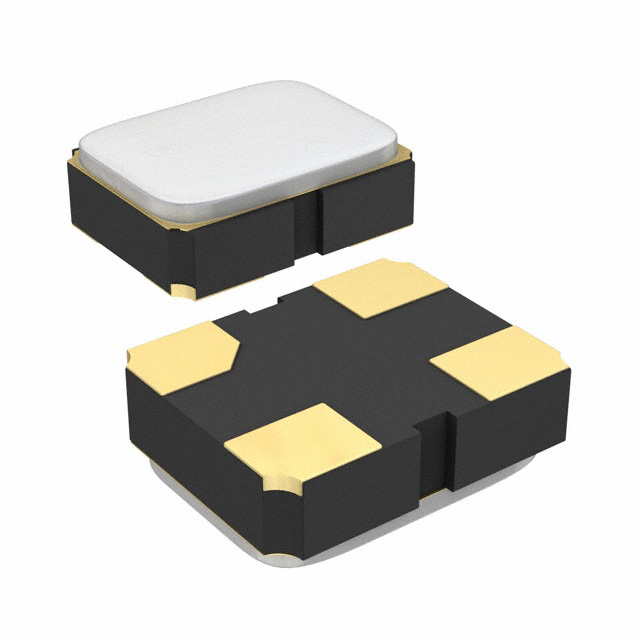
The 8W-40.000MBA-T is a 40 MHz crystal oscillator manufactured by TXC CORPORATION, designed for applications requiring a standard XO (Oscillator) with CMOS output and Enable/Disable functionality. This Surface Mount Device (SMD) operates at 3.3V supply voltage and is housed in a compact 4-SMD, No Lead package measuring 2.50mm x 2.00mm. The part is Active in product status and ROHS3 Compliant, making it suitable for modern electronic applications requiring environmental compliance.
Substitute parts are identified when equivalent electrical performance and mechanical compatibility can be maintained across different manufacturers while meeting the same functional requirements and compliance standards.
Substiute Parts
Key Parameters
| Parameter | Value |
|---|---|
| Frequency | 40 MHz |
| Output Type | CMOS |
| Supply Voltage | 3.3V |
| Function | Enable/Disable |
| Frequency Stability | ±25ppm |
| Operating Temperature Range | -10°C ~ 70°C |
| Maximum Supply Current | 15mA |
| Package Type | 4-SMD, No Lead |
| Package Dimensions | 2.50mm x 2.00mm |
| RoHS Status | ROHS3 Compliant |
Substitute Part Grouping Explanation
Substitute parts for the 8W-40.000MBA-T are classified based on strict electrical and mechanical parameter alignment:
Direct Substitutes maintain identical or tighter specifications across all critical parameters: 40 MHz frequency, CMOS output, 3.3V supply voltage, Enable/Disable function, 4-SMD No Lead package, and ROHS3 compliance. These parts are interchangeable in applications where the original part specifications are required.
Similar Substitutes maintain core electrical functionality and mechanical compatibility but may exhibit variations in secondary parameters such as frequency stability tolerance, operating temperature range, or maximum supply current in disabled state. These parts are suitable for applications where the specified variations do not impact system performance.
The following parameters determine substitution eligibility:
- Frequency: 40 MHz (mandatory match)
- Output: CMOS (mandatory match)
- Supply Voltage: 3.3V (mandatory match)
- Function: Enable/Disable (mandatory match)
- Package: 4-SMD, No Lead (mandatory match)
- Compliance: ROHS3 (mandatory match)
Parameter Comparison
| Parameter | 8W-40.000MBA-T (TXC) | SXO22C3C171-40.000M (Suntsu) | 625L3C040M00000 (CTS) |
|---|---|---|---|
| Manufacturer | TXC CORPORATION | Suntsu Electronics, Inc. | CTS-Frequency Controls |
| Frequency | 40 MHz | 40 MHz | 40 MHz |
| Output Type | CMOS | CMOS | CMOS |
| Supply Voltage | 3.3V | 3.3V | 3.3V |
| Function | Enable/Disable | Enable/Disable | Enable/Disable |
| Frequency Stability | ±25ppm | ±25ppm | ±50ppm |
| Operating Temperature | -10°C ~ 70°C | -10°C ~ 70°C | -20°C ~ 70°C |
| Maximum Supply Current | 15mA | 15mA | 15mA |
| Package Type | 4-SMD, No Lead | 4-SMD, No Lead | 4-SMD, No Lead |
| Package Dimensions | 2.50mm x 2.00mm | 2.50mm x 2.00mm | 2.50mm x 2.00mm |
| Maximum Seated Height | 0.90mm | 1.00mm | 1.00mm |
| RoHS Status | ROHS3 Compliant | ROHS3 Compliant | ROHS3 Compliant |
| Product Status | Active | Active | Active |
Engineering Selection Recommendations
SXO22C3C171-40.000M (Suntsu Electronics, Inc.) is a direct substitute for the 8W-40.000MBA-T. This part maintains identical electrical specifications including ±25ppm frequency stability and -10°C ~ 70°C operating temperature range. Both parts are ROHS3 Compliant and Active in product status. The primary difference is packaging format: the Suntsu part is supplied in Bulk packaging versus Tape & Reel for the TXC part. This substitution is appropriate for applications requiring equivalent performance without packaging format constraints.
625L3C040M00000 (CTS-Frequency Controls) is a similar substitute suitable for applications where the specified parameter variations are acceptable. This part maintains the core electrical and mechanical requirements but differs in frequency stability (±50ppm versus ±25ppm) and operating temperature range (-20°C ~ 70°C versus -10°C ~ 70°C). The CTS part provides extended lower temperature operation and includes a specified maximum supply current in disabled state (10µA). This substitution is appropriate for applications where tighter frequency stability is not required and extended temperature range provides system benefit. Both parts are ROHS3 Compliant and Active in product status.
Frequently Asked Questions (FAQ)
Q: Can SXO22C3C171-40.000M be used as a direct replacement for 8W-40.000MBA-T?
A: Yes. Both parts share identical electrical specifications: 40 MHz frequency, ±25ppm stability, 3.3V supply, CMOS output with Enable/Disable function, and 4-SMD No Lead package. The difference in packaging format (Bulk versus Tape & Reel) does not affect electrical compatibility. Verify your procurement and assembly processes accommodate the Bulk packaging format.
Q: What are the limitations of using 625L3C040M00000 as a substitute?
A: The CTS part has ±50ppm frequency stability compared to ±25ppm for the TXC part. This wider tolerance may impact applications requiring tighter frequency accuracy. The CTS part operates from -20°C to 70°C, providing extended lower temperature capability. Confirm your application can tolerate the reduced frequency stability specification before selecting this substitute.
Q: Are all three parts mechanically compatible in the same PCB footprint?
A: All three parts use the 4-SMD No Lead package with 2.50mm x 2.00mm footprint dimensions. Maximum seated heights differ slightly: TXC at 0.90mm, Suntsu and CTS at 1.00mm. Verify your PCB design accommodates the maximum 1.00mm height if using Suntsu or CTS parts to ensure clearance with adjacent components.
Q: Do all substitute parts meet the same compliance requirements?
A: Yes. All three parts are ROHS3 Compliant, ECCN EAR99, and HTSUS 8542.39.0001. All parts are Active in product status. Compliance requirements are equivalent across all options.
Q: What is the difference between Enable/Disable function and standard oscillator output?
A: Enable/Disable function allows the oscillator output to be controlled via an external signal, reducing power consumption when the oscillator is not needed. All three parts in this comparison include this function, making them suitable for applications requiring dynamic power management.
Alternative Parts

SJ6012L2TP
Littelfuse Inc.
6 Alternative Parts

JMK107BBJ476MA-RE
Taiyo Yuden
10 Alternative Parts

GMK107BBJ475MA-T
Taiyo Yuden
5 Alternative Parts
SJ6020N2ARP
Littelfuse Inc.
3 Alternative Parts
SJ6025R2ATP
Littelfuse Inc.
4 Alternative Parts

2474-05L
API Delevan Inc.
1 Alternative Parts

4590R-684K
API Delevan Inc.
1 Alternative Parts

CM6560R-334
API Delevan Inc.
1 Alternative Parts

CM6460-104
API Delevan Inc.
1 Alternative Parts

5526-12
API Delevan Inc.
1 Alternative Parts