


Request Quote
(Ships tomorrow)
Equivalent & Substitute Parts for Winchester Interconnect 810A209A
Part Overview
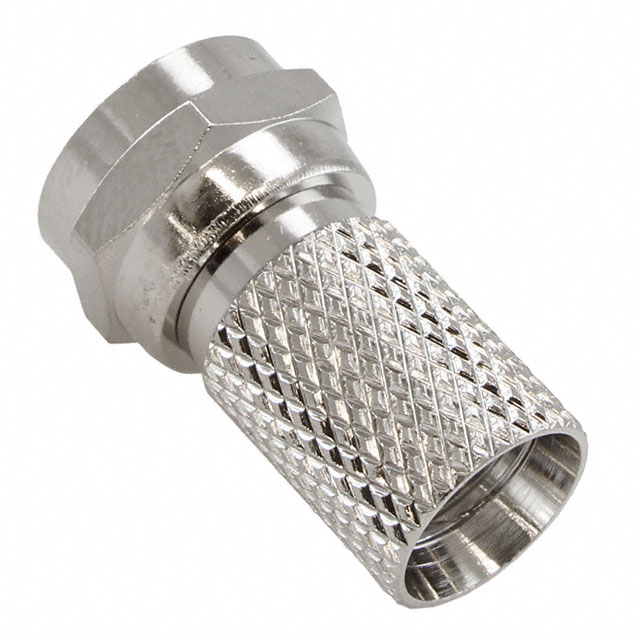
The Winchester Interconnect 810A209A is an F Type Connector Plug with male pin configuration, designed for coaxial cable termination in RF applications. This connector features crimp termination for both center contact and shield, operates across the RG-6 cable group, and maintains non-constant impedance characteristics. The part is currently active in production with 760 units in stock. Substitute parts are identified to provide alternative sourcing options when the primary part is unavailable or when specific application requirements necessitate different termination methods or performance characteristics.
Substiute Parts
Key Parameters
| Parameter | Value |
|---|---|
| Connector Style | F Type |
| Connector Type | Plug, Male Pin |
| Contact Termination | Crimp |
| Shield Termination | Crimp |
| Impedance | Non-Constant |
| Mounting Type | Free Hanging (In-Line) |
| Cable Group | RG-6 |
| Fastening Type | Threaded |
| Frequency - Max | 500 MHz |
| Number of Ports | 1 |
| Housing Color | Silver |
| Body Material | Brass |
| Body Finish | Nickel |
| Operating Temperature | -40°C ~ 65°C |
| Voltage Rating | 500 V |
| Mating Cycles | 500 |
| RoHS Status | RoHS Compliant |
| MSL Rating | 1 (Unlimited) |
Substitute Part Grouping Explanation
Substitution eligibility for the Winchester Interconnect 810A209A is determined by the following critical parameters:
Primary Substitution Criteria:
- Connector Style: F Type (required match)
- Connector Type: Plug, Male Pin (required match)
- Mounting Type: Free Hanging (In-Line) (required match)
- Fastening Type: Threaded (required match)
- Number of Ports: 1 (required match)
Secondary Compatibility Parameters:
- Cable Group: RG-6 or compatible cable groups
- Impedance: Non-Constant (required match)
- Body Material: Brass (required match)
- Body Finish: Nickel (required match)
Allowable Variations:
- Contact Termination: Crimp or Push On (both acceptable for F Type connectors)
- Shield Termination: Crimp or Twist On (both acceptable for F Type connectors)
- Frequency - Max: Equal to or greater than 500 MHz
- Operating Temperature: Range must encompass or exceed -40°C ~ 65°C
- Voltage Rating: Equal to or greater than 500 V
- Mating Cycles: Equal to or greater than 500 cycles
The Cinch Connectivity Solutions TOF56 qualifies as a substitute based on these criteria, with variations in termination method and enhanced frequency performance.
Parameter Comparison
| Parameter | Winchester 810A209A | Cinch TOF56 | Compatibility Status |
|---|---|---|---|
| Connector Style | F Type | F Type | Match |
| Connector Type | Plug, Male Pin | Plug, Male Pin | Match |
| Contact Termination | Crimp | Push On | Variation Allowed |
| Shield Termination | Crimp | Twist On | Variation Allowed |
| Impedance | Non-Constant | Non-Constant | Match |
| Mounting Type | Free Hanging (In-Line) | Free Hanging (In-Line) | Match |
| Cable Group | RG-6 | RG-6, CT100 | Compatible |
| Fastening Type | Threaded | Threaded | Match |
| Frequency - Max | 500 MHz | 2 GHz | Exceeds Requirement |
| Number of Ports | 1 | 1 | Match |
| Housing Color | Silver | Silver | Match |
| Body Material | Brass | Brass | Match |
| Body Finish | Nickel | Nickel | Match |
| Operating Temperature | -40°C ~ 65°C | -65°C ~ 165°C | Exceeds Requirement |
| Voltage Rating | 500 V | 250 V | Below Requirement |
| Mating Cycles | 500 | 50 | Below Requirement |
| RoHS Status | RoHS Compliant | RoHS Compliant | Match |
| MSL Rating | 1 (Unlimited) | 1 (Unlimited) | Match |
Engineering Selection Recommendations
Winchester Interconnect 810A209A is the primary selection for applications requiring:
- Crimp termination for both center contact and shield
- 500 V voltage rating
- 500 mating cycles minimum
- Operating temperature range of -40°C to 65°C
- Maximum frequency of 500 MHz
This part is RoHS Compliant and carries MSL Rating 1, indicating unlimited shelf life under standard storage conditions.
Cinch Connectivity Solutions TOF56 serves as a substitute when:
- Push On contact termination and Twist On shield termination are acceptable
- Applications operate within -65°C to 165°C temperature range
- Frequency performance up to 2 GHz is required
- Voltage requirements do not exceed 250 V
- Mating cycle requirements do not exceed 50 cycles
- RG-6 or CT100 cable compatibility is required
The TOF56 is also RoHS Compliant with MSL Rating 1. Both parts are currently active in production status.
Frequently Asked Questions (FAQ)
Q: Can the Cinch TOF56 replace the Winchester 810A209A in all applications?
A: No. The TOF56 has reduced voltage rating (250 V versus 500 V) and lower mating cycle rating (50 versus 500). Applications requiring 500 V or 500+ mating cycles must use the Winchester 810A209A.
Q: What is the primary difference between these two connectors?
A: The Winchester 810A209A uses crimp termination for both center contact and shield, while the Cinch TOF56 uses push-on contact termination and twist-on shield termination. Both are F Type male plug connectors with identical mechanical form factors and mounting characteristics.
Q: Are both connectors compatible with RG-6 cable?
A: Yes. Both the Winchester 810A209A and Cinch TOF56 are rated for RG-6 cable group. The TOF56 additionally supports CT100 cable.
Q: What does "Non-Constant Impedance" mean for these connectors?
A: Non-Constant impedance indicates that the connector does not maintain a constant 75-ohm impedance throughout its structure. Both substitute parts share this characteristic.
Q: Can I use the TOF56 in high-frequency applications?
A: Yes. The TOF56 supports frequencies up to 2 GHz, which exceeds the Winchester 810A209A specification of 500 MHz. However, voltage and mating cycle limitations must still be observed.
Q: Are both connectors RoHS Compliant?
A: Yes. Both the Winchester 810A209A and Cinch TOF56 are RoHS Compliant with MSL Rating 1 (Unlimited shelf life).
Q: What is the difference in termination method between crimp and push-on?
A: Crimp termination (Winchester 810A209A) requires a crimping tool to permanently attach the connector to the cable. Push-on termination (Cinch TOF56) allows the connector to be slid onto the cable without tools. Both methods provide electrical connection; the choice depends on application requirements and assembly processes.
Alternative Parts

SJ6012L2TP
Littelfuse Inc.
6 Alternative Parts

JMK107BBJ476MA-RE
Taiyo Yuden
10 Alternative Parts

GMK107BBJ475MA-T
Taiyo Yuden
5 Alternative Parts
SJ6020N2ARP
Littelfuse Inc.
3 Alternative Parts
SJ6025R2ATP
Littelfuse Inc.
4 Alternative Parts

2474-05L
API Delevan Inc.
1 Alternative Parts

4590R-684K
API Delevan Inc.
1 Alternative Parts

CM6560R-334
API Delevan Inc.
1 Alternative Parts

CM6460-104
API Delevan Inc.
1 Alternative Parts

5526-12
API Delevan Inc.
1 Alternative Parts