



Request Quote
(Ships tomorrow)
Honeywell 58C1500 Equivalent & Substitute Parts
Part Overview
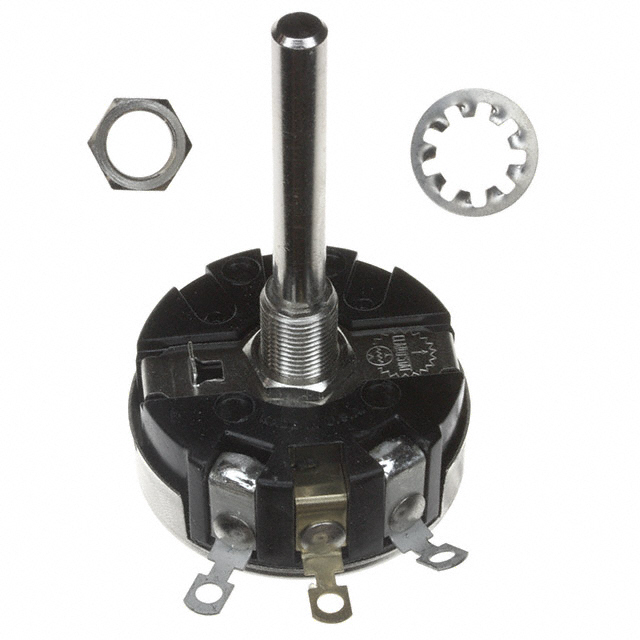
The Honeywell 58C1500 is a 500 Ohm, 4W wirewound linear potentiometer designed for panel mount applications with a 1-turn rotation and solder lug termination. This component is classified as obsolete, necessitating identification of active equivalent parts to maintain design continuity and ensure supply chain availability for new production and maintenance applications.
Substiute Parts
Key Parameters
| Parameter | Value | Substitution Relevance |
|---|---|---|
| Resistance | 500 Ohms | Critical - must match exactly |
| Power Rating | 4W | Critical - substitute must meet or exceed |
| Taper | Linear | Critical - functional characteristic |
| Number of Turns | 1 | Critical - mechanical specification |
| Termination Style | Solder Lug | Critical - electrical connection method |
| Mounting Type | Panel Mount | Critical - mechanical interface |
| Bushing Thread | 3/8-32 | Critical - mechanical compatibility |
| Rotation | 300° | Important - operational range |
| Actuator Diameter | 0.250" (6.35mm) | Important - mechanical fit |
Substitute Part Grouping Explanation
Substitution eligibility for the Honeywell 58C1500 is determined by the following mandatory parameters:
Electrical Parameters:
- Resistance value must equal 500 Ohms
- Power rating must be equal to or greater than 4W
- Taper must be Linear
- Termination style must be Solder Lug
Mechanical Parameters:
- Number of turns must equal 1
- Mounting type must be Panel Mount
- Bushing thread must be 3/8-32
- Rotation must equal 300°
- Actuator diameter must equal 0.250" (6.35mm)
The CTS Electrocomponents 026TB32R501B1A1 satisfies all mandatory substitution criteria. This part maintains identical electrical function (500 Ohm, linear, 1-turn) and mechanical interface (panel mount, 3/8-32 bushing, 0.250" actuator diameter, 300° rotation). The substitute provides 5W power rating, which exceeds the 4W requirement of the original part.
Parameter Comparison
| Parameter | Honeywell 58C1500 | CTS 026TB32R501B1A1 | Match Status |
|---|---|---|---|
| Manufacturer | Honeywell Sensing and Productivity Solutions | CTS Electrocomponents | Different manufacturer |
| Resistance (Ohms) | 500 | 500 | Identical |
| Tolerance | ±5% | ±20% | Original tighter |
| Power (Watts) | 4W | 5W | Substitute exceeds |
| Taper | Linear | Linear | Identical |
| Number of Turns | 1 | 1 | Identical |
| Number of Gangs | 1 | 1 | Identical |
| Termination Style | Solder Lug | Solder Lug | Identical |
| Actuator Type | Round | Round | Identical |
| Actuator Diameter | 0.250" (6.35mm) | 0.250" (6.35mm) | Identical |
| Bushing Thread | 3/8-32 | 3/8-32 | Identical |
| Mounting Type | Panel Mount | Panel Mount | Identical |
| Rotation | 300° | 300° | Identical |
| Resistive Material | Wirewound | Wirewound | Identical |
| Product Status | Obsolete | Active | Substitute active |
| RoHS Status | RoHS Compliant | ROHS3 Compliant | Both compliant |
| REACH Status | REACH Unaffected | REACH Unaffected | Identical |
| Moisture Sensitivity Level | 1 (Unlimited) | 1 (Unlimited) | Identical |
Engineering Selection Recommendations
The CTS Electrocomponents 026TB32R501B1A1 is the qualified substitute for the obsolete Honeywell 58C1500 based on the following engineering criteria:
Functional Equivalence: Both parts are 500 Ohm, 1-turn linear wirewound potentiometers with identical mechanical interfaces (panel mount, 3/8-32 bushing, 0.250" round actuator, 300° rotation) and electrical termination (solder lug).
Power Rating: The CTS substitute provides 5W power capacity, which exceeds the 4W requirement of the original part, ensuring adequate thermal performance in the same application envelope.
Compliance Status: The CTS 026TB32R501B1A1 maintains RoHS3 compliance and REACH unaffected status, meeting current regulatory requirements. Both parts share identical moisture sensitivity classification (MSL 1).
Supply Availability: The CTS part is classified as active with 2081 units in stock, compared to the obsolete Honeywell part with limited remaining inventory of 698 units.
Tolerance Consideration: The CTS substitute carries ±20% tolerance versus the original ±5% tolerance. Applications requiring tighter tolerance control must evaluate this parameter against functional requirements.
Frequently Asked Questions (FAQ)
Q: Can the CTS 026TB32R501B1A1 directly replace the Honeywell 58C1500 in existing designs?
A: Yes. Both parts share identical resistance (500 Ohm), taper (linear), termination (solder lug), mechanical mounting interface (panel mount, 3/8-32 bushing), actuator diameter (0.250"), and rotation (300°). The CTS part provides higher power rating (5W versus 4W), which is compatible with the original application.
Q: What is the significance of the tolerance difference between these parts?
A: The Honeywell 58C1500 specifies ±5% tolerance, while the CTS 026TB32R501B1A1 specifies ±20% tolerance. For applications where resistance accuracy is critical, this difference must be evaluated. The wider tolerance of the substitute may require circuit-level compensation or selection screening.
Q: Are there physical size differences between these potentiometers?
A: Yes. The Honeywell 58C1500 has a body diameter of 1.690" (42.93mm) and actuator length of 2.000" (50.80mm). The CTS 026TB32R501B1A1 has a body diameter of 0.937" (23.80mm) and actuator length of 1.000" (25.40mm). The CTS part is physically smaller. Panel cutout and mounting hole dimensions must be verified for mechanical compatibility.
Q: Do both parts meet current regulatory requirements?
A: Yes. The CTS 026TB32R501B1A1 is RoHS3 compliant and REACH unaffected. The Honeywell 58C1500 is RoHS compliant and REACH unaffected. Both parts carry MSL 1 (unlimited moisture sensitivity level).
Q: What is the inventory status for each part?
A: The Honeywell 58C1500 is obsolete with 698 units remaining in stock. The CTS 026TB32R501B1A1 is active with 2081 units in stock, providing superior long-term supply availability.
Q: Are the solder lug terminations compatible with the same PCB or wiring connections?
A: Both parts use solder lug termination style. Verification of lug size and spacing against existing connection points is required, as physical dimensions differ between the two potentiometers.
Alternative Parts

SJ6012L2TP
Littelfuse Inc.
6 Alternative Parts

JMK107BBJ476MA-RE
Taiyo Yuden
10 Alternative Parts

GMK107BBJ475MA-T
Taiyo Yuden
5 Alternative Parts
SJ6020N2ARP
Littelfuse Inc.
3 Alternative Parts
SJ6025R2ATP
Littelfuse Inc.
4 Alternative Parts

2474-05L
API Delevan Inc.
1 Alternative Parts

4590R-684K
API Delevan Inc.
1 Alternative Parts

CM6560R-334
API Delevan Inc.
1 Alternative Parts

CM6460-104
API Delevan Inc.
1 Alternative Parts

5526-12
API Delevan Inc.
1 Alternative Parts