



Request Quote
(Ships tomorrow)
Honeywell 53C310K Potentiometer: Equivalent & Substitute Parts
Part Overview
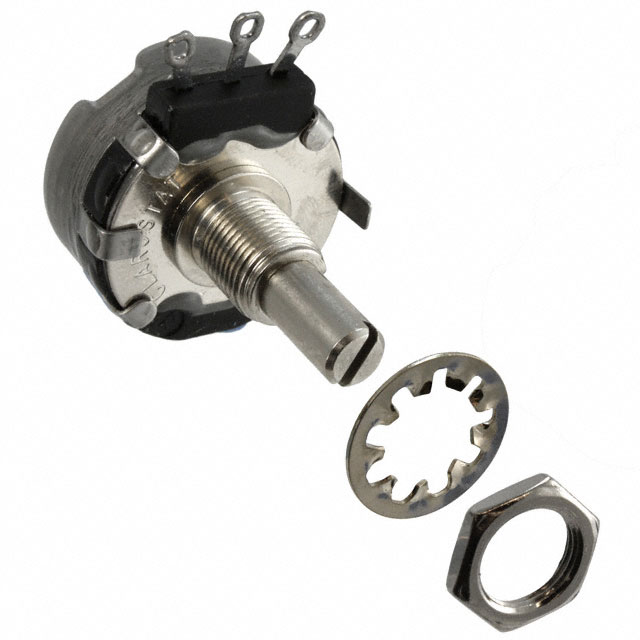
The Honeywell 53C310K is a 10k Ohm, 2-watt linear panel mount potentiometer featuring conductive plastic resistive material and solder lug termination. This component is classified as obsolete, necessitating identification of active substitute parts for new designs and ongoing production requirements. The 53C series potentiometer is designed for applications requiring precise linear resistance adjustment with panel-mounted configuration and user-defined adjustment capability.
Substiute Parts
Key Parameters
| Parameter | Value |
|---|---|
| Resistance | 10k Ohm |
| Power Rating | 2W |
| Taper | Linear |
| Number of Gangs | 1 |
| Number of Turns | 1 |
| Termination Style | Solder Lug |
| Mounting Type | Panel Mount |
| Bushing Thread | 3/8-32 |
| Tolerance | ±10% |
| Actuator Type | Slotted |
Substitute Part Grouping Explanation
Substitution of the Honeywell 53C310K is based on strict equivalence across the following critical parameters:
Electrical Parameters (Required Match):
- Resistance value: 10k Ohm
- Power rating: 2W
- Taper: Linear
- Tolerance: ±10%
- Number of turns: 1
- Number of gangs: 1
Mechanical Parameters (Required Match):
- Termination style: Solder Lug
- Mounting type: Panel Mount
- Bushing thread: 3/8-32
- Actuator type: Slotted
- Actuator length: 0.875" (22.23mm)
Acceptable Variations:
- Resistive material: Conductive Plastic or Carbon (both acceptable for linear potentiometer applications)
- Rotation angle: 312° to 314° (minor mechanical variation)
- Actuator diameter: 0.249" to 0.250" (within manufacturing tolerance)
- Body diameter: 1.094" to 1.120" (within panel mount envelope)
The RV4NAYSD103A from Precision Electronics Corporation meets all critical electrical and mechanical parameters and is classified as an active product with current inventory availability.
Parameter Comparison
| Parameter | 53C310K (Honeywell) | RV4NAYSD103A (Precision Electronics) | Match Status |
|---|---|---|---|
| Resistance (Ohms) | 10k | 10k | Exact Match |
| Power (Watts) | 2W | 2W | Exact Match |
| Tolerance | ±10% | ±10% | Exact Match |
| Taper | Linear | Linear | Exact Match |
| Number of Turns | 1 | 1 | Exact Match |
| Number of Gangs | 1 | 1 | Exact Match |
| Termination Style | Solder Lug | Solder Lug | Exact Match |
| Mounting Type | Panel Mount | Panel Mount | Exact Match |
| Bushing Thread | 3/8-32 | 3/8-32 | Exact Match |
| Actuator Type | Slotted | Slotted | Exact Match |
| Actuator Length | 0.875" (22.23mm) | 0.875" (22.23mm) | Exact Match |
| Actuator Diameter | 0.250" (6.35mm) | 0.249" (6.32mm) | Within Tolerance |
| Rotation | 312° | 314° | Within Tolerance |
| Body Diameter | 1.094" (27.78mm) | 1.120" (28.45mm) | Within Tolerance |
| Resistive Material | Conductive Plastic | Carbon | Functionally Equivalent |
| Product Status | Obsolete | Active | Substitute Available |
| RoHS Status | RoHS Compliant | ROHS3 Compliant | Compliant |
Engineering Selection Recommendations
The RV4NAYSD103A potentiometer from Precision Electronics Corporation is a direct functional equivalent to the obsolete Honeywell 53C310K. Selection of this substitute is based on the following engineering criteria:
Product Status Consideration: The 53C310K is classified as obsolete, making the RV4NAYSD103A the appropriate active alternative. The RV4NAYSD103A maintains active product status with confirmed inventory availability of 2000 units.
Compliance and Certification: Both components meet RoHS compliance requirements. The RV4NAYSD103A carries ROHS3 certification and is REACH unaffected, meeting current regulatory standards for electronic component procurement.
Electrical and Mechanical Equivalence: All critical electrical parameters match exactly: 10k Ohm resistance, 2W power rating, ±10% tolerance, and linear taper. Mechanical parameters including panel mount configuration, 3/8-32 bushing thread, solder lug termination, and slotted actuator design are identical.
Material Variation: The RV4NAYSD103A uses carbon resistive material compared to the conductive plastic material in the 53C310K. Both materials are functionally equivalent for linear potentiometer applications at the specified electrical ratings and operating parameters.
Dimensional Compatibility: Minor dimensional variations in actuator diameter (0.249" vs 0.250") and body diameter (1.120" vs 1.094") fall within acceptable manufacturing tolerances and do not affect panel mount installation or functional performance.
Frequently Asked Questions (FAQ)
Q: Can the RV4NAYSD103A be used as a direct replacement for the Honeywell 53C310K in existing designs?
A: Yes. The RV4NAYSD103A meets all critical electrical and mechanical specifications. The component features identical resistance value, power rating, taper, termination style, mounting configuration, and bushing thread specification. Installation and electrical performance are equivalent.
Q: What is the difference between conductive plastic and carbon resistive materials in these potentiometers?
A: Both materials provide linear resistance adjustment at the specified 2W power rating and 10k Ohm value. The material difference does not affect electrical performance for applications within the rated specifications. Carbon material is commonly used in industrial potentiometer applications and provides equivalent reliability.
Q: Are there any dimensional concerns when substituting the RV4NAYSD103A for the 53C310K?
A: No. The actuator diameter difference of 0.001" (0.249" vs 0.250") and body diameter difference of 0.026" (1.120" vs 1.094") are within standard manufacturing tolerances. Both components use identical 3/8-32 bushing threads and 0.875" actuator lengths, ensuring compatible panel mount installation.
Q: What is the inventory status of the RV4NAYSD103A?
A: The RV4NAYSD103A is an active product with 2000 units available in new original stock. The Honeywell 53C310K is obsolete with 983 units remaining in inventory.
Q: Do both components meet current regulatory compliance standards?
A: Yes. The Honeywell 53C310K is RoHS compliant. The RV4NAYSD103A carries ROHS3 certification and is REACH unaffected, meeting current regulatory requirements for electronic component procurement and use.
Q: What is the rotation angle difference between these components?
A: The 53C310K has a 312° rotation while the RV4NAYSD103A has a 314° rotation. This 2° difference is within acceptable mechanical tolerance and does not affect functional performance or adjustment range for standard potentiometer applications.
Q: Are the solder lug terminations compatible between these two potentiometers?
A: Yes. Both components use solder lug termination style, ensuring identical electrical connection methods and PCB assembly compatibility.
Alternative Parts

SJ6012L2TP
Littelfuse Inc.
6 Alternative Parts

JMK107BBJ476MA-RE
Taiyo Yuden
10 Alternative Parts

GMK107BBJ475MA-T
Taiyo Yuden
5 Alternative Parts
SJ6020N2ARP
Littelfuse Inc.
3 Alternative Parts
SJ6025R2ATP
Littelfuse Inc.
4 Alternative Parts

2474-05L
API Delevan Inc.
1 Alternative Parts

4590R-684K
API Delevan Inc.
1 Alternative Parts

CM6560R-334
API Delevan Inc.
1 Alternative Parts

CM6460-104
API Delevan Inc.
1 Alternative Parts

5526-12
API Delevan Inc.
1 Alternative Parts