



Request Quote
(Ships tomorrow)
450-0124 802.15.4 Zigbee® Transceiver Module 900MHz Equivalent & Substitute Parts
Part Overview
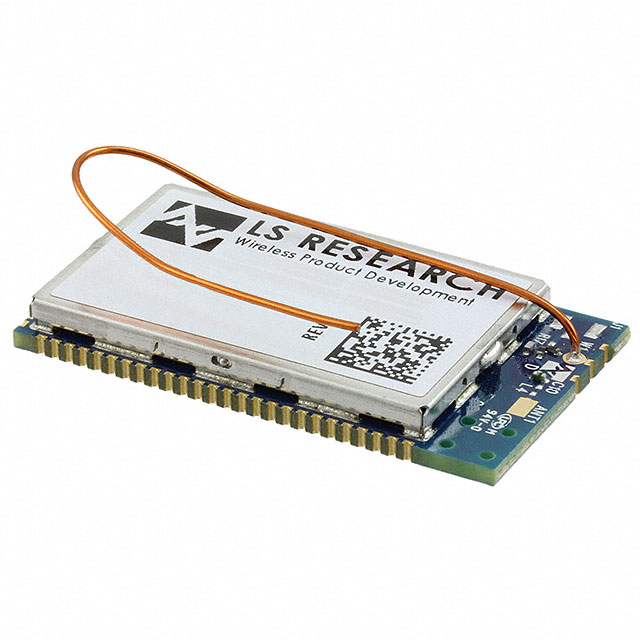
The 450-0124 is an 802.15.4 Zigbee® transceiver module manufactured by Laird Connectivity Inc., designed for wireless communication applications operating at 900MHz. This module integrates a wire antenna and is configured for surface mount deployment. The product is classified as obsolete, making identification of functionally equivalent alternatives necessary for ongoing system support, design updates, and procurement continuity.
Substiute Parts
Key Parameters
| Parameter | Value |
|---|---|
| RF Standard | 802.15.4 |
| Protocol | Zigbee® |
| Frequency Band | 900MHz |
| Data Rate | 1Mbps |
| Utilized IC | AT86RF212B |
| Memory Configuration | 256kB Flash, 4kB EEPROM, 16kB RAM |
| Voltage Supply Range | 2V ~ 3.45V |
| Operating Temperature | -40°C ~ 85°C |
| Mounting Type | Surface Mount |
| Serial Interfaces | JTAG, SPI, UART |
Substitute Part Grouping Explanation
Substitution eligibility for the 450-0124 is determined by strict alignment across the following critical parameters:
RF and Protocol Compatibility: Both the main part and substitute must operate under the 802.15.4 standard with Zigbee® protocol support at 900MHz frequency band with 1Mbps data rate capability.
Core IC Utilization: The AT86RF212B transceiver IC is the functional foundation. Substitute parts must employ the same IC to ensure register-level compatibility and firmware portability.
Memory Architecture: Flash, EEPROM, and RAM configurations must match or exceed the specified 256kB Flash, 4kB EEPROM, and 16kB RAM to maintain application compatibility.
Electrical Operating Range: Supply voltage and current consumption parameters define system integration feasibility. Substitutes must operate within compatible voltage ranges and current profiles.
Interface Availability: Serial communication interfaces (JTAG, SPI, UART) must be present to support programming, debugging, and data exchange requirements.
Thermal Operating Window: The -40°C to 85°C operating temperature range establishes environmental deployment constraints that substitutes must satisfy.
Surface Mount Packaging: Physical form factor must remain surface mount to maintain PCB integration compatibility.
Parameter Comparison
| Parameter | 450-0124 (Laird) | ATZB-X0-256-4-0-CN (Microchip) | Compatibility Assessment |
|---|---|---|---|
| Manufacturer | Laird Connectivity Inc. | Microchip Technology | Different manufacturer |
| Series | SiFLEX02-R2 | ZigBit™ | Different series designation |
| Product Status | Obsolete | Active | Substitute is actively supported |
| RF Standard | 802.15.4 | 802.15.4 | Matched |
| Protocol | Zigbee® | Zigbee® | Matched |
| Frequency | 900MHz | 900MHz | Matched |
| Data Rate | 1Mbps | 1Mbps | Matched |
| Modulation | BPSK, O-QPSK | Not specified | Main part specifies modulation types |
| Power Output | 24dBm | 11dBm | Substitute has lower output power |
| Sensitivity | -102dBm | -103dBm | Substitute has improved sensitivity |
| Utilized IC | AT86RF212B | AT86RF212B | Matched |
| Memory - Flash | 256kB | 256kB | Matched |
| Memory - EEPROM | 4kB | 4kB | Matched |
| Memory - RAM | 16kB | 16kB SRAM | Matched |
| Voltage Supply | 2V ~ 3.45V | 1.8V ~ 3.6V | Substitute has wider voltage range |
| Current - Receiving | 30mA | 8.7mA ~ 14.5mA | Substitute has lower receive current |
| Current - Transmitting | 285mA | 34.8mA | Substitute has significantly lower transmit current |
| Serial Interfaces | JTAG, SPI, UART | ISP, JTAG, SPI, UART, USART | Substitute includes additional interfaces |
| Antenna Type | Integrated, Wire Antenna | Integrated, Chip | Different antenna implementation |
| Operating Temperature | -40°C ~ 85°C | -40°C ~ 85°C | Matched |
| Mounting Type | Surface Mount | Surface Mount | Matched |
| Package Type | Module | Module | Matched |
| Moisture Sensitivity Level | MSL 4 (72 Hours) | MSL 1 (Unlimited) | Substitute has superior moisture tolerance |
| RoHS Status | Not specified | ROHS3 Compliant | Substitute meets RoHS3 requirements |
| REACH Status | REACH Unaffected | REACH Unaffected | Matched |
| ECCN | 5A002A1 | EAR99 | Different export classification |
Engineering Selection Recommendations
The ATZB-X0-256-4-0-CN from Microchip Technology qualifies as a functional equivalent for the obsolete 450-0124 based on the following engineering criteria:
RF and Protocol Alignment: Both modules operate identically within the 802.15.4 Zigbee® standard at 900MHz with 1Mbps data rate, utilizing the same AT86RF212B transceiver IC and matching memory architecture (256kB Flash, 4kB EEPROM, 16kB RAM).
Active Product Status: The ATZB-X0-256-4-0-CN is classified as active, ensuring ongoing manufacturer support, availability, and technical documentation access. This addresses the primary limitation of the obsolete 450-0124.
Regulatory Compliance: The substitute meets ROHS3 compliance requirements and maintains REACH unaffected status, aligning with current environmental and regulatory standards. The ECCN classification differs (EAR99 versus 5A002A1), which may affect export considerations depending on destination jurisdiction.
Electrical Performance Improvements: The substitute demonstrates superior electrical characteristics including wider supply voltage tolerance (1.8V ~ 3.6V versus 2V ~ 3.45V), significantly reduced current consumption during receive (8.7mA ~ 14.5mA versus 30mA) and transmit (34.8mA versus 285mA) operations, and improved receiver sensitivity (-103dBm versus -102dBm).
Interface Compatibility: The substitute provides all required serial interfaces (JTAG, SPI, UART) plus additional options (ISP, USART), supporting existing firmware and debugging infrastructure.
Antenna Configuration Difference: The 450-0124 features an integrated wire antenna, while the ATZB-X0-256-4-0-CN uses an integrated chip antenna. This difference requires PCB layout evaluation to confirm RF performance equivalence in the target application environment.
Power Output Consideration: The substitute delivers 11dBm output power compared to 24dBm for the main part. Applications requiring maximum transmit power must evaluate link budget impact.
Frequently Asked Questions (FAQ)
Q: Can the ATZB-X0-256-4-0-CN directly replace the 450-0124 without firmware modifications?
A: Both modules utilize the AT86RF212B transceiver IC with identical memory configurations and matching serial interfaces (JTAG, SPI, UART). Firmware compatibility depends on application-specific code. The substitute's additional interfaces (ISP, USART) do not affect existing implementations. However, the antenna type difference (wire versus chip) requires RF performance validation in your specific application environment.
Q: What is the impact of the 13dBm lower transmit power on system performance?
A: The ATZB-X0-256-4-0-CN outputs 11dBm versus the 450-0124's 24dBm. This 13dB reduction affects link budget calculations. Applications operating at maximum range or in high-attenuation environments must recalculate coverage margins. The substitute's improved receiver sensitivity (-103dBm versus -102dBm) provides partial offset but does not fully compensate for transmit power reduction.
Q: Are there PCB layout considerations when switching from wire antenna to chip antenna?
A: Yes. The 450-0124 integrates a wire antenna requiring specific PCB clearance and orientation. The ATZB-X0-256-4-0-CN uses a chip antenna with different impedance matching and ground plane requirements. RF performance validation through measurement or simulation is necessary to confirm equivalent coverage in your application.
Q: Does the substitute's lower current consumption affect power supply design?
A: The ATZB-X0-256-4-0-CN requires significantly less current during receive (8.7mA ~ 14.5mA versus 30mA) and transmit (34.8mA versus 285mA) operations. Existing power supply designs rated for the 450-0124 will operate with improved margin. Battery-powered applications benefit from extended runtime. No power supply redesign is required for adequate performance.
Q: What export control implications exist between the two parts?
A: The 450-0124 carries ECCN 5A002A1 classification, while the ATZB-X0-256-4-0-CN is classified as EAR99. These different export control numbers may affect shipping to certain destinations. Verify current export regulations and licensing requirements for your target markets before procurement.
Q: Is the substitute's wider voltage range (1.8V ~ 3.6V) compatible with existing 2V ~ 3.45V power supplies?
A: Yes. The substitute's 1.8V ~ 3.6V range fully encompasses the original 2V ~ 3.45V specification. Existing power supplies designed for the 450-0124 will operate within the substitute's acceptable voltage window without modification.
Q: What is the significance of the MSL rating difference?
A: The 450-0124 carries MSL 4 (72-hour moisture sensitivity), while the ATZB-X0-256-4-0-CN is MSL 1 (unlimited). The substitute demonstrates superior moisture tolerance, reducing bake-out requirements and storage constraints. This improves supply chain flexibility and reduces manufacturing process complexity.
Alternative Parts

SJ6012L2TP
Littelfuse Inc.
6 Alternative Parts

JMK107BBJ476MA-RE
Taiyo Yuden
10 Alternative Parts

GMK107BBJ475MA-T
Taiyo Yuden
5 Alternative Parts
SJ6020N2ARP
Littelfuse Inc.
3 Alternative Parts
SJ6025R2ATP
Littelfuse Inc.
4 Alternative Parts

2474-05L
API Delevan Inc.
1 Alternative Parts

4590R-684K
API Delevan Inc.
1 Alternative Parts

CM6560R-334
API Delevan Inc.
1 Alternative Parts

CM6460-104
API Delevan Inc.
1 Alternative Parts

5526-12
API Delevan Inc.
1 Alternative Parts