



Request Quote
(Ships tomorrow)
LINE FILTER 40TDS6D - Equivalent & Substitute Parts Reference
Part Overview
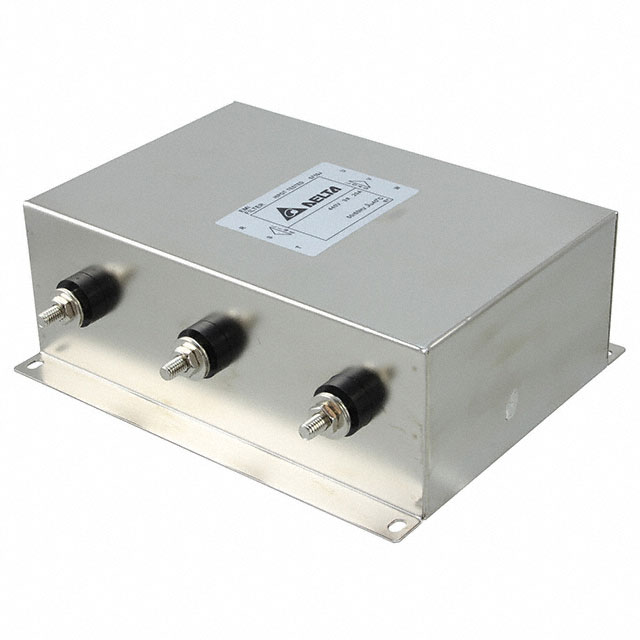
The Delta Electronics 40TDS6D is a three-phase (delta) EMC/EMI line filter rated for 440VAC at 40A with 50/60Hz operation. This chassis-mount filter features a two-stage configuration with threaded post (M6) termination and is designed for general-purpose applications requiring electromagnetic compatibility filtering in three-phase power systems. The product maintains active status with ROHS3 compliance and unlimited moisture sensitivity rating (MSL 1).
Substitute parts are identified when equivalent electrical performance can be maintained across critical parameters including voltage rating, current capacity, phase configuration, and frequency range, while accommodating differences in staging configuration and termination style.
Substiute Parts
Key Parameters
| Parameter | 40TDS6D (Main Part) |
|---|---|
| Manufacturer | Delta Electronics |
| Filter Type | Three Phase (Delta) |
| Voltage - Rated AC | 440V |
| Current Rating | 40A |
| Frequency - Operating | 50/60Hz |
| Configuration | Two Stage |
| Mounting Type | Chassis Mount |
| Termination Style | Threaded Post (M6) |
| RoHS Status | ROHS3 Compliant |
| Product Status | Active |
Substitute Part Grouping Explanation
Substitution eligibility for the 40TDS6D is determined by the following critical parameters:
- Phase Configuration: Three-phase (delta) topology required
- Voltage Rating: 440V phase-to-phase AC minimum
- Current Capacity: 40A or greater
- Frequency Range: 50/60Hz operation or broader DC~60Hz range
- Mounting: Chassis mount configuration
- Compliance: ROHS3 and REACH unaffected status
The Schaffner EMC Inc. FN351-50-33 qualifies as a substitute based on matching three-phase delta configuration, 440V phase-to-phase rating, current capacity exceeding the 40A requirement (50A), compatible frequency range (DC~60Hz encompasses 50/60Hz), and identical compliance certifications. Configuration differences (single stage vs. two stage) and termination style variations (terminal block vs. threaded post) represent acceptable trade-offs when electrical performance parameters align.
Parameter Comparison
| Parameter | 40TDS6D | FN351-50-33 |
|---|---|---|
| Manufacturer | Delta Electronics | Schaffner EMC Inc. |
| Filter Type | Three Phase (Delta) | Three Phase (Delta) |
| Voltage - Rated AC (Phase to Phase) | 440V | 440V |
| Current Rating | 40A | 50A |
| Frequency - Operating | 50/60Hz | DC ~ 60Hz |
| Configuration | Two Stage | Single Stage |
| Mounting Type | Chassis Mount | Chassis Mount |
| Termination Style | Threaded Post (M6) | Terminal Block |
| RoHS Status | ROHS3 Compliant | ROHS3 Compliant |
| MSL Rating | 1 (Unlimited) | 1 (Unlimited) |
| REACH Status | REACH Unaffected | REACH Unaffected |
| Product Status | Active | Obsolete |
Engineering Selection Recommendations
The FN351-50-33 provides electrical equivalence to the 40TDS6D across all critical filtering parameters. Both components maintain three-phase delta configuration, 440V phase-to-phase rating, and ROHS3/REACH compliance. The FN351-50-33 offers increased current capacity (50A vs. 40A), providing margin for the 40A application requirement.
Selection between these components should account for the following factors:
- Product Status: The 40TDS6D maintains active manufacturing status, while FN351-50-33 is obsolete. Active status ensures continued availability and supply chain stability.
- Termination Compatibility: The 40TDS6D uses threaded post (M6) termination; the FN351-50-33 uses terminal block. Installation method and connector compatibility must be evaluated for the target application.
- Filtering Configuration: The 40TDS6D employs two-stage filtering; the FN351-50-33 uses single-stage design. Application EMI/RFI requirements determine whether single-stage attenuation is sufficient.
- Regulatory Approvals: The FN351-50-33 carries CSA, ENEC, and UR certifications; the 40TDS6D approval agency information is not specified. Application-specific certification requirements must be verified.
Frequently Asked Questions (FAQ)
Q: Can the FN351-50-33 directly replace the 40TDS6D in an existing installation?
A: Electrical compatibility exists based on three-phase delta configuration, 440V rating, and current capacity. Physical installation compatibility depends on chassis mounting provisions and termination connector availability. Termination style differs (threaded post M6 vs. terminal block), requiring mechanical adaptation or connector modification.
Q: Why does the FN351-50-33 have a higher current rating (50A) than the 40TDS6D (40A)?
A: The FN351-50-33 is rated for 50A maximum current, exceeding the 40A requirement of the 40TDS6D. This provides operational margin and does not prevent use in 40A applications. The substitute remains suitable for the lower current demand.
Q: What is the significance of the configuration difference (two-stage vs. single-stage)?
A: Configuration refers to the number of filtering stages. The 40TDS6D employs two stages for enhanced EMI/RFI attenuation; the FN351-50-33 uses single-stage design. Application-specific electromagnetic compatibility requirements determine whether single-stage filtering provides adequate performance. This parameter must be evaluated against system EMC specifications.
Q: Is the FN351-50-33 suitable for 50/60Hz operation?
A: Yes. The FN351-50-33 is rated for DC~60Hz operation, which encompasses the 50/60Hz requirement of the 40TDS6D. The broader frequency range of the substitute does not limit its use in 50/60Hz applications.
Q: What packaging differences exist between these components?
A: The 40TDS6D is supplied in box packaging; the FN351-50-33 is supplied in tray packaging. Packaging affects handling, storage, and logistics but does not impact electrical or mechanical performance.
Q: Should product status (active vs. obsolete) influence the selection decision?
A: Product status reflects manufacturing and supply availability. The 40TDS6D maintains active status, ensuring continued production and supply chain access. The FN351-50-33 is obsolete, indicating discontinued manufacturing. For new designs or long-term applications, active-status components are preferred to ensure future availability and support.
Alternative Parts

SJ6012L2TP
Littelfuse Inc.
6 Alternative Parts

JMK107BBJ476MA-RE
Taiyo Yuden
10 Alternative Parts

GMK107BBJ475MA-T
Taiyo Yuden
5 Alternative Parts
SJ6020N2ARP
Littelfuse Inc.
3 Alternative Parts
SJ6025R2ATP
Littelfuse Inc.
4 Alternative Parts

2474-05L
API Delevan Inc.
1 Alternative Parts

4590R-684K
API Delevan Inc.
1 Alternative Parts

CM6560R-334
API Delevan Inc.
1 Alternative Parts

CM6460-104
API Delevan Inc.
1 Alternative Parts

5526-12
API Delevan Inc.
1 Alternative Parts