


Request Quote
(Ships tomorrow)
RF Power Divider 12.4 GHz–18 GHz Module (TTM Technologies 40269)
Part Overview
The TTM Technologies 40269 is an RF power divider module designed for operation in the 12.4 GHz to 18 GHz frequency band. This component is classified as obsolete, making identification of functionally equivalent alternatives necessary for ongoing system support and new design implementations. RF power dividers are critical passive components used to split RF signals with controlled isolation and minimal insertion loss across microwave frequency ranges.
Substiute Parts
Key Parameters
| Parameter | Value |
|---|---|
| Manufacturer Part Number | 40269 |
| Manufacturer | TTM Technologies, Inc. |
| Frequency Range | 12.4 GHz – 18 GHz |
| Insertion Loss | 1.2 dB |
| Package Type | Module |
| Physical Dimensions | 1.200" L × 1.000" W × 0.370" H (30.48 mm × 25.40 mm × 9.40 mm) |
| Moisture Sensitivity Level (MSL) | 1 (Unlimited) |
| Product Status | Obsolete |
| REACH Status | REACH Unaffected |
| ECCN | EAR99 |
Substitute Part Grouping Explanation
Substitution of the TTM Technologies 40269 is determined by the following critical parameters:
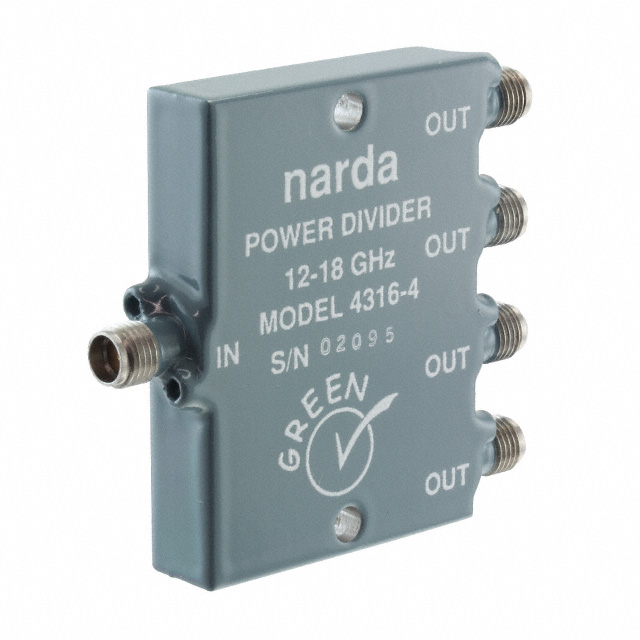
Frequency Compatibility: The substitute part must operate within or encompass the 12.4 GHz to 18 GHz frequency band. The L3 Narda-MITEQ 4316-4 operates across 12 GHz to 18 GHz, providing full coverage of the required frequency range.
Insertion Loss: The main part specifies 1.2 dB insertion loss. The substitute part exhibits 1.5 dB insertion loss, representing a 0.3 dB increase. This difference is within acceptable tolerance for most RF power divider applications where insertion loss specifications allow for component variation.
Package Configuration: Both parts are supplied as modules, ensuring mechanical and electrical interface compatibility in existing designs.
Isolation Performance: The substitute part provides minimum 18 dB isolation, a specification not provided for the original part but critical for RF power divider function and signal separation.
Regulatory and Compliance Status: Both parts maintain REACH Unaffected status and EAR99 ECCN classification, ensuring consistent export and environmental compliance.
Parameter Comparison
| Parameter | TTM Technologies 40269 | L3 Narda-MITEQ 4316-4 |
|---|---|---|
| Frequency Range | 12.4 GHz – 18 GHz | 12 GHz – 18 GHz |
| Insertion Loss | 1.2 dB | 1.5 dB |
| Isolation (Min) | Not specified | 18 dB |
| Package Type | Module | Module |
| Physical Dimensions | 1.200" L × 1.000" W × 0.370" H | 1.418" L × 1.940" W × 0.380" H |
| Moisture Sensitivity Level (MSL) | 1 (Unlimited) | Not Applicable |
| Product Status | Obsolete | Active |
| REACH Status | REACH Unaffected | REACH Unaffected |
| ECCN | EAR99 | EAR99 |
Engineering Selection Recommendations
The L3 Narda-MITEQ 4316-4 is an active product with current manufacturing support, providing supply chain continuity for the obsolete TTM Technologies 40269. Both components maintain identical regulatory classification (EAR99, REACH Unaffected), ensuring no compliance barriers to substitution.
The 4316-4 exhibits 0.3 dB higher insertion loss (1.5 dB versus 1.2 dB) and larger physical dimensions (1.418" × 1.940" × 0.380" versus 1.200" × 1.000" × 0.370"). These differences require verification against specific system requirements, particularly in space-constrained applications or designs with tight insertion loss budgets.
The substitute part's specified 18 dB minimum isolation provides documented signal separation performance, supporting reliable RF power division across the 12 GHz to 18 GHz operating range.
Frequently Asked Questions (FAQ)
Q: Can the L3 Narda-MITEQ 4316-4 directly replace the TTM Technologies 40269 in existing designs?
A: Functional substitution is possible based on frequency range and package type compatibility. However, the larger physical dimensions and increased insertion loss require confirmation that the target application accommodates these parameter differences.
Q: What is the significance of the frequency range difference (12.4 GHz–18 GHz versus 12 GHz–18 GHz)?
A: The substitute part extends coverage to 12 GHz, providing additional bandwidth below the original part's 12.4 GHz lower limit. This represents an enhancement rather than a limitation for substitution purposes.
Q: How does the 0.3 dB insertion loss increase affect system performance?
A: Insertion loss directly impacts signal attenuation through the power divider. The 0.3 dB increase represents approximately 7% additional signal loss. System-level impact depends on the application's insertion loss budget and cascade configuration.
Q: Are there mechanical mounting considerations due to dimensional differences?
A: The substitute part is 0.218" longer and 0.940" wider than the original. Mechanical integration requires verification of available mounting space and connector positioning within the target enclosure or PCB layout.
Q: Do both parts share identical regulatory compliance status?
A: Yes. Both components are classified as REACH Unaffected and carry EAR99 ECCN designation, ensuring equivalent export control and environmental compliance treatment.
Alternative Parts

SJ6012L2TP
Littelfuse Inc.
6 Alternative Parts

JMK107BBJ476MA-RE
Taiyo Yuden
10 Alternative Parts

GMK107BBJ475MA-T
Taiyo Yuden
5 Alternative Parts
SJ6020N2ARP
Littelfuse Inc.
3 Alternative Parts
SJ6025R2ATP
Littelfuse Inc.
4 Alternative Parts

2474-05L
API Delevan Inc.
1 Alternative Parts

4590R-684K
API Delevan Inc.
1 Alternative Parts

CM6560R-334
API Delevan Inc.
1 Alternative Parts

CM6460-104
API Delevan Inc.
1 Alternative Parts

5526-12
API Delevan Inc.
1 Alternative Parts