


Request Quote
(Ships tomorrow)
3BCC-A/G LED Amber/Green Bidirectional Indicator - Equivalent & Substitute Parts
Part Overview
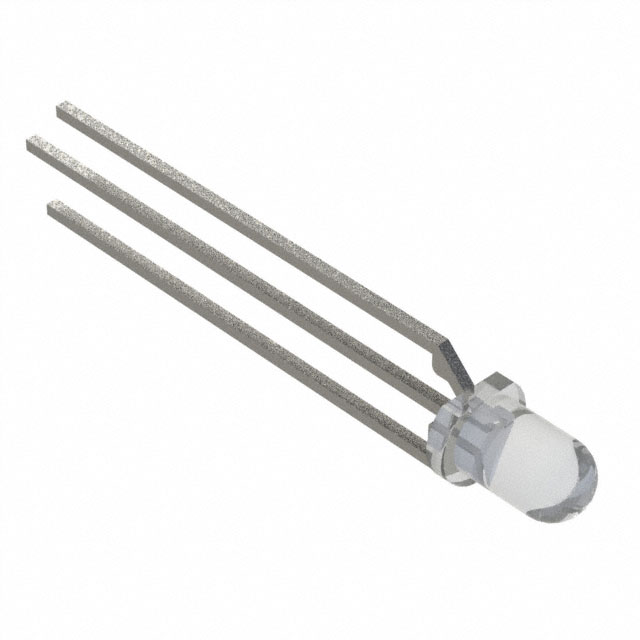
The 3BCC-A/G is a bidirectional LED indicator manufactured by Bivar Inc., featuring dual-color amber and green discrete LEDs in a T-1 through-hole package. This component provides amber (2V forward voltage, 6mcd) and green (2.1V forward voltage, 8mcd) indication capabilities with a clear, domed lens. The product status is obsolete, necessitating identification of active alternative components that maintain functional compatibility within allowable electrical and mechanical parameter ranges.
Substiute Parts
Key Parameters
| Parameter | Value |
|---|---|
| Manufacturer Part Number | 3BCC-A/G |
| Manufacturer | Bivar Inc. |
| Product Status | Obsolete |
| Color Configuration | Amber, Green (Bidirectional) |
| Lens Type | Round with Domed Top, Clear |
| Lens Size | T-1 (3mm) |
| Forward Voltage (Vf) Typical | 2V Amber, 2.1V Green |
| Test Current | 30mA Amber, 30mA Green |
| Luminous Intensity | 6mcd Amber, 8mcd Green |
| Viewing Angle | 40° |
| Mounting Type | Through Hole |
| Package | Radial (T-1 3mm) |
| Height Maximum | 4.50mm |
| Moisture Sensitivity Level | MSL 1 (Unlimited) |
| RoHS Status | Not specified in documentation |
Substitute Part Grouping Explanation
Substitution of the obsolete 3BCC-A/G requires identification of active components meeting the following critical parameters:
Electrical Compatibility:
- Forward voltage range encompassing 2V to 2.1V across amber and green colors
- Test current ratings at 20mA to 30mA
- Bidirectional configuration for dual-color operation
Mechanical Compatibility:
- Through-hole mounting with T-1 (3mm) radial package
- Maximum height 4.50mm
- Lens material and transparency affecting light distribution
Optical Characteristics:
- Luminous intensity minimum 4mcd to 8mcd range
- Viewing angle of 40° to 45°
The substitute part 3BC-Y/G shares the following qualifying attributes: T-1 through-hole radial package, 4.50mm maximum height, bidirectional configuration, compatible forward voltages (2V Yellow, 2.1V Green), and MSL 1 rating. However, the color combination differs (Green/Yellow versus Amber/Green), requiring circuit validation to confirm functional equivalence in the application.
Parameter Comparison
| Parameter | 3BCC-A/G (Obsolete) | 3BC-Y/G (Active) |
|---|---|---|
| Manufacturer | Bivar Inc. | Bivar Inc. |
| Product Status | Obsolete | Active |
| Color Configuration | Amber, Green | Green, Yellow |
| Lens Transparency | Clear | Diffused |
| Forward Voltage | 2V Amber, 2.1V Green | 2V Yellow, 2.1V Green |
| Test Current | 30mA Amber, 30mA Green | 20mA Yellow, 20mA Green |
| Luminous Intensity | 6mcd Amber, 8mcd Green | 4mcd Yellow, 6mcd Green |
| Viewing Angle | 40° | 45° |
| Lens Style | Clear Domed | Diffused Domed |
| Package / Case | Radial T-1 (3mm) | Radial T-1 (3mm) |
| Height Maximum | 4.50mm | 4.50mm |
| Mounting Type | Through Hole | Through Hole |
| Moisture Sensitivity Level | MSL 1 (Unlimited) | MSL 1 (Unlimited) |
Engineering Selection Recommendations
The 3BCC-A/G is classified as obsolete. For new designs or replacement applications, the 3BC-Y/G is identified as an active Bivar Inc. component with T-1 through-hole compatibility.
Selection Criteria Based on Provided Documentation:
The 3BC-Y/G maintains electrical and mechanical compatibility through:
- Identical forward voltage ratings for the green LED (2.1V)
- Comparable forward voltage for the yellow LED (2V) relative to the original amber (2V)
- Same package format (T-1 radial, 4.50mm maximum height)
- MSL 1 rating matching the original component
- RoHS3 compliance certification
Differences in color selection, lens transparency (clear versus diffused), test current (20mA versus 30mA), and luminous intensity must be evaluated against circuit requirements. The diffused lens in the 3BC-Y/G produces wider light distribution compared to the clear lens of the 3BCC-A/G. The yellow LED output at 4mcd (compared to amber at 6mcd) and green output at 6mcd (compared to 8mcd) may affect brightness perception in the application.
Substitution decisions must account for the specific circuit design, display requirements, and color coding significance in the intended system.
Frequently Asked Questions (FAQ)
Q: What makes 3BC-Y/G a valid substitute for the obsolete 3BCC-A/G?
A: The 3BC-Y/G shares critical mechanical and electrical compatibility: identical T-1 through-hole radial package, 4.50mm maximum height, matching forward voltage for green LEDs (2.1V), and equivalent forward voltage for the warm-color LED (2V for yellow versus 2V for amber). Both components are bidirectional with MSL 1 moisture sensitivity ratings.
Q: Are there differences between the 3BCC-A/G and 3BC-Y/G that affect selection?
A: Yes. The color pairing differs (amber/green versus yellow/green), which affects visual appearance and may impact color-coded indication schemes. The 3BC-Y/G uses a diffused lens versus the clear lens of the 3BCC-A/G, producing wider light distribution. Test currents differ (20mA versus 30mA), and luminous intensity values vary across both color pairs.
Q: Can I directly replace 3BCC-A/G with 3BC-Y/G in existing designs?
A: Direct substitution is possible only if the application's circuit design, power budget, and color-coding requirements accommodate the parameter differences. The circuit must support the yellow and green colors instead of amber and green, and accept the diffused lens characteristics.
Q: Why is lens transparency (clear versus diffused) important in substitution?
A: Clear lenses focus light output with sharper definition and narrower viewing angle (40° for 3BCC-A/G). Diffused lenses scatter light over a wider angle (45° for 3BC-Y/G), resulting in broader visibility but potentially lower peak brightness in a fixed direction.
Q: Does RoHS3 compliance of the 3BC-Y/G affect compatibility?
A: RoHS3 compliance is documented for the 3BC-Y/G. This certification confirms lead-free and restricted substance compliance. The original 3BCC-A/G documentation does not specify RoHS status, and substitution should confirm compliance requirements for the intended application or market.
Q: What is the significance of test current differences (30mA versus 20mA)?
A: Test current specifies the current level at which the luminous intensity ratings are measured. The 3BCC-A/G operates at 30mA for both colors, while the 3BC-Y/G operates at 20mA. This reflects different brightness characteristics at standard operating conditions and must be considered in circuit design for equivalent light output.
Alternative Parts

SJ6012L2TP
Littelfuse Inc.
6 Alternative Parts

JMK107BBJ476MA-RE
Taiyo Yuden
10 Alternative Parts

GMK107BBJ475MA-T
Taiyo Yuden
5 Alternative Parts
SJ6020N2ARP
Littelfuse Inc.
3 Alternative Parts
SJ6025R2ATP
Littelfuse Inc.
4 Alternative Parts

2474-05L
API Delevan Inc.
1 Alternative Parts

4590R-684K
API Delevan Inc.
1 Alternative Parts

CM6560R-334
API Delevan Inc.
1 Alternative Parts

CM6460-104
API Delevan Inc.
1 Alternative Parts

5526-12
API Delevan Inc.
1 Alternative Parts