




Request Quote
(Ships tomorrow)
30TPS12 SCR 1.2KV 30A Equivalent & Substitute Parts
Part Overview
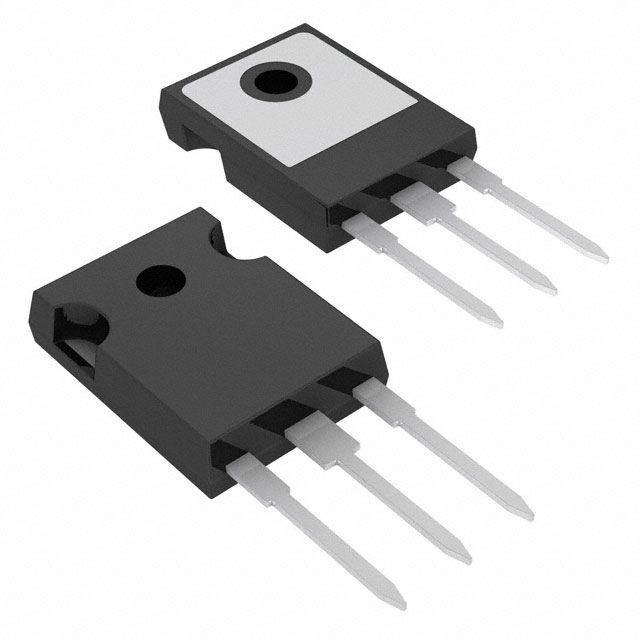
The 30TPS12 is a 1.2 kV, 30 A standard recovery silicon-controlled rectifier (SCR) manufactured by Vishay General Semiconductor - Diodes Division in TO-247AC package. This through-hole thyristor is designed for high-voltage switching and power control applications requiring reliable gate triggering and thermal management.
The 30TPS12 is classified as obsolete. Identifying equivalent and substitute parts is necessary to maintain design continuity, ensure supply chain availability, and leverage active product alternatives that meet or exceed the original specifications.
Substiute Parts
Key Parameters
| Parameter | Value | Unit |
|---|---|---|
| Voltage - Off State | 1.2 | kV |
| Voltage - Gate Trigger (Vgt) Max | 2 | V |
| Current - Gate Trigger (Igt) Max | 45 | mA |
| Voltage - On State (Vtm) Max | 1.3 | V |
| Current - On State (It RMS) Max | 30 | A |
| Current - Hold (Ih) Max | 100 | mA |
| Current - Off State Max | 500 | µA |
| Current - Non Rep. Surge (50/60Hz) | 300 | A @ 50Hz |
| Operating Temperature Range | -40 to 125 | °C |
| Mounting Type | Through Hole | — |
| Package / Case | TO-247-3 | — |
| SCR Type | Standard Recovery | — |
Substitute Part Grouping Explanation
Substitution of the 30TPS12 is determined by the following critical parameters:
- Voltage Rating: All substitutes must maintain 1.2 kV off-state voltage to ensure blocking capability in the same circuit topology.
- Current Rating: Substitutes must support at least 30 A RMS on-state current. Higher current ratings provide design margin and improved thermal performance.
- Gate Trigger Characteristics: Vgt (Max) and Igt (Max) must be compatible with existing gate drive circuits. Lower trigger voltage and current values indicate improved gate sensitivity.
- On-State Voltage Drop: Vtm (Max) affects power dissipation. Lower values reduce thermal load.
- Hold Current: Must not exceed circuit requirements to prevent unintended latching.
- Package Compatibility: TO-247-3 family packages (TO-247AC, TO-247AD, PLUS247-3, TO-247J) are mechanically and electrically compatible for through-hole mounting.
- Product Status: Active substitutes ensure long-term availability and supply chain reliability.
Parameter Comparison
| Parameter | 30TPS12 (Vishay) | CLA50E1200HB (IXYS) | CLA80E1200HF (IXYS) | CS20-12IO1 (IXYS) | SCT1255SJ (SMC) | TN5050H-12WY (STMicroelectronics) |
|---|---|---|---|---|---|---|
| Voltage - Off State (kV) | 1.2 | 1.2 | 1.2 | 1.2 | 1.2 | 1.2 |
| Voltage - Gate Trigger Max (V) | 2 | 1.5 | 1.5 | 1 | 1.5 | 1 |
| Current - Gate Trigger Max (mA) | 45 | 50 | 38 | 65 | 50 | 50 |
| Voltage - On State Max (V) | 1.3 | 1.6 | 1.77 | 2.1 | 1.6 | 1.55 |
| Current - On State RMS Max (A) | 30 | 79 | 126 | 30 | 55 | 80 |
| Current - Hold Max (mA) | 100 | 75 | 100 | 100 | 120 | 100 |
| Current - Off State Max (µA) | 500 | 50 | 50 | 2000 | 10 | 5 |
| Operating Temperature Range (°C) | -40 to 125 | -40 to 150 | -40 to 150 | -40 to 125 | -40 to 125 | -40 to 150 |
| Package / Case | TO-247-3 | TO-247-3 | TO-247-3 Variant | TO-247-3 | TO-247-3 | TO-247-3 |
| RoHS Status | Non-compliant | ROHS3 Compliant | ROHS3 Compliant | ROHS3 Compliant | ROHS3 Compliant | ROHS3 Compliant |
| Product Status | Obsolete | Active | Active | Active | Active | Active |
Engineering Selection Recommendations
Direct Replacement (Matched Current Rating)
CS20-12IO1 (IXYS) provides the closest functional match to the 30TPS12 with identical 30 A RMS current rating and TO-247-3 package compatibility. This part is ROHS3 compliant and active in production, ensuring supply continuity. Gate trigger voltage is lower (1 V vs. 2 V), indicating improved gate sensitivity. On-state voltage is higher (2.1 V vs. 1.3 V), resulting in increased power dissipation that must be evaluated in thermal design.
Higher Current Capacity Substitutes
TN5050H-12WY (STMicroelectronics) offers 80 A RMS capacity with superior gate characteristics (1 V trigger voltage, 1.55 V on-state voltage). This part carries AEC-Q101 automotive qualification and extended temperature range (-40 to 150°C). Higher current rating provides thermal margin and design flexibility.
CLA50E1200HB (IXYS) provides 79 A RMS capacity with 1.5 V gate trigger voltage and 1.6 V on-state voltage. Extended temperature range to 150°C supports demanding thermal environments.
CLA80E1200HF (IXYS) delivers maximum current capacity at 126 A RMS in PLUS247-3 package variant. This part is suitable for applications requiring significant thermal headroom or future design scaling.
Moderate Current Capacity Substitute
SCT1255SJ (SMC Diode Solutions) offers 55 A RMS capacity with 1.5 V gate trigger voltage and 1.6 V on-state voltage. Operating temperature range matches the original part (-40 to 125°C). REACH compliance status is affected; verify regulatory requirements for your application.
Product Status Consideration
All recommended substitutes are active products with established supply chains. The 30TPS12 obsolete status makes migration to active alternatives necessary for new designs and long-term production support.
Frequently Asked Questions (FAQ)
Q: Can I use a substitute with higher current rating than the original 30TPS12?
A: Yes. Higher current-rated SCRs (such as TN5050H-12WY at 80 A or CLA50E1200HB at 79 A) are electrically compatible substitutes. The circuit will operate within the substitute's safe operating area. Verify that gate drive circuitry can supply the required trigger current and that thermal management accommodates any changes in on-state voltage drop.
Q: What is the impact of different on-state voltage drops?
A: On-state voltage (Vtm) directly affects power dissipation in the SCR. The 30TPS12 specifies 1.3 V maximum; substitutes range from 1.55 V to 2.1 V. Higher voltage drops increase heat generation. Recalculate thermal design using the substitute's Vtm value and verify that heatsinking remains adequate.
Q: Are TO-247AC, TO-247AD, PLUS247-3, and TO-247J packages interchangeable?
A: These packages are mechanically and electrically compatible variants of the TO-247-3 family for through-hole mounting. Pin assignments and lead spacing are standardized. Verify PCB footprint compatibility with your specific package variant before assembly.
Q: Why do some substitutes have lower gate trigger voltage?
A: Gate trigger voltage (Vgt) varies by device design and manufacturing process. Lower Vgt values (1 V vs. 2 V) indicate improved gate sensitivity, requiring less trigger voltage to initiate conduction. This can reduce gate drive circuit complexity but must be compatible with existing drive electronics.
Q: Should I select a substitute based on RoHS compliance?
A: RoHS3 compliance is mandatory for products sold into regulated markets (EU, China, and others). All active substitutes listed are ROHS3 compliant. The original 30TPS12 is non-compliant, making migration to compliant alternatives necessary for new designs and regulatory adherence.
Q: Is the TN5050H-12WY suitable for automotive applications?
A: Yes. TN5050H-12WY carries AEC-Q101 automotive qualification, indicating validation for automotive temperature cycling, vibration, and reliability standards. This part is suitable for automotive and industrial applications requiring proven qualification.
Q: What is the difference between 50 Hz and 60 Hz surge current ratings?
A: Non-repetitive surge current (Itsm) is specified at both 50 Hz and 60 Hz line frequencies to account for different regional power standards. Both values represent the maximum transient current the SCR can withstand without damage. Use the rating corresponding to your system's operating frequency.
Alternative Parts

SJ6012L2TP
Littelfuse Inc.
6 Alternative Parts

JMK107BBJ476MA-RE
Taiyo Yuden
10 Alternative Parts

GMK107BBJ475MA-T
Taiyo Yuden
5 Alternative Parts
SJ6020N2ARP
Littelfuse Inc.
3 Alternative Parts
SJ6025R2ATP
Littelfuse Inc.
4 Alternative Parts

2474-05L
API Delevan Inc.
1 Alternative Parts

4590R-684K
API Delevan Inc.
1 Alternative Parts

CM6560R-334
API Delevan Inc.
1 Alternative Parts

CM6460-104
API Delevan Inc.
1 Alternative Parts

5526-12
API Delevan Inc.
1 Alternative Parts