



Request Quote
(Ships tomorrow)
Honeywell 309NPC2500 Potentiometer: Equivalent & Substitute Parts
Part Overview
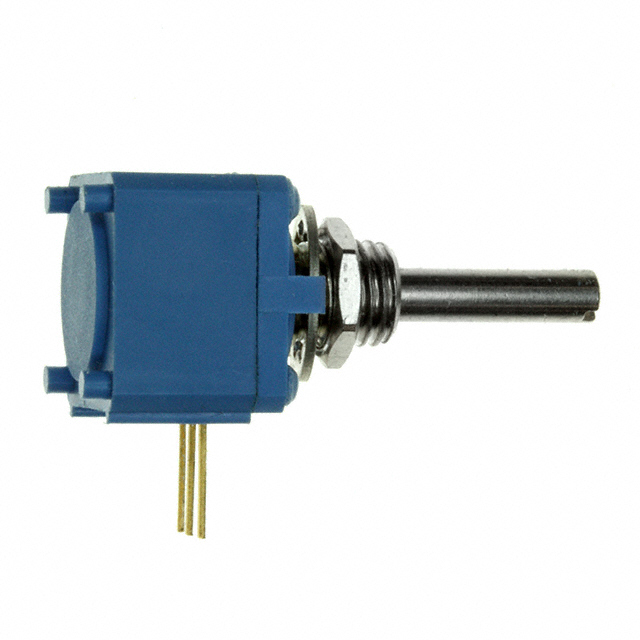
The Honeywell 309NPC2500 is a 2.5k Ohm 1 Watt linear panel mount potentiometer with cermet resistive material, single-turn operation, and PC pin termination. This component is classified as obsolete product status. Identifying equivalent and substitute parts is necessary to maintain design continuity, ensure supply chain availability, and support ongoing production or maintenance requirements for systems utilizing this potentiometer specification.
Substiute Parts
Key Parameters
| Parameter | Value |
|---|---|
| Resistance | 2.5k Ohm |
| Power Rating | 1W |
| Taper | Linear |
| Number of Turns | 1 |
| Number of Gangs | 1 |
| Resistive Material | Cermet |
| Termination Style | PC Pins |
| Mounting Type | Panel Mount |
| Bushing Thread | 1/4-32 |
| Rotation | 295° |
| Adjustment Type | Side Adjustment |
| RoHS Status | RoHS Compliant |
Substitute Part Grouping Explanation
Substitution eligibility for the 309NPC2500 is determined by the following critical parameters:
Mandatory Matching Parameters:
- Resistance value: 2.5k Ohm
- Taper characteristic: Linear
- Number of turns: 1
- Number of gangs: 1
- Mounting type: Panel Mount
- Bushing thread: 1/4-32
- Termination style: PC Pins
Allowable Variation Parameters:
- Power rating: Substitute must equal or exceed 1W
- Resistive material: Cermet or equivalent material with comparable performance characteristics
- Rotation angle: Acceptable range 290° to 310°
- Tolerance: Acceptable range ±10% to ±20%
- RoHS compliance: Must maintain RoHS compliance status
The CTS Electrocomponents 270X232A252B1A1 meets the mandatory matching parameters for resistance, taper, turns, gangs, mounting type, bushing thread, and termination style. However, this substitute exhibits a reduced power rating (0.25W versus 1W) and uses carbon resistive material instead of cermet, which represents a functional limitation in applications requiring full 1W power dissipation.
Parameter Comparison
| Parameter | Honeywell 309NPC2500 | CTS 270X232A252B1A1 | Compatibility Status |
|---|---|---|---|
| Resistance (Ohms) | 2.5k | 2.5k | Match |
| Power Rating (Watts) | 1W | 0.25W | Substitute Reduced |
| Taper | Linear | Linear | Match |
| Number of Turns | 1 | 1 | Match |
| Number of Gangs | 1 | 1 | Match |
| Resistive Material | Cermet | Carbon | Different Material |
| Termination Style | PC Pins | PC Pins, Board Locks | Compatible |
| Mounting Type | Panel Mount | Panel Mount | Match |
| Bushing Thread | 1/4-32 | 1/4-32 | Match |
| Rotation | 295° | 300° | Within Tolerance |
| Tolerance | ±10% | ±20% | Substitute Wider |
| Adjustment Type | Side Adjustment | Side Adjustment | Match |
| RoHS Status | RoHS Compliant | ROHS3 Compliant | Both Compliant |
Engineering Selection Recommendations
Primary Consideration: Power Rating Limitation
The CTS 270X232A252B1A1 substitute operates at 0.25W maximum power dissipation, compared to the original 309NPC2500 specification of 1W. This represents a 75% reduction in power handling capacity. Selection of this substitute is appropriate only for applications where actual power dissipation remains below 0.25W under all operating conditions.
Material Composition Difference
The original 309NPC2500 employs cermet resistive material, while the CTS substitute uses carbon composition. Cermet potentiometers typically exhibit superior temperature stability, longer operational life, and lower noise characteristics compared to carbon-based designs. Applications requiring extended temperature range operation or low-noise signal conditioning may experience performance degradation with the carbon substitute.
Tolerance Specification
The substitute part carries ±20% tolerance versus the original ±10% tolerance. Applications requiring tighter resistance accuracy should account for this wider tolerance band in circuit design calculations.
Compliance and Availability
Both parts maintain RoHS compliance status. The CTS 270X232A252B1A1 is listed as active product status with 1433 units in stock, providing superior supply chain availability compared to the obsolete 309NPC2500 (852 units remaining inventory).
Substitution Feasibility
Direct substitution is mechanically and electrically feasible for low-power applications (under 0.25W dissipation) where tolerance and material differences are acceptable. For applications requiring full 1W power rating or cermet performance characteristics, alternative potentiometer sources should be evaluated.
Frequently Asked Questions (FAQ)
Q: Can the CTS 270X232A252B1A1 directly replace the Honeywell 309NPC2500 in all applications?
A: No. The CTS substitute is limited to applications where power dissipation remains below 0.25W. The original 309NPC2500 is rated for 1W dissipation. Exceeding 0.25W with the substitute will cause component failure.
Q: What is the significance of the resistive material difference between cermet and carbon?
A: Cermet potentiometers provide superior temperature stability, lower noise output, and extended operational life compared to carbon-composition designs. Applications involving precision signal conditioning or wide temperature ranges may experience performance degradation with the carbon substitute.
Q: Are the mechanical mounting interfaces identical?
A: Yes. Both potentiometers share identical panel mount configuration, 1/4-32 bushing thread, and PC pin termination. The CTS substitute includes additional board lock features, which provide enhanced mechanical retention but do not prevent installation in existing mounting holes.
Q: How do the tolerance specifications affect circuit design?
A: The 309NPC2500 carries ±10% tolerance, while the CTS 270X232A252B1A1 carries ±20% tolerance. Circuits designed with tight tolerance requirements should account for the wider ±20% band when using the substitute. Resistor networks or calibration adjustments may be necessary to maintain system accuracy.
Q: What is the rotation angle difference between these potentiometers?
A: The 309NPC2500 provides 295° rotation, while the CTS substitute provides 300° rotation. This 5° difference is negligible for most applications and falls within acceptable mechanical variation for panel mount potentiometers.
Q: Are both parts RoHS compliant?
A: Yes. The Honeywell 309NPC2500 is RoHS Compliant, and the CTS 270X232A252B1A1 is ROHS3 Compliant. Both meet current environmental compliance requirements.
Q: What should be evaluated before selecting the CTS substitute?
A: Verify that actual circuit power dissipation across the potentiometer remains below 0.25W under all operating conditions, including worst-case scenarios. Confirm that ±20% tolerance is acceptable for the application. Assess whether carbon resistive material characteristics are suitable for the intended use case.
Alternative Parts

SJ6012L2TP
Littelfuse Inc.
6 Alternative Parts

JMK107BBJ476MA-RE
Taiyo Yuden
10 Alternative Parts

GMK107BBJ475MA-T
Taiyo Yuden
5 Alternative Parts
SJ6020N2ARP
Littelfuse Inc.
3 Alternative Parts
SJ6025R2ATP
Littelfuse Inc.
4 Alternative Parts

2474-05L
API Delevan Inc.
1 Alternative Parts

4590R-684K
API Delevan Inc.
1 Alternative Parts

CM6560R-334
API Delevan Inc.
1 Alternative Parts

CM6460-104
API Delevan Inc.
1 Alternative Parts

5526-12
API Delevan Inc.
1 Alternative Parts