




Request Quote
(Ships tomorrow)
2SC5200RTU Equivalent & Substitute Parts
Part Overview
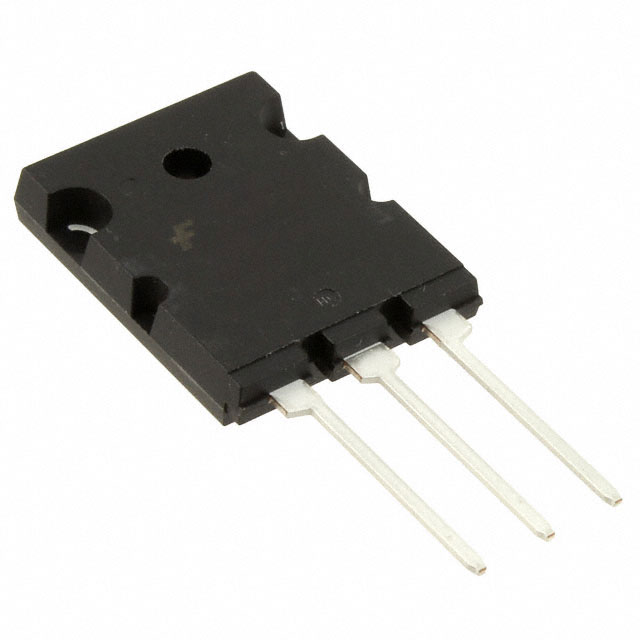
The 2SC5200RTU is an NPN bipolar junction transistor manufactured by onsemi, rated for 250 V collector-emitter breakdown voltage and 17 A maximum collector current. This device is designed for high-power switching and amplification applications in through-hole TO-264-3 packaging. The 2SC5200RTU is classified as obsolete, making identification of equivalent and substitute parts essential for ongoing system support, design updates, and procurement continuity.
Substiute Parts
Key Parameters
| Parameter | Value | Unit |
|---|---|---|
| Transistor Type | NPN | — |
| Voltage - Collector Emitter Breakdown (Max) | 250 | V |
| Current - Collector (Ic) (Max) | 17 | A |
| Power - Max | 150 | W |
| Frequency - Transition | 30 | MHz |
| Vce Saturation (Max) @ Ib, Ic | 3V @ 800mA, 8A | — |
| DC Current Gain (hFE) (Min) @ Ic, Vce | 55 @ 1A, 5V | — |
| Operating Temperature Range | -50 to 150 | °C |
| Mounting Type | Through Hole | — |
| Package / Case | TO-264-3, TO-264AA | — |
Substitute Part Grouping Explanation
Substitution of the 2SC5200RTU is determined by electrical and mechanical compatibility across the following critical parameters:
Electrical Compatibility Criteria:
- Transistor type must be NPN
- Collector-emitter breakdown voltage must be greater than or equal to 250 V
- Maximum collector current must be greater than or equal to 17 A
- Maximum power dissipation must be greater than or equal to 150 W
- Transition frequency must be 30 MHz or higher
- Vce saturation characteristics must support the same operating conditions
- DC current gain must support the intended application bias point
Mechanical Compatibility Criteria:
- Mounting type must be through-hole
- Package must be compatible with TO-264-3, TO-264AA, or equivalent footprints
Compliance Considerations:
- Product status (active vs. obsolete) affects long-term availability
- RoHS and REACH compliance status determines regulatory suitability for new designs
Parameter Comparison
| Parameter | 2SC5200RTU | FJL4315OTU | MJL3281AG | 2SC5200-O(Q) |
|---|---|---|---|---|
| Manufacturer | onsemi | Fairchild Semiconductor | onsemi | Toshiba Semiconductor and Storage |
| Product Status | Obsolete | Active | Active | Active |
| Transistor Type | NPN | NPN | NPN | NPN |
| Voltage - Collector Emitter Breakdown (Max) | 250 V | 250 V | 260 V | 230 V |
| Current - Collector (Ic) (Max) | 17 A | 17 A | 15 A | 15 A |
| Power - Max | 150 W | 150 W | 200 W | 150 W |
| Frequency - Transition | 30 MHz | 30 MHz | 30 MHz | 30 MHz |
| Vce Saturation (Max) @ Ib, Ic | 3V @ 800mA, 8A | 3V @ 800mA, 8A | 3V @ 1A, 10A | 3V @ 800mA, 8A |
| DC Current Gain (hFE) (Min) @ Ic, Vce | 55 @ 1A, 5V | 80 @ 1A, 5V | 75 @ 5A, 5V | 80 @ 1A, 5V |
| Operating Temperature Range | -50 to 150°C | -50 to 150°C | -65 to 150°C | 150°C (TJ) |
| Mounting Type | Through Hole | Through Hole | Through Hole | Through Hole |
| Package / Case | TO-264-3, TO-264AA | HPM F2 | TO-264 | TO-3PL |
| RoHS Status | Not specified | ROHS3 Compliant | ROHS3 Compliant | ROHS3 Compliant |
| REACH Status | REACH Unaffected | REACH Unaffected | REACH Unaffected | REACH Unaffected |
Engineering Selection Recommendations
FJL4315OTU (Fairchild Semiconductor)
The FJL4315OTU is a direct electrical equivalent to the 2SC5200RTU, matching all critical electrical parameters: 250 V breakdown voltage, 17 A maximum collector current, 150 W power dissipation, and 30 MHz transition frequency. The FJL4315OTU is classified as active product status, ensuring ongoing availability and supply chain stability. This device is ROHS3 compliant, meeting modern regulatory requirements for new designs. The HPM F2 package is mechanically compatible with TO-264-3 footprints. The FJL4315OTU exhibits higher DC current gain (80 @ 1A, 5V versus 55 @ 1A, 5V), which may reduce base drive requirements in switching applications.
MJL3281AG (onsemi)
The MJL3281AG is an active-status substitute with enhanced electrical performance characteristics. It provides higher breakdown voltage (260 V versus 250 V) and greater power dissipation capability (200 W versus 150 W). Maximum collector current is rated at 15 A, which is 2 A lower than the 2SC5200RTU. The MJL3281AG is ROHS3 compliant and features an extended operating temperature range (-65 to 150°C versus -50 to 150°C). The TO-264 package is mechanically compatible with the original TO-264-3 footprint. This device is suitable for applications requiring higher voltage or power margins.
2SC5200-O(Q) (Toshiba Semiconductor and Storage)
The 2SC5200-O(Q) is an active-status variant of the same base product family (2SC5200). It is ROHS3 compliant and shares the same 30 MHz transition frequency and 150 W power rating. The collector-emitter breakdown voltage is rated at 230 V, which is 20 V lower than the original 2SC5200RTU. Maximum collector current is 15 A, 2 A lower than the original specification. The TO-3PL package differs from the original TO-264-3, requiring PCB layout and mechanical mounting modifications. DC current gain is higher (80 @ 1A, 5V), reducing base drive requirements. This device is suitable for applications with lower voltage requirements and where package form factor changes are acceptable.
Frequently Asked Questions (FAQ)
Q: Can the FJL4315OTU directly replace the 2SC5200RTU without circuit modifications?
A: The FJL4315OTU matches all electrical specifications of the 2SC5200RTU and is electrically interchangeable. The HPM F2 package is mechanically compatible with TO-264-3 footprints. No circuit modifications are required for electrical operation. Physical mounting verification is necessary to confirm PCB pad compatibility.
Q: Why is the MJL3281AG rated for only 15 A when the 2SC5200RTU is rated for 17 A?
A: The MJL3281AG is designed with different electrical characteristics, including higher breakdown voltage (260 V) and greater power dissipation (200 W). The 15 A rating reflects the device's optimized performance envelope. Applications requiring exactly 17 A collector current should use the FJL4315OTU or 2SC5200-O(Q).
Q: What are the package differences between these substitute parts?
A: The 2SC5200RTU uses TO-264-3 packaging. The FJL4315OTU uses HPM F2 packaging, which is footprint-compatible with TO-264-3. The MJL3281AG uses TO-264 packaging, also compatible with TO-264-3 footprints. The 2SC5200-O(Q) uses TO-3PL packaging, which has a different footprint and requires PCB layout changes.
Q: Are all substitute parts RoHS compliant?
A: The FJL4315OTU, MJL3281AG, and 2SC5200-O(Q) are all ROHS3 compliant. The original 2SC5200RTU does not specify RoHS status. All four devices are REACH unaffected.
Q: Which substitute part has the best long-term availability?
A: All three substitute parts are classified as active product status. The FJL4315OTU and MJL3281AG are from major manufacturers with extensive distribution networks. The 2SC5200-O(Q) is from Toshiba, also a major manufacturer. Active status indicates ongoing production and supply chain support compared to the obsolete 2SC5200RTU.
Q: Can I use the 2SC5200-O(Q) in a circuit designed for 250 V operation?
A: The 2SC5200-O(Q) has a maximum breakdown voltage of 230 V, which is 20 V lower than the 2SC5200RTU. Using this device in a circuit designed for 250 V operation introduces voltage margin reduction. Circuit analysis is necessary to determine if 230 V breakdown voltage is acceptable for the specific application.
Q: What is the difference in DC current gain between these devices?
A: The 2SC5200RTU has minimum DC current gain of 55 @ 1A, 5V. The FJL4315OTU and 2SC5200-O(Q) both have minimum DC current gain of 80 @ 1A, 5V. The MJL3281AG has minimum DC current gain of 75 @ 5A, 5V. Higher current gain reduces base drive requirements in switching circuits.
Q: Is the MJL3281AG suitable for applications requiring 17 A collector current?
A: The MJL3281AG is rated for maximum 15 A collector current. Applications requiring 17 A operation should use the FJL4315OTU, which matches the original 17 A specification. Using the MJL3281AG at 17 A exceeds its rated maximum and is not recommended.
Alternative Parts

SJ6012L2TP
Littelfuse Inc.
6 Alternative Parts

JMK107BBJ476MA-RE
Taiyo Yuden
10 Alternative Parts

GMK107BBJ475MA-T
Taiyo Yuden
5 Alternative Parts
SJ6020N2ARP
Littelfuse Inc.
3 Alternative Parts
SJ6025R2ATP
Littelfuse Inc.
4 Alternative Parts

2474-05L
API Delevan Inc.
1 Alternative Parts

4590R-684K
API Delevan Inc.
1 Alternative Parts

CM6560R-334
API Delevan Inc.
1 Alternative Parts

CM6460-104
API Delevan Inc.
1 Alternative Parts

5526-12
API Delevan Inc.
1 Alternative Parts