


Request Quote
(Ships tomorrow)
Equivalent & Substitute Parts for 2SC4691J0L
Part Overview
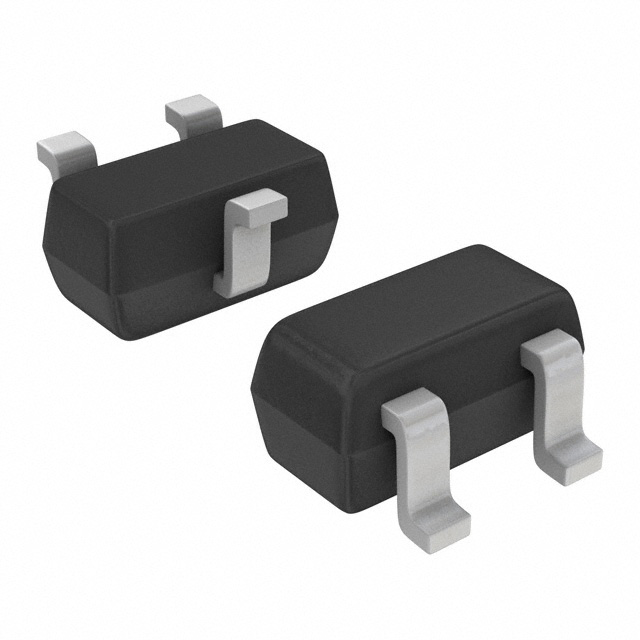
The 2SC4691J0L is an NPN bipolar junction transistor manufactured by Panasonic Electronic Components, designed for general-purpose switching and amplification applications. This device features a maximum collector current of 100 mA, collector-emitter breakdown voltage of 40 V, and a transition frequency of 450 MHz in a surface mount SSMini3-F1 package. The product status is obsolete, necessitating identification of functionally equivalent alternatives for ongoing design requirements and component procurement.
Substiute Parts
Key Parameters
| Parameter | Value | Unit |
|---|---|---|
| Transistor Type | NPN | — |
| Current - Collector (Ic) (Max) | 100 | mA |
| Voltage - Collector Emitter Breakdown (Max) | 40 | V |
| Vce Saturation (Max) | 250 mV @ 1 mA, 10 mA | — |
| DC Current Gain (hFE) (Min) | 60 @ 10 mA, 1 V | — |
| Power - Max | 125 | mW |
| Frequency - Transition | 450 | MHz |
| Operating Temperature (TJ) | 125 | °C |
| Mounting Type | Surface Mount | — |
| Package / Case | SC-89, SOT-490 | — |
| Moisture Sensitivity Level (MSL) | 1 (Unlimited) | — |
| Product Status | Obsolete | — |
Substitute Part Grouping Explanation
Substitution of the 2SC4691J0L is determined by electrical and mechanical compatibility across the following critical parameters:
Electrical Compatibility Criteria:
- Transistor type must be NPN
- Collector-emitter breakdown voltage must be equal to or greater than 40 V
- Maximum collector current must be equal to or greater than 100 mA
- DC current gain (hFE) must support the intended bias conditions
- Transition frequency must be sufficient for the application bandwidth
Mechanical Compatibility Criteria:
- Surface mount mounting type
- Package footprint compatibility or acceptable PCB redesign tolerance
Compliance Criteria:
- Product status should be active or current production for long-term availability
- Moisture sensitivity level of 1 (Unlimited) or equivalent
The MMBT3904TT1G from onsemi meets these substitution criteria with electrical parameters that exceed the minimum requirements of the 2SC4691J0L, providing enhanced performance margins in collector current capacity, power dissipation, and DC current gain.
Parameter Comparison
| Parameter | 2SC4691J0L (Panasonic) | MMBT3904TT1G (onsemi) | Compatibility |
|---|---|---|---|
| Transistor Type | NPN | NPN | Match |
| Current - Collector (Ic) (Max) | 100 mA | 200 mA | Substitute exceeds requirement |
| Voltage - Collector Emitter Breakdown (Max) | 40 V | 40 V | Match |
| Vce Saturation (Max) | 250 mV @ 1 mA, 10 mA | 300 mV @ 5 mA, 50 mA | Comparable |
| DC Current Gain (hFE) (Min) | 60 @ 10 mA, 1 V | 100 @ 10 mA, 1 V | Substitute exceeds requirement |
| Power - Max | 125 mW | 300 mW | Substitute exceeds requirement |
| Frequency - Transition | 450 MHz | 300 MHz | Substitute lower; acceptable for most applications |
| Operating Temperature (TJ) | 125 °C | −55 °C to 150 °C | Substitute provides wider range |
| Mounting Type | Surface Mount | Surface Mount | Match |
| Package / Case | SC-89, SOT-490 | SC-75, SOT-416 | Different package; PCB layout modification required |
| Moisture Sensitivity Level (MSL) | 1 (Unlimited) | 1 (Unlimited) | Match |
| Product Status | Obsolete | Active | Substitute is current production |
Engineering Selection Recommendations
The MMBT3904TT1G is a suitable substitute for the obsolete 2SC4691J0L based on the following engineering factors:
Electrical Performance: The substitute device provides superior electrical specifications across all critical parameters. The maximum collector current of 200 mA exceeds the original 100 mA requirement, offering increased design margin. The DC current gain of 100 at 10 mA, 1 V exceeds the original specification of 60, enabling more efficient bias circuit design. The maximum power dissipation of 300 mW provides enhanced thermal headroom compared to the original 125 mW rating.
Voltage Rating: Both devices share an identical 40 V collector-emitter breakdown voltage, ensuring direct electrical compatibility in voltage-constrained applications.
Frequency Response: The substitute device operates at 300 MHz transition frequency, which is lower than the original 450 MHz. This characteristic is acceptable for applications where the original 450 MHz specification was not a critical design requirement. For bandwidth-limited applications, this parameter must be evaluated against specific circuit requirements.
Product Status and Availability: The MMBT3904TT1G is in active production status with onsemi, ensuring long-term component availability and supply chain stability. The original 2SC4691J0L is obsolete, making substitution necessary for new designs and ongoing production.
Compliance: Both devices carry MSL 1 (Unlimited) moisture sensitivity classification and are subject to the same tariff codes (HTSUS 8541.21.0075). The substitute is RoHS3 compliant and REACH unaffected, meeting current regulatory requirements.
Package Consideration: The substitute uses SC-75 (SOT-416) packaging, which differs from the original SC-89 (SOT-490) package. PCB layout modification is required to accommodate the different footprint. Pin configuration compatibility must be verified against the specific application circuit.
Frequently Asked Questions (FAQ)
Q: Can the MMBT3904TT1G directly replace the 2SC4691J0L without circuit modification?
A: Electrical substitution is direct based on NPN type, voltage rating, and current capacity. However, the different package footprint (SC-75 versus SC-89) requires PCB layout modification. Pin-to-pin functionality is compatible for standard NPN transistor applications.
Q: What is the significance of the lower transition frequency (300 MHz vs. 450 MHz) in the substitute?
A: The transition frequency determines the maximum useful operating frequency for the transistor. The substitute's 300 MHz specification is lower than the original 450 MHz. For applications operating below 300 MHz, this difference is not significant. For high-frequency applications requiring operation above 300 MHz, the substitute may not be suitable without circuit redesign.
Q: Why does the substitute have higher maximum collector current (200 mA vs. 100 mA)?
A: The MMBT3904TT1G is designed for a broader range of applications and provides greater current-handling capability. This higher rating does not affect substitution compatibility; it simply provides additional design margin. The circuit will operate within the original 100 mA specification range without modification.
Q: Is the higher DC current gain (100 vs. 60) of the substitute a concern?
A: No. Higher DC current gain is beneficial for bias circuit design, allowing lower base current requirements for the same collector current. This characteristic improves circuit efficiency and does not create compatibility issues.
Q: What does the wider operating temperature range (−55 °C to 150 °C vs. 125 °C) mean for substitution?
A: The substitute supports a wider temperature range, providing greater flexibility for applications operating in extreme thermal environments. This is an enhancement over the original specification and does not create compatibility issues.
Q: Are there any compliance or regulatory differences between the two devices?
A: The substitute (MMBT3904TT1G) is RoHS3 compliant and REACH unaffected, meeting current regulatory standards. Both devices share the same ECCN (EAR99) classification. The substitute's active production status ensures compliance with current manufacturing standards.
Q: What packaging considerations should be addressed when substituting?
A: The original 2SC4691J0L uses SC-89 (SOT-490) packaging, while the MMBT3904TT1G uses SC-75 (SOT-416) packaging. These packages have different physical dimensions and footprints. PCB redesign is required to accommodate the new package. Verify pin assignments and orientation before layout modification.
Q: Is the substitute suitable for all applications using the original part?
A: The substitute is suitable for most general-purpose NPN switching and amplification applications operating below 300 MHz. Applications with specific high-frequency requirements above 300 MHz or unique thermal constraints may require alternative evaluation. Verify transition frequency and operating temperature requirements against your specific application.
Alternative Parts

SJ6012L2TP
Littelfuse Inc.
6 Alternative Parts

JMK107BBJ476MA-RE
Taiyo Yuden
10 Alternative Parts

GMK107BBJ475MA-T
Taiyo Yuden
5 Alternative Parts
SJ6020N2ARP
Littelfuse Inc.
3 Alternative Parts
SJ6025R2ATP
Littelfuse Inc.
4 Alternative Parts

2474-05L
API Delevan Inc.
1 Alternative Parts

4590R-684K
API Delevan Inc.
1 Alternative Parts

CM6560R-334
API Delevan Inc.
1 Alternative Parts

CM6460-104
API Delevan Inc.
1 Alternative Parts

5526-12
API Delevan Inc.
1 Alternative Parts