




Request Quote
(Ships tomorrow)
2SA2127-AE Equivalent & Substitute Parts
Part Overview
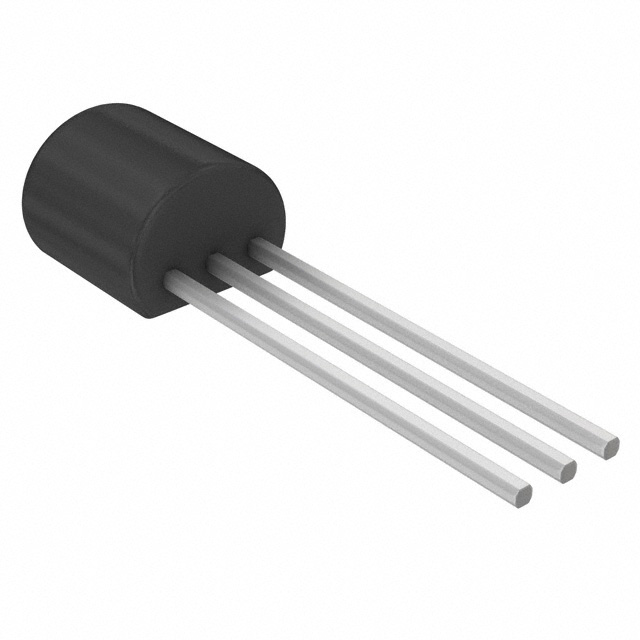
The 2SA2127-AE is a PNP bipolar junction transistor manufactured by onsemi, rated for 50 V collector-emitter breakdown voltage and 2 A maximum collector current. This component is designed for through-hole mounting in TO-226-3 and TO-92-3 long body packages. The part is classified as obsolete, making equivalent and substitute parts necessary for ongoing design support, maintenance, and production continuity.
Substiute Parts
Key Parameters
| Parameter | Value | Unit |
|---|---|---|
| Transistor Type | PNP | — |
| Current - Collector (Ic) (Max) | 2 | A |
| Voltage - Collector Emitter Breakdown (Max) | 50 | V |
| Power - Max | 1 | W |
| Frequency - Transition | 420 | MHz |
| Operating Temperature (TJ) | 150 | °C |
| Mounting Type | Through Hole | — |
| Package / Case | TO-226-3, TO-92-3 Long Body | — |
Substitute Part Grouping Explanation
Substitution of the 2SA2127-AE is determined by the following critical parameters:
Primary Substitution Criteria:
- Transistor type must be PNP
- Collector-emitter breakdown voltage must be greater than or equal to 50 V
- Maximum collector current must be greater than or equal to 2 A
- Maximum power dissipation must be greater than or equal to 1 W
- Operating temperature range must support 150°C (TJ)
- Mounting type must be through-hole compatible
Secondary Compatibility Factors:
- DC current gain (hFE) characteristics
- Vce saturation voltage
- Transition frequency
- Package form factor compatibility
The 2SA2126-H and MPS751 satisfy the primary substitution criteria and are therefore classified as equivalent parts for the 2SA2127-AE.
Parameter Comparison
| Parameter | 2SA2127-AE | 2SA2126-H | MPS751 | Unit |
|---|---|---|---|---|
| Transistor Type | PNP | PNP | PNP | — |
| Current - Collector (Ic) (Max) | 2 | 3 | 2 | A |
| Voltage - Collector Emitter Breakdown (Max) | 50 | 50 | 60 | V |
| Vce Saturation (Max) @ Ib, Ic | 400mV @ 50mA, 1A | 520mV @ 100mA, 2A | 500mV @ 200mA, 2A | V |
| Current - Collector Cutoff (Max) | 1µA (ICBO) | 1µA (ICBO) | 100nA (ICBO) | A |
| DC Current Gain (hFE) (Min) @ Ic, Vce | 200 @ 100mA, 2V | 200 @ 100mA, 2V | 75 @ 1A, 2V | — |
| Power - Max | 1 | 0.8 | 0.625 | W |
| Frequency - Transition | 420 | 390 | 75 | MHz |
| Operating Temperature (TJ) | 150 | 150 | 150 | °C |
| Mounting Type | Through Hole | Through Hole | Through Hole | — |
| Package / Case | TO-226-3, TO-92-3 Long Body | TO-251-3 Short Leads, IPak, TO-251AA | TO-226-3, TO-92-3 | — |
| Product Status | Obsolete | Obsolete | Active | — |
Engineering Selection Recommendations
2SA2126-H Substitution: The 2SA2126-H is an obsolete onsemi PNP transistor that meets all primary substitution criteria. It provides higher maximum collector current (3 A versus 2 A) and maintains identical DC current gain characteristics (200 @ 100mA, 2V). However, the 2SA2126-H features a different package form factor (TO-251-3 short leads versus TO-92-3 long body), which may require PCB layout modifications. Power dissipation is lower at 800 mW compared to 1 W. Transition frequency is slightly lower at 390 MHz versus 420 MHz. This part is suitable for applications where package compatibility can be accommodated.
MPS751 Substitution: The MPS751 is an active-status Fairchild Semiconductor PNP transistor that satisfies all primary substitution criteria. It maintains the same maximum collector current (2 A) and supports the same operating temperature (150°C). The MPS751 offers higher collector-emitter breakdown voltage (60 V versus 50 V), providing additional voltage margin. Package compatibility is direct with TO-92-3 form factor. However, the MPS751 exhibits lower DC current gain (75 @ 1A, 2V versus 200 @ 100mA, 2V) and significantly lower transition frequency (75 MHz versus 420 MHz). Power dissipation is lower at 625 mW. The active product status of the MPS751 provides long-term availability assurance.
Compliance and Certification: The 2SA2127-AE carries REACH Unaffected status and EAR99 export classification. The MPS751 maintains identical export classification (EAR99). The 2SA2126-H is ROHS3 compliant, whereas the 2SA2127-AE does not specify RoHS compliance. All three parts are suitable for applications requiring EAR99 classification.
Frequently Asked Questions (FAQ)
Q: Can the 2SA2126-H directly replace the 2SA2127-AE in existing PCB designs?
A: The 2SA2126-H is electrically compatible as a PNP transistor with equivalent voltage and current ratings. However, the package form factor differs (TO-251-3 short leads versus TO-92-3 long body), requiring PCB layout verification and potential rework of through-hole mounting positions.
Q: What is the primary advantage of selecting the MPS751 over the 2SA2126-H?
A: The MPS751 is an active-status product with confirmed long-term availability, whereas both the 2SA2127-AE and 2SA2126-H are classified as obsolete. The MPS751 also provides higher collector-emitter breakdown voltage (60 V) and direct TO-92-3 package compatibility with the original 2SA2127-AE.
Q: Are there frequency-dependent applications where the MPS751 is unsuitable?
A: Yes. The MPS751 transition frequency is 75 MHz, significantly lower than the 2SA2127-AE (420 MHz) and 2SA2126-H (390 MHz). Applications requiring high-frequency switching or RF performance should retain the 2SA2127-AE or use the 2SA2126-H. The MPS751 is suitable for low-frequency switching and audio applications.
Q: What is the impact of lower DC current gain in the MPS751?
A: The MPS751 exhibits a minimum DC current gain of 75 @ 1A, 2V, compared to 200 @ 100mA, 2V for the 2SA2127-AE. This requires higher base current to achieve equivalent collector current levels. Circuit designs must account for increased base drive requirements when substituting with the MPS751.
Q: Can the 2SA2126-H be used in applications requiring 1 W power dissipation?
A: The 2SA2126-H is rated for 800 mW maximum power dissipation, which is below the 1 W specification of the 2SA2127-AE. Applications requiring sustained 1 W dissipation should not use the 2SA2126-H without thermal analysis confirming operation within safe limits.
Q: Are all three parts suitable for 150°C operating temperature applications?
A: Yes. The 2SA2127-AE, 2SA2126-H, and MPS751 all support maximum junction temperature (TJ) of 150°C, making them suitable for high-temperature environments within this specification.
Q: What packaging considerations apply when substituting these parts?
A: The 2SA2127-AE and MPS751 both use TO-92-3 package form factor, enabling direct physical substitution. The 2SA2126-H uses TO-251-3 short leads (IPak), requiring PCB redesign for mounting compatibility. Verify lead spacing and through-hole positioning before implementing the 2SA2126-H substitution.
Alternative Parts

SJ6012L2TP
Littelfuse Inc.
6 Alternative Parts

JMK107BBJ476MA-RE
Taiyo Yuden
10 Alternative Parts

GMK107BBJ475MA-T
Taiyo Yuden
5 Alternative Parts
SJ6020N2ARP
Littelfuse Inc.
3 Alternative Parts
SJ6025R2ATP
Littelfuse Inc.
4 Alternative Parts

2474-05L
API Delevan Inc.
1 Alternative Parts

4590R-684K
API Delevan Inc.
1 Alternative Parts

CM6560R-334
API Delevan Inc.
1 Alternative Parts

CM6460-104
API Delevan Inc.
1 Alternative Parts

5526-12
API Delevan Inc.
1 Alternative Parts