


Request Quote
(Ships tomorrow)
Equivalent & Substitute Parts Reference for 2SA1774TLR
Part Overview
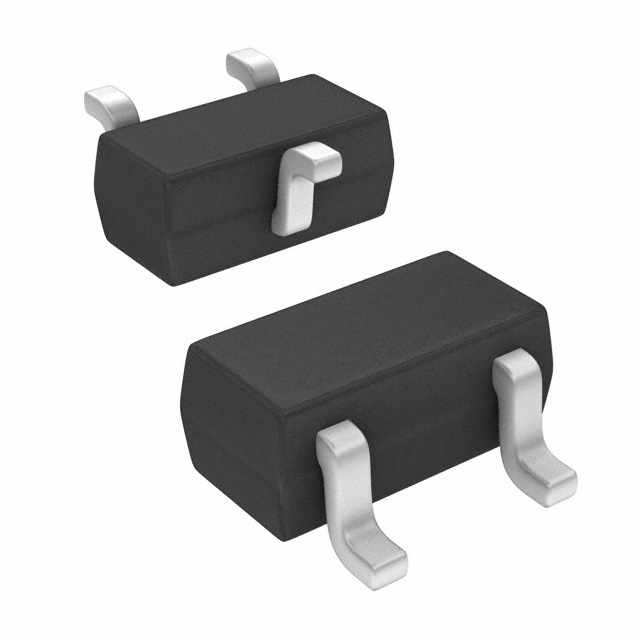
2SA1774TLR is a surface-mount PNP bipolar junction transistor (BJT) with a maximum collector-emitter voltage of 50 V and collector current of 150 mA. It features a transition frequency of 140 MHz and a maximum power dissipation of 150 mW in an EMT3 (SC-75, SOT-416) package. The product status is Active, with ROHS3 compliance and REACH unaffected status.
Alternative models are needed to ensure continued production, design flexibility, and supply chain redundancy. Substituting parts with equivalent key parameters maintains system functionality and compliance.
Substiute Parts
Key Parameters
| Parameter | 2SA1774TLR |
|---|---|
| Transistor Type | PNP |
| Voltage - Collector Emitter Breakdown (Max) | 50 V |
| Current - Collector (Ic) (Max) | 150 mA |
| DC Current Gain (hFE) (Min) | 180 @ 1mA, 6V |
| Power - Max | 150 mW |
| Frequency - Transition | 140 MHz |
| Current - Collector Cutoff (Max) | 100 nA (ICBO) |
| Vce Saturation (Max) @ Ib, Ic | 500 mV @ 5mA, 50mA |
| Package / Case | SC-75, SOT-416 |
| Supplier Device Package | EMT3 |
| Mounting Type | Surface Mount |
| Operating Temperature | 150°C (TJ) |
| RoHS Status | ROHS3 Compliant |
| Moisture Sensitivity Level (MSL) | 1 (Unlimited) |
| Product Status | Active |
Substitute Part Grouping Explanation
Substitution is determined by matching the following key parameters within the Bipolar (BJT) Transistor category: transistor type (PNP), collector-emitter breakdown voltage, maximum collector current, DC current gain, maximum power dissipation, transition frequency, collector cutoff current, Vce saturation, package/case, supplier device package, mounting type, operating temperature, RoHS status, moisture sensitivity level, and product status.
All listed alternatives must meet or exceed these electrical and mechanical parameters as specified for compatibility.
Parameter Comparison
| Parameter | 2SA1774TLR (Main) | 2SA1832-Y,LF (Substitute) |
|---|---|---|
| Transistor Type | PNP | PNP |
| Voltage - Collector Emitter Breakdown (Max) | 50 V | 50 V |
| Current - Collector (Ic) (Max) | 150 mA | 150 mA |
| DC Current Gain (hFE) (Min) | 180 @ 1mA, 6V | 120 @ 2mA, 6V |
| Power - Max | 150 mW | 100 mW |
| Frequency - Transition | 140 MHz | 80 MHz |
| Current - Collector Cutoff (Max) | 100 nA (ICBO) | 100 nA (ICBO) |
| Vce Saturation (Max) @ Ib, Ic | 500 mV @ 5mA, 50mA | 300 mV @ 10mA, 100mA |
| Package / Case | SC-75, SOT-416 | SC-75, SOT-416 |
| Supplier Device Package | EMT3 | SSM |
| Mounting Type | Surface Mount | Surface Mount |
| Operating Temperature | 150°C (TJ) | 125°C (TJ) |
| RoHS Status | ROHS3 Compliant | ROHS3 Compliant |
| Moisture Sensitivity Level (MSL) | 1 (Unlimited) | 1 (Unlimited) |
| Product Status | Active | Active |
Engineering Selection Recommendations
Both 2SA1774TLR and 2SA1832-Y,LF are Active and ROHS3 Compliant. Moisture Sensitivity Level is 1 (Unlimited) for all options. These factors allow direct substitution from a compliance and inventory control standpoint. Certifications, compliance status, and product activity meet the requirements for selection.
Frequently Asked Questions (FAQ)
Q1: What are the key criteria for substituting 2SA1774TLR in Bipolar (BJT) applications?
A1: Substitute selection is based on transistor type (PNP), voltage and current ratings, DC current gain, power dissipation, transition frequency, cutoff current, Vce saturation, package/case, mounting type, operating temperature, RoHS status, MSL, and product status.
Q2: Does the package or supplier device package affect substitution?
A2: Package compatibility (SC-75, SOT-416) and surface-mount configuration are required for direct substitution. Supplier device package variations (EMT3 vs SSM) fall within the specified input parameters.
Q3: Are compliance and RoHS status mandatory for substitution?
A3: ROHS3 Compliant status and Moisture Sensitivity Level 1 (Unlimited) are required for selection based on provided input criteria.
Q4: Is the electrical performance between substitutes identical?
A4: Substitutes meet or exceed required parameters. Electrical performance may differ within the specified limits defined by the input parameters.
Q5: Is operating temperature range a consideration for substitution?
A5: The substitute must match or exceed the operating temperature specification provided in the input. 2SA1832-Y,LF provides a maximum TJ of 125°C, while 2SA1774TLR provides 150°C. Both values are explicitly listed in the table for engineering evaluation.
Alternative Parts

SJ6012L2TP
Littelfuse Inc.
6 Alternative Parts

JMK107BBJ476MA-RE
Taiyo Yuden
10 Alternative Parts

GMK107BBJ475MA-T
Taiyo Yuden
5 Alternative Parts
SJ6020N2ARP
Littelfuse Inc.
3 Alternative Parts
SJ6025R2ATP
Littelfuse Inc.
4 Alternative Parts

2474-05L
API Delevan Inc.
1 Alternative Parts

4590R-684K
API Delevan Inc.
1 Alternative Parts

CM6560R-334
API Delevan Inc.
1 Alternative Parts

CM6460-104
API Delevan Inc.
1 Alternative Parts

5526-12
API Delevan Inc.
1 Alternative Parts