



Request Quote
(Ships tomorrow)
Equivalent & Substitute Parts for 2N6428ABU
Part Overview
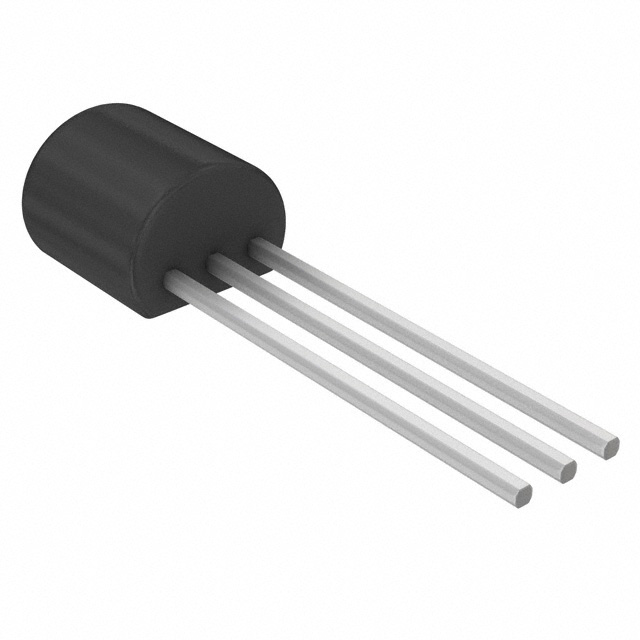
The 2N6428ABU is a through-hole NPN bipolar junction transistor manufactured by onsemi, rated for 50 V collector-emitter breakdown voltage and 200 mA maximum collector current. This device is classified as obsolete, which necessitates identification of active equivalent components for ongoing design support and procurement continuity. The 2N6428ABU operates at a transition frequency of 700 MHz with a maximum power dissipation of 625 mW in a TO-92-3 package configuration.
Substiute Parts
Key Parameters
| Parameter | Value | Unit |
|---|---|---|
| Transistor Type | NPN | — |
| Voltage - Collector Emitter Breakdown (Max) | 50 | V |
| Current - Collector (Ic) (Max) | 200 | mA |
| Vce Saturation (Max) @ Ib, Ic | 600 mV @ 5 mA, 100 mA | — |
| Current - Collector Cutoff (Max) | 25 | nA |
| DC Current Gain (hFE) (Min) @ Ic, Vce | 250 @ 100 µA, 5 V | — |
| Power - Max | 625 | mW |
| Frequency - Transition | 700 | MHz |
| Operating Temperature (TJ) | 150 | °C |
| Mounting Type | Through Hole | — |
| Package / Case | TO-92-3 (TO-226AA) | — |
Substitute Part Grouping Explanation
Substitution of the 2N6428ABU is determined by electrical and mechanical parameter alignment within the NPN bipolar junction transistor category. The critical parameters governing substitution eligibility are:
- Transistor Type: Must be NPN
- Voltage Rating: Collector-emitter breakdown voltage must equal or exceed 50 V
- Current Rating: Maximum collector current must equal or exceed 200 mA
- Saturation Voltage: Vce saturation characteristics must match or be superior at specified bias conditions
- Leakage Current: Collector cutoff current must not exceed 25 nA
- DC Current Gain: Minimum hFE must meet or exceed 250 at specified operating points
- Package: Must be compatible with TO-92-3 through-hole footprint
- Mounting Type: Must support through-hole installation
The 2N6428 PBFREE variant from Central Semiconductor Corp meets all electrical parameter requirements for direct substitution. This part maintains identical voltage and current ratings, matching saturation voltage specifications, and provides equivalent DC current gain performance. The through-hole TO-92-3 package ensures mechanical compatibility with existing PCB designs.
Parameter Comparison
| Parameter | 2N6428ABU (onsemi) | 2N6428 PBFREE (Central Semiconductor) | Unit |
|---|---|---|---|
| Transistor Type | NPN | NPN | — |
| Voltage - Collector Emitter Breakdown (Max) | 50 | 50 | V |
| Current - Collector (Ic) (Max) | 200 | 200 | mA |
| Vce Saturation (Max) @ Ib, Ic | 600 mV @ 5 mA, 100 mA | 600 mV @ 5 mA, 100 mA | — |
| Current - Collector Cutoff (Max) | 25 | 25 | nA |
| DC Current Gain (hFE) (Min) @ Ic, Vce | 250 @ 100 µA, 5 V | 250 @ 10 mA, 5 V | — |
| Power - Max | 625 | 1.5 | mW / W |
| Frequency - Transition | 700 | 100 | MHz |
| Operating Temperature (TJ) | 150 | −65 to 150 | °C |
| Mounting Type | Through Hole | Through Hole | — |
| Package / Case | TO-92-3 | TO-92-3 | — |
| Product Status | Obsolete | Active | — |
| RoHS Status | Not specified | ROHS3 Compliant | — |
Engineering Selection Recommendations
The 2N6428 PBFREE from Central Semiconductor Corp is the direct electrical equivalent for the obsolete 2N6428ABU. This substitute part satisfies all mandatory electrical parameters: identical voltage and current ratings, matching saturation voltage characteristics, equivalent DC current gain specifications, and compatible through-hole TO-92-3 packaging.
The 2N6428 PBFREE offers additional advantages for new designs and procurement:
- Active Product Status: Ensures long-term availability and supply chain continuity, eliminating obsolescence risk associated with the 2N6428ABU
- RoHS3 Compliance: Meets current environmental and regulatory requirements for electronic component manufacturing
- Enhanced Power Rating: The 1.5 W maximum power dissipation provides superior thermal performance compared to the 625 mW rating of the original part
- Extended Temperature Range: Operating range of −65°C to 150°C accommodates broader environmental conditions
- Lead-Free Construction: Eliminates lead content in accordance with modern manufacturing standards
The transition frequency difference (700 MHz versus 100 MHz) reflects the 2N6428 PBFREE's lower high-frequency performance. This characteristic is not a substitution barrier for applications operating below 100 MHz. For circuits requiring the full 700 MHz transition frequency capability of the original 2N6428ABU, frequency-dependent performance must be evaluated against specific application requirements.
Frequently Asked Questions (FAQ)
Q: Can the 2N6428 PBFREE directly replace the 2N6428ABU in existing designs?
A: Yes. The 2N6428 PBFREE meets all critical electrical specifications: 50 V breakdown voltage, 200 mA collector current, 600 mV saturation voltage at specified bias conditions, and 250 minimum DC current gain. The TO-92-3 package ensures mechanical and pin compatibility with existing PCB layouts.
Q: What is the significance of the transition frequency difference between these parts?
A: The 2N6428ABU operates at 700 MHz transition frequency, while the 2N6428 PBFREE operates at 100 MHz. For applications with signal frequencies below 100 MHz, this difference has no practical impact. Applications requiring operation above 100 MHz must evaluate whether the reduced transition frequency affects circuit performance.
Q: Why is the 2N6428ABU classified as obsolete?
A: The 2N6428ABU is an older component no longer in active production. The 2N6428 PBFREE represents the current active equivalent, incorporating lead-free manufacturing and RoHS3 compliance standards.
Q: Are there any compliance differences between these parts?
A: The 2N6428 PBFREE is RoHS3 compliant and lead-free. The 2N6428ABU compliance status is not specified in available documentation. Both parts carry REACH Unaffected status and EAR99 export classification.
Q: What is the packaging difference between TO-92 and TO-92-3?
A: Both designations refer to the same three-lead through-hole package configuration. TO-92-3 and TO-226-3 are equivalent package identifiers. The 2N6428 PBFREE is supplied in TO-92 format, which is mechanically and electrically identical to the TO-92-3 package of the original part.
Q: Can the 2N6428 PBFREE be used in high-frequency applications?
A: The 2N6428 PBFREE is suitable for applications with signal frequencies up to 100 MHz. Applications requiring higher frequency performance should evaluate alternative components with transition frequencies matching specific circuit requirements.
Q: What is the moisture sensitivity level for the 2N6428 PBFREE?
A: The 2N6428 PBFREE moisture sensitivity level is not applicable, indicating this component does not require special moisture control during storage or handling.
Alternative Parts

SJ6012L2TP
Littelfuse Inc.
6 Alternative Parts

JMK107BBJ476MA-RE
Taiyo Yuden
10 Alternative Parts

GMK107BBJ475MA-T
Taiyo Yuden
5 Alternative Parts
SJ6020N2ARP
Littelfuse Inc.
3 Alternative Parts
SJ6025R2ATP
Littelfuse Inc.
4 Alternative Parts

2474-05L
API Delevan Inc.
1 Alternative Parts

4590R-684K
API Delevan Inc.
1 Alternative Parts

CM6560R-334
API Delevan Inc.
1 Alternative Parts

CM6460-104
API Delevan Inc.
1 Alternative Parts

5526-12
API Delevan Inc.
1 Alternative Parts