


Request Quote
(Ships tomorrow)
2N5416 Equivalent & Substitute Parts
Part Overview
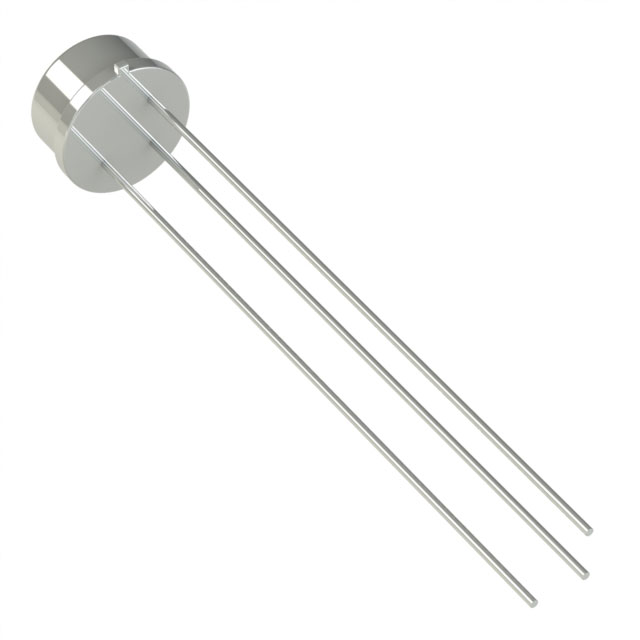
The 2N5416 is a PNP bipolar junction transistor (BJT) rated for 300 V collector-emitter breakdown voltage and 1 A maximum collector current. Manufactured by STMicroelectronics, this through-hole component is housed in a TO-39 metal can package and delivers 1 W maximum power dissipation with a 15 MHz transition frequency. The 2N5416 is classified as obsolete, making identification of functionally equivalent alternatives necessary for ongoing design support and production continuity. Substitute parts must maintain electrical compatibility across voltage, current, and power ratings while accommodating packaging and compliance requirements.
Substiute Parts
Key Parameters
| Parameter | Value | Unit |
|---|---|---|
| Transistor Type | PNP | — |
| Current - Collector (Ic) (Max) | 1 | A |
| Voltage - Collector Emitter Breakdown (Max) | 300 | V |
| Power - Max | 1 | W |
| Frequency - Transition | 15 | MHz |
| DC Current Gain (hFE) (Min) @ Ic, Vce | 30 @ 50mA, 10V | — |
| Mounting Type | Through Hole | — |
| Package / Case | TO-39 | — |
Substitute Part Grouping Explanation
Substitution of the 2N5416 is determined by strict equivalence across the following electrical and mechanical parameters:
Critical Matching Parameters:
- Transistor Type: PNP configuration
- Maximum Collector Current (Ic): 1 A minimum
- Maximum Collector-Emitter Breakdown Voltage (Vceo): 300 V minimum
- Maximum Power Dissipation: 1 W minimum
- DC Current Gain (hFE): 30 minimum at specified bias conditions
- Mounting Type: Through Hole
- Package Category: Metal Can (TO-39 or equivalent form factor)
The 2N5416 manufactured by Microchip Technology meets these criteria. Although packaged in a TO-5AA variant and rated at 750 mW maximum power (below the 1 W specification), the Microchip 2N5416 maintains all critical electrical parameters including 300 V breakdown voltage, 1 A collector current, and 30 minimum hFE. The reduced power rating represents a conservative design margin suitable for applications not requiring the full 1 W dissipation envelope.
Parameter Comparison
| Parameter | STMicroelectronics 2N5416 | Microchip Technology 2N5416 | Unit |
|---|---|---|---|
| Transistor Type | PNP | PNP | — |
| Current - Collector (Ic) (Max) | 1 | 1 | A |
| Voltage - Collector Emitter Breakdown (Max) | 300 | 300 | V |
| Vce Saturation (Max) @ Ib, Ic | 2.5V @ 5mA, 50mA | 2V @ 5mA, 50mA | V |
| Current - Collector Cutoff (Max) | 50µA | 1mA | A |
| DC Current Gain (hFE) (Min) @ Ic, Vce | 30 @ 50mA, 10V | 30 @ 50mA, 10V | — |
| Power - Max | 1 | 0.75 | W |
| Frequency - Transition | 15 | Not specified | MHz |
| Operating Temperature | Not specified | -65°C ~ 200°C (TJ) | — |
| Mounting Type | Through Hole | Through Hole | — |
| Package / Case | TO-39 | TO-5AA | — |
| Product Status | Obsolete | Active | — |
| RoHS Status | ROHS3 Compliant | RoHS non-compliant | — |
Engineering Selection Recommendations
Microchip Technology 2N5416 as Primary Substitute:
The Microchip 2N5416 is electrically equivalent to the STMicroelectronics 2N5416 across all critical parameters. The part maintains 300 V breakdown voltage, 1 A collector current capability, and 30 minimum hFE. The 750 mW power rating is lower than the original 1 W specification; applications requiring full 1 W dissipation must verify thermal performance under actual operating conditions.
Product Status Consideration:
The STMicroelectronics 2N5416 is obsolete, while the Microchip variant is active. Selection of the active Microchip part ensures long-term availability and supply chain continuity.
Compliance Consideration:
The STMicroelectronics part is ROHS3 compliant. The Microchip part is RoHS non-compliant. Applications subject to RoHS requirements must evaluate regulatory implications before substitution.
Package Consideration:
The STMicroelectronics part uses TO-39 packaging; the Microchip substitute uses TO-5AA packaging. Both are metal can through-hole packages with similar pin configurations and mechanical footprints suitable for standard PCB layouts. Physical verification of board-level fit is required for space-constrained applications.
Frequently Asked Questions (FAQ)
Q: Can the Microchip 2N5416 directly replace the STMicroelectronics 2N5416 in existing designs?
A: Electrical substitution is valid across all critical parameters: 300 V breakdown voltage, 1 A collector current, and 30 minimum hFE. Pin configuration and mechanical form factor are compatible with standard TO-39 footprints. Applications not requiring the full 1 W power dissipation of the original part are suitable for direct substitution. Designs operating near the 1 W thermal limit require thermal analysis with the 750 mW rated part.
Q: What is the significance of the different Vce saturation values between the two parts?
A: The STMicroelectronics part specifies 2.5 V saturation at 5 mA base current and 50 mA collector current, while the Microchip part specifies 2 V under identical bias conditions. The Microchip part exhibits lower saturation voltage, indicating superior switching performance and reduced power loss in saturated operation. This difference is favorable for switching applications.
Q: Does the higher collector cutoff current of the Microchip part affect circuit performance?
A: The Microchip part specifies 1 mA maximum collector cutoff current compared to 50 µA for the STMicroelectronics part. In applications where leakage current is critical (high-impedance circuits, precision analog stages), this difference must be evaluated. For standard switching and amplification circuits, the higher leakage is typically negligible.
Q: Are the TO-39 and TO-5AA packages mechanically interchangeable?
A: Both packages are metal can through-hole configurations with three leads. Pin spacing and overall dimensions are similar, allowing use of existing TO-39 PCB footprints. Physical verification of lead positioning and board clearances is required for applications with tight mechanical constraints.
Q: What compliance implications arise from the RoHS status difference?
A: The STMicroelectronics part is ROHS3 compliant; the Microchip part is RoHS non-compliant. Applications subject to RoHS directives (EU markets, certain industries) must confirm regulatory acceptance of the non-compliant substitute or identify alternative compliant sources before design release.
Q: Is the unspecified transition frequency of the Microchip part a limitation?
A: The STMicroelectronics part specifies 15 MHz transition frequency. The Microchip datasheet does not provide this parameter. For applications requiring confirmed high-frequency performance, the STMicroelectronics specification provides explicit design margin. Applications operating below 15 MHz do not require this specification from the substitute part.
Alternative Parts

SJ6012L2TP
Littelfuse Inc.
6 Alternative Parts

JMK107BBJ476MA-RE
Taiyo Yuden
10 Alternative Parts

GMK107BBJ475MA-T
Taiyo Yuden
5 Alternative Parts
SJ6020N2ARP
Littelfuse Inc.
3 Alternative Parts
SJ6025R2ATP
Littelfuse Inc.
4 Alternative Parts

2474-05L
API Delevan Inc.
1 Alternative Parts

4590R-684K
API Delevan Inc.
1 Alternative Parts

CM6560R-334
API Delevan Inc.
1 Alternative Parts

CM6460-104
API Delevan Inc.
1 Alternative Parts

5526-12
API Delevan Inc.
1 Alternative Parts