



Request Quote
(Ships tomorrow)
2N5087G Equivalent & Substitute Parts
Part Overview
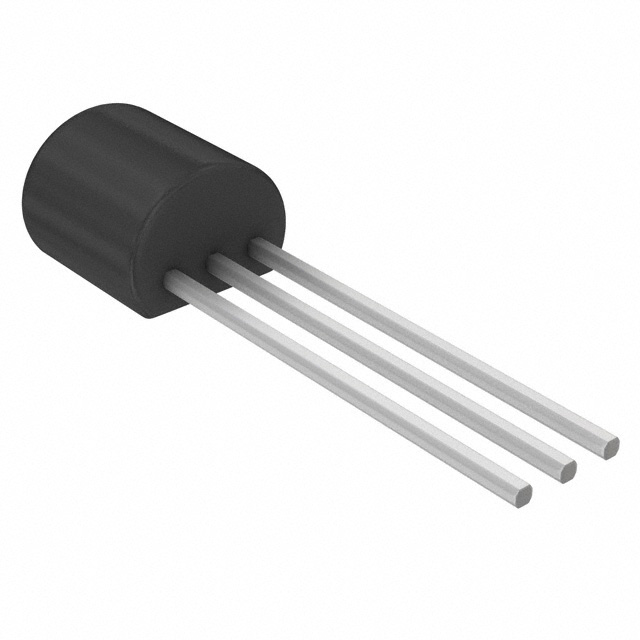
The 2N5087G is a PNP bipolar junction transistor manufactured by onsemi, designed for general-purpose switching and amplification applications. This device features a 50 V collector-emitter breakdown voltage rating and a maximum collector current of 50 mA, housed in a Through Hole TO-92 package. The 2N5087G is classified as an obsolete product, making equivalent substitute parts necessary for new designs and ongoing production requirements. Identifying compatible alternatives ensures design continuity and supply chain reliability.
Substiute Parts
Key Parameters
| Parameter | Value | Unit |
|---|---|---|
| Transistor Type | PNP | — |
| Current - Collector (Ic) (Max) | 50 | mA |
| Voltage - Collector Emitter Breakdown (Max) | 50 | V |
| Vce Saturation (Max) @ Ib, Ic | 300mV @ 1mA, 10mA | — |
| Current - Collector Cutoff (Max) | 50 | nA |
| DC Current Gain (hFE) (Min) @ Ic, Vce | 250 @ 100µA, 5V | — |
| Frequency - Transition | 40 | MHz |
| Power - Max | 625 | mW |
| Operating Temperature Range | -55 to 150 | °C |
| Mounting Type | Through Hole | — |
| Package / Case | TO-92-3 | — |
Substitute Part Grouping Explanation
Substitute parts for the 2N5087G are identified based on electrical parameter equivalence and functional compatibility. The primary substitution criterion is matching the core electrical specifications: PNP transistor type, 50 V collector-emitter breakdown voltage, 50 mA maximum collector current, 40 MHz transition frequency, and identical DC current gain characteristics. The MMBT5087LT1G meets all electrical parameter requirements and maintains the same base product number (MMBT5087 vs. 2N5087), confirming functional equivalence.
The key differentiator between the main part and its substitute is the mounting technology and package form factor. The 2N5087G uses Through Hole TO-92 packaging, while the MMBT5087LT1G uses Surface Mount SOT-23-3 packaging. Both devices are manufactured by onsemi and share identical electrical performance specifications, making them functionally interchangeable in circuit design provided the PCB layout accommodates the different package type.
Parameter Comparison
| Parameter | 2N5087G (Main Part) | MMBT5087LT1G (Substitute) | Match Status |
|---|---|---|---|
| Transistor Type | PNP | PNP | Identical |
| Current - Collector (Ic) (Max) | 50 mA | 50 mA | Identical |
| Voltage - Collector Emitter Breakdown (Max) | 50 V | 50 V | Identical |
| Vce Saturation (Max) @ Ib, Ic | 300mV @ 1mA, 10mA | 300mV @ 1mA, 10mA | Identical |
| Current - Collector Cutoff (Max) | 50 nA | 50 nA | Identical |
| DC Current Gain (hFE) (Min) @ Ic, Vce | 250 @ 100µA, 5V | 250 @ 100µA, 5V | Identical |
| Frequency - Transition | 40 MHz | 40 MHz | Identical |
| Operating Temperature Range | -55 to 150°C | -55 to 150°C | Identical |
| Mounting Type | Through Hole | Surface Mount | Different |
| Package / Case | TO-92-3 | SOT-23-3 | Different |
| Power - Max | 625 mW | 300 mW | Different |
| Product Status | Obsolete | Active | Different |
Engineering Selection Recommendations
The MMBT5087LT1G is the direct electrical equivalent to the 2N5087G and is the appropriate substitute for new designs and production transitions. The substitute part maintains all critical electrical specifications including voltage rating, current capacity, gain characteristics, and frequency response.
The primary consideration for part selection is the mounting technology requirement. The 2N5087G Through Hole TO-92 package is suitable for through-hole PCB assembly and breadboarding applications. The MMBT5087LT1G Surface Mount SOT-23-3 package is required for surface mount PCB assembly processes.
The MMBT5087LT1G carries an Active product status, ensuring long-term availability and supply chain continuity, whereas the 2N5087G is classified as Obsolete. The substitute part is RoHS3 Compliant, providing environmental and regulatory compliance for modern manufacturing standards.
The power dissipation rating differs between the two parts: the 2N5087G is rated at 625 mW while the MMBT5087LT1G is rated at 300 mW. Circuit designs must ensure that the actual power dissipation in the application does not exceed 300 mW when using the MMBT5087LT1G substitute.
Frequently Asked Questions (FAQ)
Q: Can the MMBT5087LT1G directly replace the 2N5087G in existing designs?
A: The MMBT5087LT1G is electrically equivalent to the 2N5087G and provides identical performance in circuit operation. However, direct replacement requires PCB layout modification due to the different package types. The 2N5087G uses Through Hole TO-92 leads, while the MMBT5087LT1G uses Surface Mount SOT-23-3 pads. Schematic-level substitution is valid; physical board layout must be adapted accordingly.
Q: What are the key electrical parameters that confirm substitution compatibility?
A: Substitution compatibility is confirmed by matching the following parameters: PNP transistor type, 50 V collector-emitter breakdown voltage, 50 mA maximum collector current, 40 MHz transition frequency, 250 minimum DC current gain at specified conditions, and 300 mV maximum saturation voltage. All these parameters are identical between the 2N5087G and MMBT5087LT1G.
Q: Why does the MMBT5087LT1G have a lower power rating than the 2N5087G?
A: The power dissipation rating difference (300 mW vs. 625 mW) reflects the thermal characteristics of the respective packages. The TO-92 Through Hole package has greater thermal mass and better heat dissipation capability than the SOT-23-3 Surface Mount package. Circuit designs using the MMBT5087LT1G must ensure actual power dissipation remains within the 300 mW limit.
Q: Is the MMBT5087LT1G suitable for new product designs?
A: Yes. The MMBT5087LT1G is classified as an Active product with RoHS3 compliance, making it the appropriate choice for new designs. The 2N5087G is Obsolete and should not be specified for new products. The MMBT5087LT1G provides long-term supply availability and regulatory compliance.
Q: What packaging considerations apply when substituting these parts?
A: The 2N5087G requires Through Hole PCB assembly with lead insertion and wave soldering or manual soldering processes. The MMBT5087LT1G requires Surface Mount PCB assembly with reflow soldering processes. These represent fundamentally different manufacturing processes and require distinct PCB designs, assembly equipment, and quality control procedures.
Q: Are there any compliance or certification differences between these parts?
A: The MMBT5087LT1G is RoHS3 Compliant, while the 2N5087G compliance status is not specified in the provided data. Both parts are REACH Unaffected and carry the same ECCN (EAR99) and HTSUS classifications. The MMBT5087LT1G's RoHS3 compliance makes it the preferred choice for applications requiring environmental regulatory adherence.
Alternative Parts

SJ6012L2TP
Littelfuse Inc.
6 Alternative Parts

JMK107BBJ476MA-RE
Taiyo Yuden
10 Alternative Parts

GMK107BBJ475MA-T
Taiyo Yuden
5 Alternative Parts
SJ6020N2ARP
Littelfuse Inc.
3 Alternative Parts
SJ6025R2ATP
Littelfuse Inc.
4 Alternative Parts

2474-05L
API Delevan Inc.
1 Alternative Parts

4590R-684K
API Delevan Inc.
1 Alternative Parts

CM6560R-334
API Delevan Inc.
1 Alternative Parts

CM6460-104
API Delevan Inc.
1 Alternative Parts

5526-12
API Delevan Inc.
1 Alternative Parts