


Request Quote
(Ships tomorrow)
2N4402BU Equivalent & Substitute Parts
Part Overview
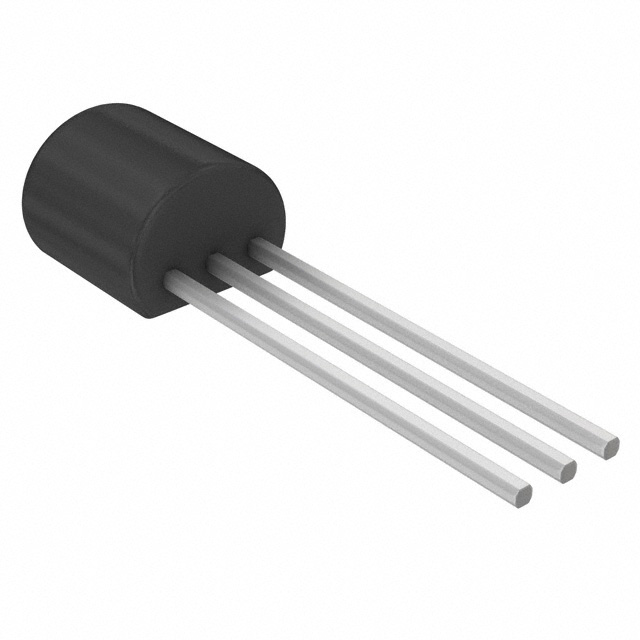
The 2N4402BU is a PNP bipolar junction transistor manufactured by onsemi, rated for 40 V collector-emitter breakdown voltage and 600 mA maximum collector current in a TO-92-3 through-hole package. This device is classified as obsolete, making identification of functionally equivalent alternatives necessary for ongoing design support and production continuity. The 2N4402BU delivers 625 mW maximum power dissipation with a minimum DC current gain of 50 at 150 mA collector current and 2 V collector-emitter voltage.
Substiute Parts
Key Parameters
| Parameter | Value | Unit |
|---|---|---|
| Transistor Type | PNP | — |
| Voltage - Collector Emitter Breakdown (Max) | 40 | V |
| Current - Collector (Ic) (Max) | 600 | mA |
| Power - Max | 625 | mW |
| Vce Saturation (Max) @ Ib, Ic | 750mV @ 50mA, 500mA | V |
| DC Current Gain (hFE) (Min) @ Ic, Vce | 50 @ 150mA, 2V | — |
| Operating Temperature | -55 to 150 | °C |
| Mounting Type | Through Hole | — |
| Package / Case | TO-92-3 | — |
Substitute Part Grouping Explanation
Substitution of the 2N4402BU requires matching of critical electrical and mechanical parameters. The primary constraint is that the 2N4402BU is a PNP transistor; direct PNP equivalents must maintain identical voltage and current ratings, power dissipation capability, and through-hole TO-92-3 packaging.
The 2N4401BU is listed as a substitute part in the provided data. However, the 2N4401BU is classified as an NPN transistor, which represents a polarity inversion relative to the 2N4402BU. While both devices share identical maximum ratings for collector-emitter breakdown voltage (40 V), maximum collector current (600 mA), maximum power dissipation (625 mW), saturation voltage characteristics, and operating temperature range (-55°C to 150°C), the transistor type difference (NPN versus PNP) means these parts are not direct functional substitutes in circuits designed for PNP operation.
Substitution logic is based on the following parameters:
- Voltage - Collector Emitter Breakdown (Max): 40 V
- Current - Collector (Ic) (Max): 600 mA
- Power - Max: 625 mW
- Vce Saturation (Max): 750mV @ 50mA, 500mA
- Operating Temperature: -55°C to 150°C
- Package / Case: TO-92-3
- Mounting Type: Through Hole
Parameter Comparison
| Parameter | 2N4402BU (Main) | 2N4401BU (Substitute) |
|---|---|---|
| Transistor Type | PNP | NPN |
| Voltage - Collector Emitter Breakdown (Max) | 40 V | 40 V |
| Current - Collector (Ic) (Max) | 600 mA | 600 mA |
| Power - Max | 625 mW | 625 mW |
| Vce Saturation (Max) @ Ib, Ic | 750mV @ 50mA, 500mA | 750mV @ 50mA, 500mA |
| DC Current Gain (hFE) (Min) @ Ic, Vce | 50 @ 150mA, 2V | 100 @ 150mA, 1V |
| Operating Temperature | -55°C to 150°C | -55°C to 150°C |
| Mounting Type | Through Hole | Through Hole |
| Package / Case | TO-92-3 | TO-92-3 |
| Frequency - Transition | Not specified | 250 MHz |
| Product Status | Obsolete | Active |
Engineering Selection Recommendations
The 2N4402BU is classified as obsolete, while the 2N4401BU maintains active product status with current manufacturing support. Both devices are REACH Unaffected and assigned ECCN EAR99 classification.
Selection between these parts must account for circuit topology requirements. The 2N4402BU is a PNP device suitable for circuits requiring PNP polarity. The 2N4401BU is an NPN device and cannot serve as a direct replacement in PNP-specific applications without circuit redesign to accommodate polarity inversion.
The 2N4401BU offers higher DC current gain (100 @ 150mA, 1V versus 50 @ 150mA, 2V) and specified transition frequency of 250 MHz, providing enhanced switching performance characteristics. Both devices maintain identical maximum voltage, current, and power ratings, as well as identical operating temperature range and saturation voltage specifications.
Frequently Asked Questions (FAQ)
Q: Can the 2N4401BU directly replace the 2N4402BU in an existing circuit?
A: Direct replacement is not possible without circuit modification. The 2N4402BU is PNP while the 2N4401BU is NPN. These represent opposite polarity devices. Substitution requires redesign of bias networks and signal paths to accommodate the transistor type change.
Q: What are the matching electrical parameters between these devices?
A: Both devices share identical maximum collector-emitter breakdown voltage (40 V), maximum collector current (600 mA), maximum power dissipation (625 mW), saturation voltage characteristics (750mV @ 50mA, 500mA), and operating temperature range (-55°C to 150°C).
Q: Are there packaging differences between the 2N4402BU and 2N4401BU?
A: Both devices use identical TO-92-3 through-hole packaging. Physical form factor and pin configuration are compatible from a mechanical standpoint.
Q: Why is the 2N4402BU listed as obsolete?
A: The 2N4402BU carries obsolete product status. The 2N4401BU maintains active status with current manufacturing availability, making it the preferred choice for new designs requiring NPN functionality in this performance class.
Q: What is the significance of the transition frequency specification on the 2N4401BU?
A: The 2N4401BU specifies 250 MHz transition frequency, indicating capability for higher-speed switching applications. The 2N4402BU does not provide this specification in the available data.
Alternative Parts

SJ6012L2TP
Littelfuse Inc.
6 Alternative Parts

JMK107BBJ476MA-RE
Taiyo Yuden
10 Alternative Parts

GMK107BBJ475MA-T
Taiyo Yuden
5 Alternative Parts
SJ6020N2ARP
Littelfuse Inc.
3 Alternative Parts
SJ6025R2ATP
Littelfuse Inc.
4 Alternative Parts

2474-05L
API Delevan Inc.
1 Alternative Parts

4590R-684K
API Delevan Inc.
1 Alternative Parts

CM6560R-334
API Delevan Inc.
1 Alternative Parts

CM6460-104
API Delevan Inc.
1 Alternative Parts

5526-12
API Delevan Inc.
1 Alternative Parts