




Request Quote
(Ships tomorrow)
2N3019 PBFREE Equivalent & Substitute Parts
Part Overview
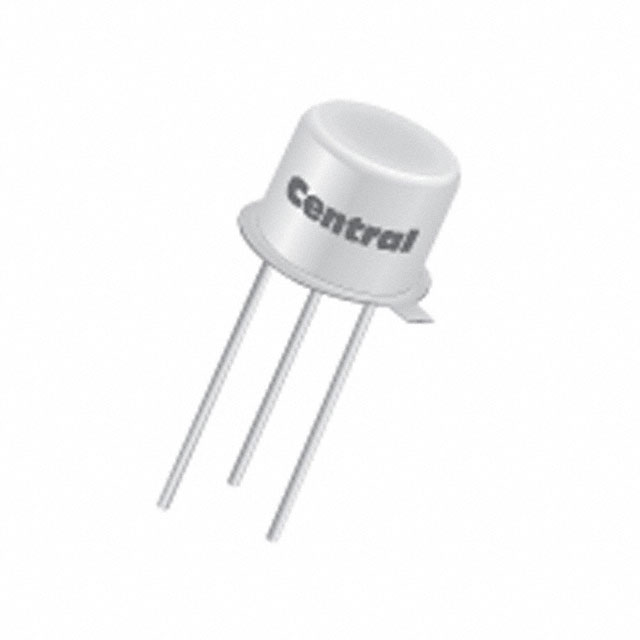
The 2N3019 PBFREE is an NPN bipolar junction transistor manufactured by Central Semiconductor Corp, designed for general-purpose switching and amplification applications. This through-hole TO-39 package device operates at maximum collector current of 1 A and collector-emitter breakdown voltage of 80 V, with a maximum power dissipation of 800 mW. The part is currently active in production with 1099 pieces in stock. Equivalent and substitute parts are identified to support procurement flexibility, inventory management, and design continuity when the primary part becomes unavailable or when alternative sourcing is required.
Substiute Parts
Key Parameters
| Parameter | Value | Unit |
|---|---|---|
| Transistor Type | NPN | — |
| Current - Collector (Ic) Max | 1 | A |
| Voltage - Collector Emitter Breakdown (Max) | 80 | V |
| Vce Saturation (Max) | 500 mV @ 50 mA, 500 mA | — |
| Current - Collector Cutoff (Max) | 10 nA | — |
| DC Current Gain (hFE) Min | 100 @ 150 mA, 10 V | — |
| Power - Max | 800 | mW |
| Frequency - Transition | 100 | MHz |
| Operating Temperature Range | −65 to +200 | °C |
| Mounting Type | Through Hole | — |
| Package / Case | TO-205AD, TO-39-3 Metal Can | — |
| RoHS Status | ROHS3 Compliant | — |
Substitute Part Grouping Explanation
Substitute parts for the 2N3019 PBFREE are identified based on strict electrical and mechanical parameter matching. The substitution logic is based on the following critical parameters:
Electrical Parameters (Must Match):
- Transistor Type: NPN
- Maximum Collector Current (Ic): 1 A
- Collector-Emitter Breakdown Voltage: 80 V
- Maximum Power Dissipation: 800 mW
- Vce Saturation: 500 mV @ 50 mA, 500 mA
- Operating Temperature Range: −65°C to +200°C
Mechanical Parameters (Must Match):
- Mounting Type: Through Hole
- Package / Case: TO-39 (TO-205AD)
Substitution Categories:
Direct Manufacturer Substitute: 2N3019S (Microchip Technology) — Identical electrical specifications with minor variations in DC current gain specification and transition frequency documentation.
Parametric Equivalent: 2N3019 (Solid State Inc.) — Meets all critical electrical and mechanical parameters with full specification alignment.
Parameter Comparison
| Parameter | 2N3019 PBFREE (Central Semiconductor) | 2N3019S (Microchip Technology) | 2N3019 (Solid State Inc.) |
|---|---|---|---|
| Transistor Type | NPN | NPN | NPN |
| Current - Collector (Ic) Max | 1 A | 1 A | 1 A |
| Voltage - Collector Emitter Breakdown (Max) | 80 V | 80 V | 80 V |
| Vce Saturation (Max) | 500 mV @ 50 mA, 500 mA | 500 mV @ 50 mA, 500 mA | 500 mV @ 50 mA, 500 mA |
| Current - Collector Cutoff (Max) | 10 nA | 10 µA | 10 nA |
| DC Current Gain (hFE) Min | 100 @ 150 mA, 10 V | 50 @ 500 mA, 10 V | 100 @ 150 mA, 10 V |
| Power - Max | 800 mW | 800 mW | 800 mW |
| Frequency - Transition | 100 MHz | Not specified | 100 MHz |
| Operating Temperature Range | −65 to +200°C | −65 to +200°C | −65 to +200°C (TJ) |
| Mounting Type | Through Hole | Through Hole | Through Hole |
| Package / Case | TO-205AD, TO-39-3 Metal Can | TO-205AD, TO-39-3 Metal Can | TO-205AD, TO-39-3 Metal Can |
| RoHS Status | ROHS3 Compliant | RoHS non-compliant | ROHS3 Compliant |
| Product Status | Active | Active | Active |
Engineering Selection Recommendations
2N3019 PBFREE (Central Semiconductor Corp) — Primary Part
Use as the primary selection. ROHS3 compliant, active production status, and full specification documentation. Suitable for applications requiring RoHS compliance and environmental regulations adherence.
2N3019S (Microchip Technology) — Direct Substitute
Acceptable as a direct substitute where RoHS compliance is not a design requirement. Electrical parameters are functionally equivalent for switching and amplification applications. Note: Collector cutoff current specification differs (10 µA vs. 10 nA) and DC current gain is specified at different operating point (500 mA vs. 150 mA). Transition frequency is not specified in available documentation. Suitable for legacy designs or applications where RoHS non-compliance is acceptable.
2N3019 (Solid State Inc.) — Parametric Equivalent
Acceptable as a parametric equivalent. ROHS3 compliant, active production status, and full electrical specification alignment with the primary part. Suitable for applications requiring RoHS compliance and identical electrical performance characteristics.
Frequently Asked Questions (FAQ)
Q: Can 2N3019S be used as a direct replacement for 2N3019 PBFREE?
A: Yes, 2N3019S is functionally equivalent for most switching and amplification applications. Both devices share identical maximum ratings for collector current (1 A), collector-emitter breakdown voltage (80 V), and power dissipation (800 mW). However, 2N3019S is RoHS non-compliant, whereas 2N3019 PBFREE is ROHS3 compliant. Design requirements regarding environmental compliance must be evaluated before substitution.
Q: What is the difference between the DC current gain specifications for 2N3019S and 2N3019 PBFREE?
A: The DC current gain (hFE) is specified at different operating points. 2N3019 PBFREE specifies hFE minimum of 100 at 150 mA collector current and 10 V collector-emitter voltage. 2N3019S specifies hFE minimum of 50 at 500 mA collector current and 10 V collector-emitter voltage. Both specifications are valid within their respective operating regions. Circuit design must account for the actual operating point to ensure adequate gain margin.
Q: Are all substitute parts available in the same TO-39 package?
A: Yes. All listed substitute parts are available in TO-39 (TO-205AD) through-hole metal can package. Pin configuration and mechanical dimensions are identical, enabling direct socket replacement without PCB modification.
Q: Which substitute part should be selected for new designs requiring RoHS compliance?
A: For new designs requiring RoHS compliance, select either 2N3019 PBFREE (Central Semiconductor Corp) or 2N3019 (Solid State Inc.). Both are ROHS3 compliant. 2N3019 PBFREE is the primary recommended part; 2N3019 from Solid State Inc. is an acceptable alternative with identical electrical specifications.
Q: What is the significance of the collector cutoff current difference between 2N3019 PBFREE and 2N3019S?
A: Collector cutoff current (ICBO) represents leakage current when the transistor is in the off state. 2N3019 PBFREE specifies 10 nA maximum, while 2N3019S specifies 10 µA maximum. This 1000-fold difference may be significant in low-power or high-impedance applications where leakage current affects circuit performance. For standard switching applications, this difference is typically negligible.
Q: Is transition frequency a critical parameter for substitution?
A: Transition frequency (fT) indicates the frequency at which current gain drops to unity. 2N3019 PBFREE and 2N3019 (Solid State Inc.) both specify 100 MHz. 2N3019S does not specify transition frequency in available documentation. For applications operating below 100 MHz, this difference is not critical. For high-frequency applications approaching or exceeding 100 MHz, confirm 2N3019S performance through detailed device characterization or manufacturer consultation.
Alternative Parts

SJ6012L2TP
Littelfuse Inc.
6 Alternative Parts

JMK107BBJ476MA-RE
Taiyo Yuden
10 Alternative Parts

GMK107BBJ475MA-T
Taiyo Yuden
5 Alternative Parts
SJ6020N2ARP
Littelfuse Inc.
3 Alternative Parts
SJ6025R2ATP
Littelfuse Inc.
4 Alternative Parts

2474-05L
API Delevan Inc.
1 Alternative Parts

4590R-684K
API Delevan Inc.
1 Alternative Parts

CM6560R-334
API Delevan Inc.
1 Alternative Parts

CM6460-104
API Delevan Inc.
1 Alternative Parts

5526-12
API Delevan Inc.
1 Alternative Parts