


Request Quote
(Ships tomorrow)
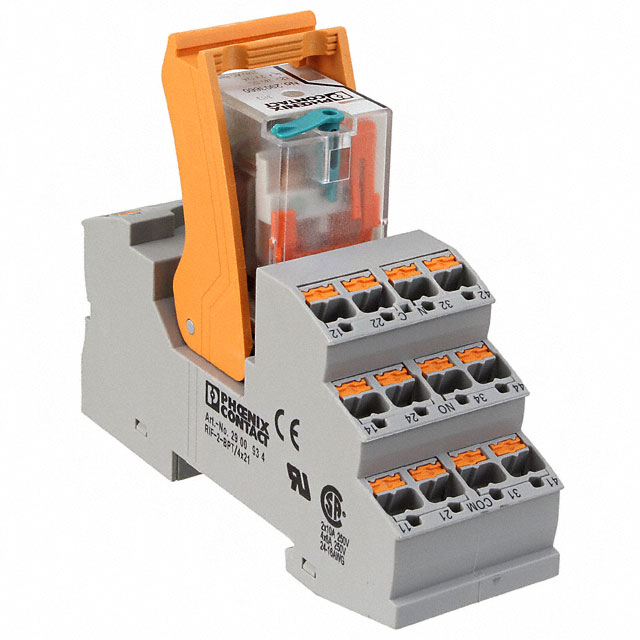
Phoenix Contact 2952172 General Purpose Relay DPDT 24VDC - Equivalent & Substitute Parts
Part Overview
The Phoenix Contact 2952172 is a general purpose relay with DPDT (2 Form C) contact configuration, rated for 3A at 24VDC coil voltage. This relay is designed for DIN rail mounting with screw terminal connections and includes a socket and diode. The part is currently obsolete, making identification of suitable substitute components essential for system maintenance and new designs requiring equivalent functionality.
Substiute Parts
Key Parameters
| Parameter | Value |
|---|---|
| Manufacturer Part Number | 2952172 |
| Manufacturer | Phoenix Contact |
| Series | EMG 45-REL |
| Product Status | Obsolete |
| Mounting Type | DIN Rail |
| Coil Voltage | 24VDC |
| Contact Form | DPDT (2 Form C) |
| Contact Rating (Current) | 3 A |
| Switching Voltage | 250VAC, 250VDC - Max |
| Coil Current | 31 mA |
| Coil Type | Non Latching |
| Features | Diode, Socket Included |
| Termination Style | Screw Terminal |
| Operate Time | 14 ms |
| Release Time | 16 ms |
| Operating Temperature | -20°C ~ 50°C |
| Contact Material | Silver Nickel (AgNi) |
| Coil Resistance | 774.2 Ohms |
| RoHS Status | RoHS Compliant |
| Moisture Sensitivity Level (MSL) | 1 (Unlimited) |
Substitute Part Grouping Explanation
Substitution of the Phoenix Contact 2952172 is determined by the following critical parameters that must remain consistent or be compatible with the original application:
Core Substitution Criteria:
- Coil voltage: 24VDC (fixed requirement)
- Contact form: DPDT (2 Form C) (fixed requirement)
- Mounting type: DIN Rail (fixed requirement)
- Coil type: Non Latching (fixed requirement)
- Contact material: Silver Nickel (AgNi) (fixed requirement)
Allowable Variations:
- Contact rating (current): May be equal to or greater than 3A
- Switching voltage: Must meet or exceed 250VAC, 250VDC
- Termination style: May differ if mechanical compatibility is maintained
- Operating temperature range: May be wider than -20°C ~ 50°C
- Product status: Active status preferred for long-term availability
- Compliance certifications: RoHS3 or equivalent acceptable
The Phoenix Contact 2903315 qualifies as a substitute because it maintains all core parameters while offering enhanced current rating (10A vs 3A), improved temperature range (-40°C ~ 60°C), and active product status.
Parameter Comparison
| Parameter | 2952172 (Main Part) | 2903315 (Substitute) |
|---|---|---|
| Manufacturer | Phoenix Contact | Phoenix Contact |
| Mounting Type | DIN Rail | DIN Rail |
| Coil Voltage | 24VDC | 24VDC |
| Contact Form | DPDT (2 Form C) | DPDT (2 Form C) |
| Contact Rating (Current) | 3 A | 10 A |
| Switching Voltage | 250VAC, 250VDC - Max | 250VAC, 250VDC - Max |
| Coil Current | 31 mA | 41 mA |
| Coil Type | Non Latching | Non Latching |
| Features | Diode, Socket Included | Diode, Lighted Indicator, Socket Included |
| Termination Style | Screw Terminal | Spring Terminal |
| Operate Time | 14 ms | 13 ms |
| Release Time | 16 ms | 14 ms |
| Operating Temperature | -20°C ~ 50°C | -40°C ~ 60°C |
| Contact Material | Silver Nickel (AgNi) | Silver Nickel (AgNi) |
| Product Status | Obsolete | Active |
| RoHS Status | RoHS Compliant | ROHS3 Compliant |
| Moisture Sensitivity Level (MSL) | 1 (Unlimited) | 1 (Unlimited) |
Engineering Selection Recommendations
The Phoenix Contact 2903315 is the qualified substitute for the obsolete 2952172. Selection is based on the following engineering factors:
Product Status: The 2952172 is obsolete, creating supply chain risk. The 2903315 maintains active product status, ensuring long-term availability and continued manufacturer support.
Compliance: Both parts maintain RoHS compliance. The 2903315 carries ROHS3 certification and REACH Unaffected status, meeting current regulatory requirements.
Functional Equivalence: The 2903315 preserves all critical electrical parameters: 24VDC coil voltage, DPDT contact configuration, non-latching operation, and Silver Nickel contact material. The higher current rating (10A vs 3A) provides design margin without compromising compatibility.
Operational Improvements: The substitute offers faster switching times (13ms operate, 14ms release vs 14ms and 16ms), an extended operating temperature range (-40°C ~ 60°C vs -20°C ~ 50°C), and includes a lighted indicator feature.
Mechanical Consideration: The termination style differs (spring terminal vs screw terminal). Mechanical compatibility must be verified for the specific mounting configuration in the target application.
Frequently Asked Questions (FAQ)
Q: Can the 2903315 directly replace the 2952172 in all applications?
A: The 2903315 maintains electrical and functional equivalence for DPDT relay applications at 24VDC. However, the termination style differs (spring terminal vs screw terminal). Mechanical compatibility with the existing installation must be confirmed before substitution.
Q: Why is the contact rating higher on the substitute part?
A: The 2903315 is rated for 10A versus 3A on the 2952172. A higher current rating is acceptable for substitution as it provides design margin. The application will operate within the substitute's rated capacity if it operated within the original part's 3A limit.
Q: Are there compliance differences between the two parts?
A: Both parts are RoHS compliant. The 2903315 carries ROHS3 certification and REACH Unaffected status, representing current regulatory compliance standards. The 2952172 carries RoHS Compliant status. Both meet environmental requirements.
Q: What is the impact of the different coil currents (31mA vs 41mA)?
A: The 2903315 requires 41mA versus 31mA for the 2952172. The control circuit must supply sufficient current to operate the substitute relay. This represents a 10mA increase and should be verified against the control circuit's current capacity.
Q: Does the lighted indicator feature on the 2903315 affect substitution?
A: The lighted indicator is an additional feature on the 2903315 and does not prevent substitution. If the indicator is not required by the application, it remains inactive and does not impact relay operation.
Q: How do the switching times compare?
A: The 2903315 operates slightly faster (13ms vs 14ms) and releases faster (14ms vs 16ms). These differences are minimal and do not affect compatibility for general purpose relay applications.
Q: What is the temperature range difference?
A: The 2903315 operates across -40°C ~ 60°C versus -20°C ~ 50°C for the 2952172. The wider range on the substitute provides greater environmental flexibility without compromising performance in the original operating range.
Alternative Parts

SJ6012L2TP
Littelfuse Inc.
6 Alternative Parts

JMK107BBJ476MA-RE
Taiyo Yuden
10 Alternative Parts

GMK107BBJ475MA-T
Taiyo Yuden
5 Alternative Parts
SJ6020N2ARP
Littelfuse Inc.
3 Alternative Parts
SJ6025R2ATP
Littelfuse Inc.
4 Alternative Parts

2474-05L
API Delevan Inc.
1 Alternative Parts

4590R-684K
API Delevan Inc.
1 Alternative Parts

CM6560R-334
API Delevan Inc.
1 Alternative Parts

CM6460-104
API Delevan Inc.
1 Alternative Parts

5526-12
API Delevan Inc.
1 Alternative Parts