




Request Quote
(Ships tomorrow)
TE Connectivity 2-5330061-1 BNC Connector Plug Equivalent & Substitute Parts
Part Overview
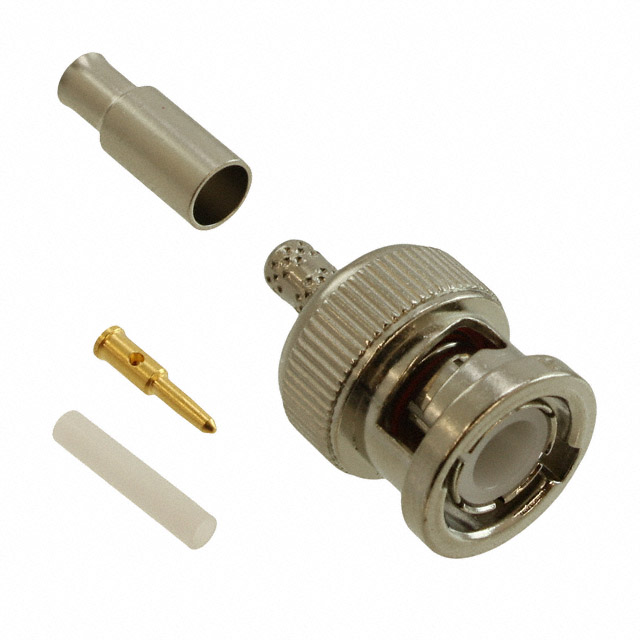
The TE Connectivity AMP Connectors 2-5330061-1 is a BNC connector plug designed for 50 ohm coaxial cable applications. This male pin connector features push-on contact termination with crimp shield termination, suitable for free-hanging inline mounting. The connector operates across a frequency range up to 2.5 GHz and supports RG-174 and RG-188 cable groups.
The 2-5330061-1 maintains active product status and is RoHS compliant. Substitute parts are necessary when specific cable group compatibility, termination method preferences, frequency requirements, or operating temperature ranges differ from the original specification.
Substiute Parts
Key Parameters
| Parameter | Value |
|---|---|
| Connector Style | BNC |
| Connector Type | Plug, Male Pin |
| Impedance | 50 Ohms |
| Contact Termination | Push On |
| Shield Termination | Crimp |
| Mounting Type | Free Hanging (In-Line) |
| Fastening Type | Bayonet Lock |
| Frequency - Max | 2.5 GHz |
| Cable Group | RG-174, 188 |
| Operating Temperature | -65°C ~ 85°C |
| Voltage Rating | 500 V |
| Mating Cycles | 500 |
| Body Material | Brass |
| Body Finish | Silver |
| Center Contact Plating | Gold |
| Dielectric Material | Polytetrafluoroethylene (PTFE) |
| RoHS Status | RoHS Compliant |
| Moisture Sensitivity Level | 1 (Unlimited) |
Substitute Part Grouping Explanation
Substitution of the 2-5330061-1 is determined by the following critical parameters:
Primary Compatibility Criteria:
- Connector Style: BNC (all substitutes maintain BNC configuration)
- Connector Type: Plug, Male Pin (all substitutes are male pin plugs)
- Impedance: 50 Ohms (all substitutes maintain 50 ohm impedance)
- Mounting Type: Free Hanging (In-Line) (all substitutes are inline connectors)
- Fastening Type: Bayonet Lock (all substitutes use bayonet locking mechanism)
- Voltage Rating: 500 V (all substitutes maintain 500 V rating)
- Mating Cycles: 500 (all substitutes support 500 mating cycles)
Secondary Differentiation Parameters:
- Contact Termination: The main part uses Push On; substitutes employ Crimp or Crimp/Solder methods
- Cable Group Compatibility: Varies by substitute part
- Frequency - Max: Ranges from 2.5 GHz to 4 GHz across substitutes
- Operating Temperature: Ranges from -40°C ~ 85°C to -65°C ~ 165°C
- Body Finish: Silver (main part) versus Nickel (most substitutes)
- Dielectric Material: PTFE or POM Acetal variants
- Product Status: Active or Not For New Designs
Substitutes are grouped by cable group compatibility and termination method, allowing selection based on specific application requirements while maintaining core RF performance characteristics.
Parameter Comparison
| Parameter | 2-5330061-1 (Main) | 31-315-RFX | 31-242 | 031-5999-RFX | 031-5998-RFX | 36650-3RFX | 31-320-RFX |
|---|---|---|---|---|---|---|---|
| Manufacturer | TE Connectivity AMP | Amphenol RF | Amphenol RF | Amphenol RF | Amphenol RF | Amphenol RF | Amphenol RF |
| Connector Style | BNC | BNC | BNC | BNC | BNC | BNC | BNC |
| Connector Type | Plug, Male Pin | Plug, Male Pin | Plug, Male Pin | Plug, Male Pin | Plug, Male Pin | Plug, Male Pin | Plug, Male Pin |
| Contact Termination | Push On | Crimp | Crimp or Solder | Crimp | Crimp | Crimp | Crimp or Solder |
| Shield Termination | Crimp | Crimp | Crimp | Crimp | Crimp | Crimp | Crimp |
| Impedance | 50 Ohms | 50 Ohms | 50 Ohms | 50 Ohms | 50 Ohms | 50 Ohms | 50 Ohms |
| Mounting Type | Free Hanging (In-Line) | Free Hanging (In-Line) | Free Hanging (In-Line) | Free Hanging (In-Line) | Free Hanging (In-Line) | Free Hanging (In-Line) | Free Hanging (In-Line) |
| Fastening Type | Bayonet Lock | Bayonet Lock | Bayonet Lock | Bayonet Lock | Bayonet Lock | Bayonet Lock | Bayonet Lock |
| Frequency - Max | 2.5 GHz | 4 GHz | 4 GHz | 4 GHz | 4 GHz | 4 GHz | 4 GHz |
| Cable Group | RG-174, 188 | RG-174, 188, 188A, 316, LMR-100, M17/119-RG174 | RG-179, 179A, 179B, 187, 187A, Belden 9221, M17/94-RG179 | RG-8, 8A, 9, 9A, 9B, 87, 213, 214, 225, 302, 393 | Belden 9913, 9914, LMR-400 | RG-58 Plenum, 122, Belden 88240, 89907 | RG-58, 58A, 58B, 58C, 141, 303, LMR-195, Belden B7806A, 9907 |
| Operating Temperature | -65°C ~ 85°C | -65°C ~ 165°C | -65°C ~ 165°C | -65°C ~ 165°C | -65°C ~ 165°C | -65°C ~ 165°C | -40°C ~ 85°C |
| Voltage Rating | 500 V | 500 V | 500 V | 500 V | 500 V | 500 V | 500 V |
| Mating Cycles | 500 | 500 | 500 | 500 | 500 | 500 | 500 |
| Body Finish | Silver | Nickel | Nickel | Nickel | Nickel | Nickel | Nickel |
| Center Contact Plating | Gold | Gold | Gold | Gold | Gold | Gold | Gold |
| Dielectric Material | PTFE | POM Acetal | PTFE | POM Acetal | PTFE | PTFE | POM Acetal |
| RoHS Status | RoHS Compliant | ROHS3 Compliant | ROHS3 Compliant | ROHS3 Compliant | ROHS3 Compliant | ROHS3 Compliant | ROHS3 Compliant |
| Product Status | Active | Active | Active | Active | Not For New Designs | Active | Active |
Engineering Selection Recommendations
For RG-174 and RG-188 Cable Compatibility:
The 31-315-RFX is the primary substitute for applications requiring RG-174 and RG-188 cable compatibility. This part maintains the same cable group support as the 2-5330061-1 while offering crimp termination, extended operating temperature range (-65°C ~ 165°C), and active product status. The 31-315-RFX uses POM Acetal dielectric material and nickel body finish, differing from the original silver finish and PTFE dielectric.
For Extended Operating Temperature Requirements:
Multiple substitutes support the extended temperature range of -65°C ~ 165°C: 31-315-RFX, 31-242, 031-5999-RFX, 031-5998-RFX, and 36650-3RFX. Selection among these should be based on specific cable group requirements and termination method preferences.
For Crimp Termination Applications:
All listed substitutes employ crimp or crimp/solder termination methods, differing from the push-on termination of the 2-5330061-1. This termination method change requires corresponding cable preparation modifications.
For Active Product Status:
Parts with Active product status are: 31-315-RFX, 31-242, 031-5999-RFX, 36650-3RFX, and 31-320-RFX. The 031-5998-RFX carries Not For New Designs status and should be avoided for new circuit designs.
For Frequency Performance:
All substitutes support 4 GHz maximum frequency, exceeding the 2.5 GHz specification of the 2-5330061-1. This provides additional frequency margin for applications requiring higher bandwidth capability.
For Compliance Requirements:
All substitute parts maintain ROHS3 compliance and REACH affected status, consistent with the original part's RoHS compliance. All parts carry EAR99 ECCN classification and identical HTSUS code 8536.69.4010.
Frequently Asked Questions (FAQ)
Q: Can the 31-315-RFX directly replace the 2-5330061-1 in existing assemblies?
A: The 31-315-RFX maintains identical connector style, impedance, mounting type, and fastening type. However, the contact termination differs: the 2-5330061-1 uses push-on termination while the 31-315-RFX requires crimp termination. Cable preparation and assembly methods must be modified accordingly. The 31-315-RFX supports the same RG-174 and RG-188 cable groups.
Q: What is the primary difference between push-on and crimp termination?
A: Push-on termination (2-5330061-1) allows the cable to be inserted directly into the connector without additional tooling. Crimp termination (all substitutes) requires a crimping tool to compress a ferrule onto the cable shield. Crimp termination generally provides superior mechanical and electrical connection reliability in high-vibration or high-reliability applications.
Q: Are all substitute parts RoHS compliant?
A: Yes. The 2-5330061-1 is RoHS Compliant, and all listed substitutes are ROHS3 Compliant. Both designations meet current RoHS requirements. All parts are REACH affected and carry EAR99 ECCN classification.
Q: Which substitute supports the widest operating temperature range?
A: Multiple substitutes support -65°C ~ 165°C: 31-315-RFX, 31-242, 031-5999-RFX, 031-5998-RFX, and 36650-3RFX. The 2-5330061-1 operates from -65°C ~ 85°C, and the 31-320-RFX operates from -40°C ~ 85°C. Selection should be based on specific cable group compatibility requirements.
Q: What cable groups are supported by each substitute?
A: The 31-315-RFX supports RG-174, 188, 188A, 316, LMR-100, and M17/119-RG174. The 31-242 supports RG-179, 179A, 179B, 187, 187A, Belden 9221, and M17/94-RG179. The 031-5999-RFX supports RG-8, 8A, 9, 9A, 9B, 87, 213, 214, 225, 302, and 393. The 031-5998-RFX supports Belden 9913, 9914, and LMR-400. The 36650-3RFX supports RG-58 Plenum, 122, Belden 88240, and 89907. The 31-320-RFX supports RG-58, 58A, 58B, 58C, 141, 303, LMR-195, Belden B7806A, and 9907.
Q: Why do some substitutes have Not For New Designs status?
A: The 031-5998-RFX and 31-321-1000 carry Not For New Designs status, indicating these parts are in mature or declining production phases. For new circuit designs, select from parts with Active status: 31-315-RFX, 31-242, 031-5999-RFX, 36650-3RFX, or 31-320-RFX.
Q: What is the difference between PTFE and POM Acetal dielectric materials?
A: The 2-5330061-1 uses PTFE (Polytetrafluoroethylene) dielectric. Some substitutes use POM Acetal (Polyoxymethylene) dielectric. Both materials provide adequate RF performance at the specified frequencies and impedance levels. PTFE generally offers superior high-temperature performance, while POM Acetal provides cost advantages. Selection should be based on application temperature requirements and cable group compatibility.
Q: Do all substitutes maintain 500 volt rating and 500 mating cycles?
A: Yes. The 2-5330061-1 and all listed substitutes maintain 500 V voltage rating and 500 mating cycles specification. These parameters are consistent across all parts in this substitution group.
Q: What is the significance of body finish differences (Silver versus Nickel)?
A: The 2-5330061-1 features silver body finish, while most substitutes use nickel finish. Both finishes provide corrosion resistance and RF performance. Nickel finish is more commonly used in modern connector designs and offers cost advantages. Silver finish may be preferred in specific applications requiring enhanced conductivity or aesthetic requirements.
Q: Can the TNC connector 122393 substitute for the BNC 2-5330061-1?
A: No. The 122393 is a TNC connector plug, not a BNC connector. While both are 50 ohm RF connectors with similar electrical specifications, they use different fastening types: TNC uses threaded fastening while BNC uses bayonet lock. These connectors are not mechanically or electrically interchangeable. The 122393 is listed as a related part but not a direct substitute.
Q: What insertion loss values are specified for the substitutes?
A: The 2-5330061-1 does not specify insertion loss. Most substitutes specify 0.2 dB insertion loss at the operating frequency. The 122393 TNC connector specifies 0.18 dB insertion loss. These values indicate minimal signal attenuation across the specified frequency ranges.
Alternative Parts

SJ6012L2TP
Littelfuse Inc.
6 Alternative Parts

JMK107BBJ476MA-RE
Taiyo Yuden
10 Alternative Parts

GMK107BBJ475MA-T
Taiyo Yuden
5 Alternative Parts
SJ6020N2ARP
Littelfuse Inc.
3 Alternative Parts
SJ6025R2ATP
Littelfuse Inc.
4 Alternative Parts

2474-05L
API Delevan Inc.
1 Alternative Parts

4590R-684K
API Delevan Inc.
1 Alternative Parts

CM6560R-334
API Delevan Inc.
1 Alternative Parts

CM6460-104
API Delevan Inc.
1 Alternative Parts

5526-12
API Delevan Inc.
1 Alternative Parts