


Request Quote
(Ships tomorrow)
Equivalent & Substitute Parts for Signal Transformer 241-3-56
Part Overview
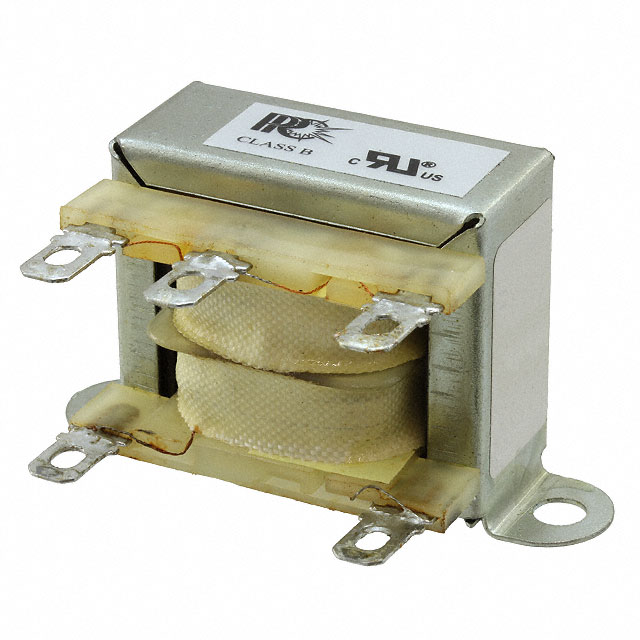
The Signal Transformer 241-3-56 is a laminated core power transformer rated at 2.4VA with a 115V primary and 56V secondary output. This chassis mount transformer is designed for applications requiring isolated 56V power delivery at up to 45mA output current. The part is currently active in production with full RoHS3 compliance and 2500Vrms isolation rating. Substitute parts may be required due to inventory availability, lead time constraints, or application-specific performance requirements within the allowed electrical and mechanical parameter ranges.
Substiute Parts
Key Parameters
| Parameter | Value |
|---|---|
| Manufacturer Part Number | 241-3-56 |
| Manufacturer | Signal Transformer |
| Series | Two-4-One™ |
| Type | Laminated Core |
| Voltage - Primary | 115V |
| Voltage - Secondary (Full Load) | 56V |
| Current - Output (Max) | 45mA |
| Power - Max | 2.4VA |
| Mounting Type | Chassis Mount |
| Termination Style | Solder, Quick Connect |
| Voltage - Isolation | 2500Vrms |
| RoHS Status | RoHS3 Compliant |
| Product Status | Active |
Substitute Part Grouping Explanation
Substitution eligibility for the 241-3-56 is determined by the following critical parameters:
- Secondary Voltage: Must be 56V (full load)
- Mounting Type: Must be Chassis Mount
- Termination Style: Must include Solder and/or Quick Connect options
- Core Type: Must be Laminated Core
- Center Tap: Must be present
- Primary Winding Configuration: Single primary winding required
- Secondary Winding Configuration: Single secondary winding required
- Compliance: RoHS3 Compliant and REACH Unaffected status required
Substitute parts may exceed the main part's electrical ratings (voltage isolation, power capacity, output current) without restriction. Substitute parts may also support dual primary voltage inputs (115V/230V) as an enhancement. Physical dimensions and weight are not substitution-limiting factors for chassis mount applications.
Parameter Comparison
| Parameter | 241-3-56 (Signal Transformer) | F3-56 (Triad Magnetics) | 186B56 (Hammond Manufacturing) |
|---|---|---|---|
| Voltage - Primary | 115V | 115V | 115V, 230V |
| Voltage - Secondary (Full Load) | 56V | 56V | 56V |
| Current - Output (Max) | 45mA | 20mA | 110mA |
| Power - Max | 2.4VA | 2.4VA | 6.16VA |
| Primary Winding(s) | Single | Single | Dual |
| Secondary Winding(s) | Single | Single | Single |
| Center Tap | Yes | Yes | Yes |
| Type | Laminated Core | Laminated Core | Laminated Core |
| Mounting Type | Chassis Mount | Chassis Mount | Chassis Mount |
| Termination Style | Solder, Quick Connect | Solder, Quick Connect - 0.187" (4.7mm) | Solder, Quick Connect |
| Voltage - Isolation | 2500Vrms | 2500VAC | 2000Vrms |
| RoHS Status | RoHS3 Compliant | RoHS3 Compliant | RoHS3 Compliant |
| Product Status | Active | Active | Active |
Engineering Selection Recommendations
Both F3-56 (Triad Magnetics) and 186B56 (Hammond Manufacturing) are qualified substitutes for the 241-3-56 based on matching secondary voltage, mounting configuration, winding topology, and compliance certifications.
F3-56 (Triad Magnetics): This substitute maintains identical power rating (2.4VA) and primary voltage (115V) as the main part. Output current capacity is 20mA, which is lower than the main part's 45mA rating. This part is suitable for applications where output current requirements do not exceed 20mA. Isolation voltage matches the main part at 2500VAC. All three parts share RoHS3 compliance and active product status.
186B56 (Hammond Manufacturing): This substitute provides enhanced electrical performance with 6.16VA power capacity and 110mA maximum output current, exceeding the main part's ratings. The primary winding supports dual voltage input (115V/230V), offering operational flexibility. Isolation voltage is rated at 2000Vrms, which is lower than the main part but remains within acceptable industrial standards. This part is suitable for applications requiring higher output current or dual-voltage primary input capability.
All three transformers maintain active product status, RoHS3 compliance, and REACH unaffected designation, ensuring regulatory consistency across substitution options.
Frequently Asked Questions (FAQ)
Q: Can F3-56 be used as a direct replacement for 241-3-56?
A: F3-56 is a qualified substitute with matching secondary voltage (56V), mounting type (Chassis Mount), termination style (Solder, Quick Connect), and compliance certifications. However, F3-56 has a maximum output current of 20mA compared to 241-3-56's 45mA. Substitution is valid only if your application's output current requirement does not exceed 20mA.
Q: What is the primary advantage of 186B56 over 241-3-56?
A: 186B56 provides higher power capacity (6.16VA vs. 2.4VA) and higher maximum output current (110mA vs. 45mA). Additionally, 186B56 supports dual primary voltage input (115V/230V), whereas 241-3-56 supports only 115V. These enhancements make 186B56 suitable for applications requiring higher power delivery or multi-voltage operation.
Q: Are there any isolation voltage differences between these parts?
A: Yes. 241-3-56 and F3-56 both provide 2500V isolation (Vrms/VAC), while 186B56 provides 2000Vrms isolation. All three ratings exceed standard industrial isolation requirements. Selection should be based on your specific isolation voltage specification.
Q: Do all three transformers have center tap secondary windings?
A: Yes. All three parts (241-3-56, F3-56, and 186B56) include center tap secondary windings, enabling symmetric dual-voltage output configurations if required by your application.
Q: What are the packaging differences?
A: 241-3-56 and F3-56 are supplied in Bulk packaging, while 186B56 is supplied in Box packaging. This distinction affects inventory management and handling but does not impact electrical or mechanical compatibility.
Q: Can 186B56 be used in applications designed for 241-3-56?
A: Yes, 186B56 is a qualified substitute. Its higher power capacity and output current make it suitable for 241-3-56 applications. However, verify that your circuit design can accommodate the larger physical dimensions (60.20mm L x 41.28mm W vs. 52.60mm L x 29.60mm W) and increased weight (0.6 lb vs. 0.25 lb) if space constraints exist.
Alternative Parts

SJ6012L2TP
Littelfuse Inc.
6 Alternative Parts

JMK107BBJ476MA-RE
Taiyo Yuden
10 Alternative Parts

GMK107BBJ475MA-T
Taiyo Yuden
5 Alternative Parts
SJ6020N2ARP
Littelfuse Inc.
3 Alternative Parts
SJ6025R2ATP
Littelfuse Inc.
4 Alternative Parts

2474-05L
API Delevan Inc.
1 Alternative Parts

4590R-684K
API Delevan Inc.
1 Alternative Parts

CM6560R-334
API Delevan Inc.
1 Alternative Parts

CM6460-104
API Delevan Inc.
1 Alternative Parts

5526-12
API Delevan Inc.
1 Alternative Parts