



Request Quote
(Ships tomorrow)
TE Connectivity 226601-3 Mini UHF Coaxial Connector Equivalent & Substitute Parts
Part Overview
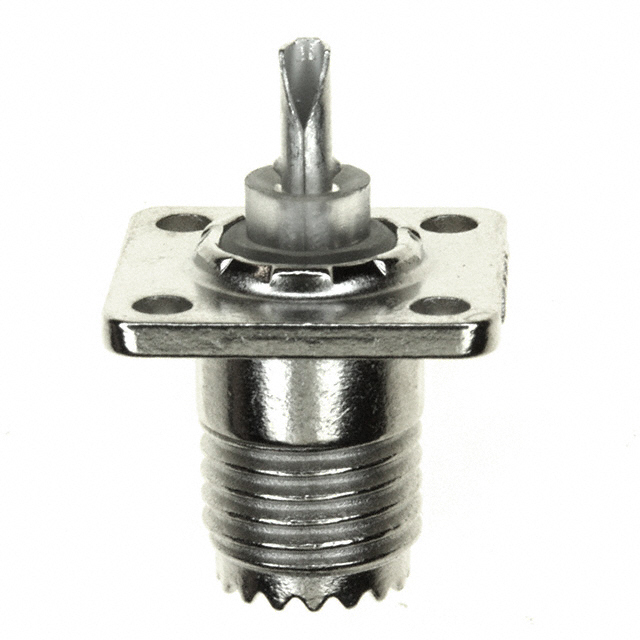
The TE Connectivity 226601-3 is a Mini UHF receptacle coaxial connector designed for RF applications requiring panel-mount solder termination. This connector features a female socket configuration with extended insulation and operates across frequencies up to 2 GHz. The part is classified as obsolete, necessitating identification of active equivalent alternatives that maintain electrical and mechanical compatibility for continued system support and new designs.
Substiute Parts
Key Parameters
| Parameter | Specification |
|---|---|
| Connector Style | UHF, Mini |
| Connector Type | Receptacle, Female Socket |
| Contact Termination | Solder Cup |
| Shield Termination | Solder |
| Mounting Type | Panel Mount |
| Mounting Feature | Flange |
| Fastening Type | Threaded |
| Frequency - Max | 2 GHz |
| Number of Ports | 1 |
| Operating Temperature | -55°C ~ 85°C |
| Voltage Rating | 335 V |
| Mating Cycles | 500 |
| Body Material | Zinc |
| Body Finish | Nickel |
| Housing Color | Silver |
| Impedance | Non-Constant |
Substitute Part Grouping Explanation
Substitution of the obsolete 226601-3 is determined by strict equivalence across the following critical parameters: connector style (UHF, Mini), connector type (receptacle, female socket), contact termination method (solder cup), shield termination (solder), mounting configuration (panel mount with flange), fastening mechanism (threaded), maximum frequency (2 GHz), operating temperature range (-55°C ~ 85°C), voltage rating (335 V), mating cycle rating (500), body material (zinc), body finish (nickel), housing color (silver), and impedance classification (non-constant).
Two active substitute parts meet these criteria: 5226601-3 and 5226601-1. Both maintain identical mechanical and electrical specifications across all critical parameters. Variations exist only in center contact material composition and dielectric material selection, which do not affect interchangeability within the defined application envelope.
Parameter Comparison
| Parameter | 226601-3 (Obsolete) | 5226601-3 (Active) | 5226601-1 (Active) |
|---|---|---|---|
| Connector Style | UHF, Mini | UHF, Mini | UHF, Mini |
| Connector Type | Receptacle, Female Socket | Receptacle, Female Socket | Receptacle, Female Socket |
| Contact Termination | Solder Cup | Solder Cup | Solder Cup |
| Shield Termination | Solder | Solder | Solder |
| Mounting Type | Panel Mount | Panel Mount | Panel Mount |
| Mounting Feature | Flange | Flange | Flange |
| Fastening Type | Threaded | Threaded | Threaded |
| Frequency - Max | 2 GHz | 2 GHz | 2 GHz |
| Number of Ports | 1 | 1 | 1 |
| Operating Temperature | -55°C ~ 85°C | -55°C ~ 85°C | -55°C ~ 85°C |
| Voltage Rating | 335 V | 335 V | 335 V |
| Mating Cycles | 500 | 500 | 500 |
| Body Material | Zinc | Zinc | Zinc |
| Body Finish | Nickel | Nickel | Nickel |
| Housing Color | Silver | Silver | Silver |
| Impedance | Non-Constant | Non-Constant | Non-Constant |
| Center Contact Material | Phosphor Bronze | Phosphor Bronze | Brass |
| Center Contact Plating | Tin | Tin | Tin |
| Dielectric Material | Polymethylpentene (PMP) | Polymethylpentene (PMP) | Polytetrafluoroethylene (PTFE) |
| Product Status | Obsolete | Active | Active |
| RoHS Status | RoHS non-compliant | RoHS Compliant | RoHS Compliant |
| REACH Status | Vendor Undefined | Vendor Undefined | REACH Affected |
Engineering Selection Recommendations
Both 5226601-3 and 5226601-1 serve as direct functional replacements for the obsolete 226601-3 across all critical electrical and mechanical parameters. Selection between the two active alternatives is determined by regulatory and compliance requirements.
5226601-3 is the primary substitute, offering identical material composition to the original part (phosphor bronze center contact, polymethylpentene dielectric) while achieving RoHS compliance. This part maintains the closest material specification alignment and is suitable for applications where original material specifications are preferred.
5226601-1 provides an alternative with modified center contact material (brass instead of phosphor bronze) and dielectric material (PTFE instead of PMP). This part carries RoHS compliance and REACH affected status, making it suitable for applications subject to REACH regulatory requirements. The material substitutions do not alter the connector's electrical performance within the specified operating envelope.
Both parts are available in bulk packaging and maintain full inventory availability. Selection should be based on specific regulatory compliance mandates and material specification requirements of the end application.
Frequently Asked Questions (FAQ)
Q: Can 5226601-3 and 5226601-1 be used interchangeably with 226601-3?
A: Both parts are electrically and mechanically equivalent to 226601-3 across all critical parameters including connector style, type, termination method, mounting configuration, frequency rating, temperature range, and voltage rating. Direct substitution is supported.
Q: What is the difference between 5226601-3 and 5226601-1?
A: The parts differ in center contact material (phosphor bronze versus brass) and dielectric material (polymethylpentene versus polytetrafluoroethylene). Both differences are material-level variations that do not affect connector performance within the specified operating parameters. 5226601-1 carries REACH affected status, while 5226601-3 does not.
Q: Why is 226601-3 classified as obsolete?
A: The part is no longer in active production. Active equivalents 5226601-3 and 5226601-1 are available for new designs and replacement applications.
Q: Are there packaging differences between the substitute parts?
A: The original 226601-3 was supplied in unspecified packaging. Both substitute parts are supplied in bulk packaging. Inventory availability is confirmed for both alternatives.
Q: Which substitute should be selected for RoHS-compliant applications?
A: Both 5226601-3 and 5226601-1 are RoHS compliant. Selection between them should be based on REACH compliance requirements and material specification preferences.
Q: Do the substitute parts maintain the same mating cycle rating?
A: Yes, both substitute parts maintain the 500 mating cycle rating of the original 226601-3.
Q: Are the operating temperature ranges identical across all three parts?
A: Yes, all three parts operate across the identical temperature range of -55°C to 85°C.
Alternative Parts

SJ6012L2TP
Littelfuse Inc.
6 Alternative Parts

JMK107BBJ476MA-RE
Taiyo Yuden
10 Alternative Parts

GMK107BBJ475MA-T
Taiyo Yuden
5 Alternative Parts
SJ6020N2ARP
Littelfuse Inc.
3 Alternative Parts
SJ6025R2ATP
Littelfuse Inc.
4 Alternative Parts

2474-05L
API Delevan Inc.
1 Alternative Parts

4590R-684K
API Delevan Inc.
1 Alternative Parts

CM6560R-334
API Delevan Inc.
1 Alternative Parts

CM6460-104
API Delevan Inc.
1 Alternative Parts

5526-12
API Delevan Inc.
1 Alternative Parts