


Request Quote
(Ships tomorrow)
18TQ040 Schottky Diode Equivalent & Substitute Parts
Part Overview
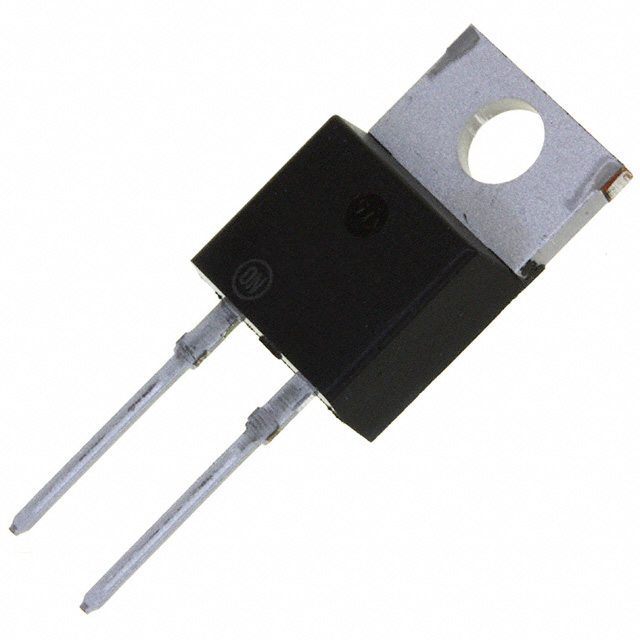
The 18TQ040 is a Schottky rectifier diode manufactured by Vishay General Semiconductor - Diodes Division, rated for 40 V DC reverse voltage and 18 A average rectified current in a Through Hole TO-220AC package. This component is classified as obsolete, making equivalent and substitute parts necessary for ongoing design support and procurement.
Schottky diodes in this voltage and current class are commonly used in power supply rectification, freewheeling applications, and high-frequency switching circuits where fast recovery characteristics are required.
Substiute Parts
Key Parameters
| Parameter | Value |
|---|---|
| Voltage - DC Reverse (Vr) (Max) | 40 V |
| Current - Average Rectified (Io) | 18 A |
| Voltage - Forward (Vf) (Max) @ If | 600 mV @ 18 A |
| Speed | Fast Recovery ≤ 500ns, > 200mA (Io) |
| Current - Reverse Leakage @ Vr | 2.5 mA @ 40 V |
| Mounting Type | Through Hole |
| Package / Case | TO-220-2 |
| Operating Temperature - Junction | -55°C ~ 175°C |
| Technology | Schottky |
Substitute Part Grouping Explanation
Substitution of the 18TQ040 is determined by the following critical parameters:
Voltage Rating: Substitute parts must have a DC reverse voltage rating equal to or greater than 40 V to maintain circuit protection and reliability.
Current Rating: Substitute parts must have an average rectified current rating equal to or greater than 18 A to handle the design load without thermal stress.
Package Type: All substitutes must use Through Hole mounting in TO-220-2 or TO-220AC configuration to ensure mechanical and electrical compatibility with existing PCB layouts.
Speed Characteristics: All substitutes must maintain Fast Recovery characteristics (≤ 500ns, > 200mA) to preserve switching performance in high-frequency applications.
Operating Temperature Range: Substitute parts must support the junction temperature range of -55°C to 175°C or wider to ensure operation across the intended thermal envelope.
The identified substitute parts meet or exceed these parameters while maintaining functional equivalence in power supply and switching applications.
Parameter Comparison
| Parameter | 18TQ040 (Vishay) | DSS25-0045A (IXYS) | MBR1645G (onsemi) |
|---|---|---|---|
| Voltage - DC Reverse (Vr) (Max) | 40 V | 45 V | 45 V |
| Current - Average Rectified (Io) | 18 A | 25 A | 16 A |
| Voltage - Forward (Vf) (Max) @ If | 600 mV @ 18 A | 690 mV @ 25 A | 630 mV @ 16 A |
| Speed | Fast Recovery ≤ 500ns, > 200mA | Fast Recovery ≤ 500ns, > 200mA | Fast Recovery ≤ 500ns, > 200mA |
| Current - Reverse Leakage @ Vr | 2.5 mA @ 40 V | 1 mA @ 45 V | 200 µA @ 45 V |
| Mounting Type | Through Hole | Through Hole | Through Hole |
| Package / Case | TO-220-2 | TO-220-2 | TO-220-2 |
| Operating Temperature - Junction | -55°C ~ 175°C | -55°C ~ 175°C | -65°C ~ 175°C |
| Technology | Schottky | Schottky | Schottky |
| Product Status | Obsolete | Active | Active |
| RoHS Status | Non-compliant | ROHS3 Compliant | ROHS3 Compliant |
Engineering Selection Recommendations
DSS25-0045A (IXYS): This substitute provides higher voltage (45 V) and current (25 A) ratings compared to the 18TQ040, offering design margin for applications requiring increased performance headroom. The part is Active status with ROHS3 compliance, supporting modern procurement and environmental requirements. Forward voltage is slightly elevated at 690 mV versus 600 mV, which may result in marginally higher power dissipation in high-current applications.
MBR1645G (onsemi): This substitute provides matched voltage (45 V) with slightly reduced current rating (16 A) relative to the 18TQ040. The part is Active status with ROHS3 compliance and features the lowest reverse leakage current (200 µA @ 45 V) among the substitutes, indicating superior blocking characteristics. Forward voltage of 630 mV is intermediate between the main part and DSS25-0045A. The extended operating temperature range (-65°C to 175°C) provides additional thermal margin.
Both substitutes are suitable for direct replacement in applications where the 18TQ040 is specified, provided that circuit design accommodates the parameter variations documented in the comparison table.
Frequently Asked Questions (FAQ)
Q: Can the DSS25-0045A replace the 18TQ040 in all applications?
A: The DSS25-0045A meets or exceeds all critical parameters of the 18TQ040 (voltage, current, speed, temperature range, and package). The higher current rating (25 A vs. 18 A) and voltage rating (45 V vs. 40 V) provide design margin. The slightly higher forward voltage (690 mV vs. 600 mV) may increase power dissipation by approximately 1.5% in maximum-current applications and should be verified in thermal analysis.
Q: Can the MBR1645G replace the 18TQ040?
A: The MBR1645G is compatible with the 18TQ040 in most applications. The current rating is slightly lower (16 A vs. 18 A), which may be limiting in designs operating at or near the 18 A specification. The voltage rating (45 V) exceeds the 40 V requirement. The superior reverse leakage characteristics (200 µA vs. 2.5 mA) and extended temperature range (-65°C to 175°C) are advantageous for precision and thermal applications.
Q: Are all substitutes available in the same package?
A: Yes. All three parts (18TQ040, DSS25-0045A, and MBR1645G) use Through Hole mounting in TO-220-2 or TO-220AC configuration, ensuring mechanical and thermal compatibility with existing PCB designs without layout modification.
Q: What is the impact of forward voltage differences on circuit performance?
A: Forward voltage differences affect power dissipation and voltage drop across the diode. The 18TQ040 specifies 600 mV @ 18 A, while DSS25-0045A specifies 690 mV @ 25 A and MBR1645G specifies 630 mV @ 16 A. In power supply applications, these differences translate to increased heat generation. Thermal design verification is required if the substitute operates at significantly different current levels than the original design point.
Q: Why is reverse leakage current important in substitution?
A: Reverse leakage current affects blocking efficiency and power dissipation in standby or reverse-biased conditions. The 18TQ040 specifies 2.5 mA @ 40 V, while MBR1645G specifies 200 µA @ 45 V. Lower leakage improves efficiency in precision rectification and reduces standby power consumption. Higher leakage (as in the 18TQ040) may be acceptable in high-current applications where reverse-bias conditions are transient.
Q: What is the significance of RoHS compliance in selecting a substitute?
A: RoHS3 compliance indicates that the substitute part meets current environmental and regulatory requirements for lead-free manufacturing and restricted substance limitations. Both DSS25-0045A and MBR1645G are ROHS3 compliant, while the 18TQ040 is non-compliant. For new designs or procurement in regulated markets, RoHS-compliant substitutes are required.
Q: Can I use these substitutes interchangeably in the same circuit?
A: The substitutes are functionally equivalent but have different electrical characteristics. DSS25-0045A and MBR1645G can both replace the 18TQ040, but they should not be mixed within the same circuit without verification that the circuit design accommodates the parameter variations. Thermal and electrical analysis is required when substituting between parts with different current or voltage ratings.
Alternative Parts

SJ6012L2TP
Littelfuse Inc.
6 Alternative Parts

JMK107BBJ476MA-RE
Taiyo Yuden
10 Alternative Parts

GMK107BBJ475MA-T
Taiyo Yuden
5 Alternative Parts
SJ6020N2ARP
Littelfuse Inc.
3 Alternative Parts
SJ6025R2ATP
Littelfuse Inc.
4 Alternative Parts

2474-05L
API Delevan Inc.
1 Alternative Parts

4590R-684K
API Delevan Inc.
1 Alternative Parts

CM6560R-334
API Delevan Inc.
1 Alternative Parts

CM6460-104
API Delevan Inc.
1 Alternative Parts

5526-12
API Delevan Inc.
1 Alternative Parts