


Request Quote
(Ships tomorrow)
Phoenix Contact 1768804 Terminal Block Plug - Equivalent & Substitute Parts
Part Overview
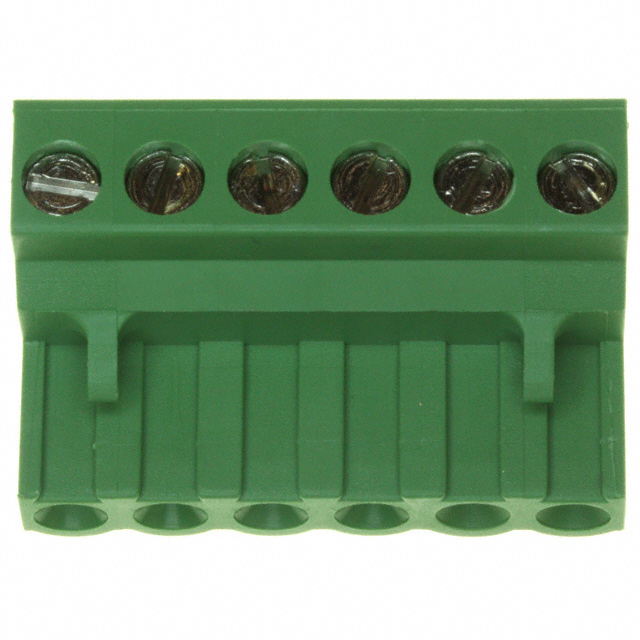
The Phoenix Contact 1768804 is a 6-position terminal block plug with female sockets, 0.197" (5.00mm) pitch, and 225° free-hanging wire entry configuration. This component is classified as Active product status and is designed for screw-based cage clamp termination in industrial control and power distribution applications. Substitute parts are identified when equivalent electrical ratings, mechanical compatibility, and connector geometry align with the original specification, enabling direct replacement in applications where form factor and performance requirements are met.
Substiute Parts
Key Parameters
| Parameter | Value |
|---|---|
| Manufacturer Part Number | 1768804 |
| Manufacturer | Phoenix Contact |
| Category | Terminal Blocks |
| Number of Positions | 6 |
| Pitch | 0.197" (5.00mm) |
| Plug Wire Entry | 225° |
| Current - UL | 15 A |
| Voltage - UL | 300 V |
| Wire Gauge Range | 12-30 AWG (0.2-2.5mm²) |
| Termination Style | Screw - Rising Cage Clamp |
| Mounting Type | Free Hanging (In-Line) |
| Material Flammability Rating | UL94 V-0 |
| RoHS Status | ROHS3 Compliant |
Substitute Part Grouping Explanation
Substitution eligibility for the Phoenix Contact 1768804 is determined by the following critical parameters:
- Connector Pitch: 0.197" (5.00mm) - must match exactly for mechanical interchangeability
- Number of Positions: 6 positions required for circuit continuity and form factor compatibility
- Termination Method: Screw-based cage clamp technology ensures compatible wire termination
- Electrical Ratings: UL current rating of 15 A and voltage rating of 300 V establish minimum performance thresholds
- Wire Gauge Compatibility: 12-30 AWG (0.2-2.5mm²) range defines acceptable conductor sizes
- Mounting Configuration: Free-hanging in-line orientation for direct mechanical replacement
- Flammability Compliance: UL94 V-0 rating required for safety-critical applications
The TE Connectivity AMP Connectors 796640-6 qualifies as a substitute based on alignment across these parameters, with the exception of plug wire entry angle (180° versus 225°), which represents a geometric variation that may require application-specific validation.
Parameter Comparison
| Parameter | Phoenix Contact 1768804 | TE Connectivity 796640-6 |
|---|---|---|
| Number of Positions | 6 | 6 |
| Pitch | 0.197" (5.00mm) | 0.197" (5.00mm) |
| Plug Wire Entry | 225° | 180° |
| Termination Style | Screw - Rising Cage Clamp | Screw - Rising Cage Clamp |
| Mounting Type | Free Hanging (In-Line) | Free Hanging (In-Line) |
| Current - UL | 15 A | 15 A |
| Voltage - UL | 300 V | 300 V |
| Wire Gauge Range - AWG | 12-30 AWG | 12-30 AWG |
| Wire Gauge Range - mm² | 0.2-2.5mm² | 0.05-3mm² |
| Screw Size | M3 | M3 |
| Material Flammability Rating | UL94 V-0 | UL94 V-0 |
| Housing Material | Polyamide (PA), Nylon | Polyamide (PA66), Nylon 6/6 |
| Insulation Height | 0.610" (15.49mm) | 0.610" (15.49mm) |
| RoHS Status | ROHS3 Compliant | ROHS3 Compliant |
| Product Status | Active | Active |
Engineering Selection Recommendations
Both the Phoenix Contact 1768804 and TE Connectivity 796640-6 maintain Active product status and ROHS3 compliance, confirming ongoing manufacturer support and environmental regulatory alignment. The electrical specifications (15 A UL current, 300 V UL voltage) and mechanical parameters (6 positions, 5.00mm pitch, M3 screw termination) are equivalent across both components.
The primary geometric difference is the plug wire entry angle: 225° for the Phoenix Contact versus 180° for the TE Connectivity. This variation affects the spatial orientation of wire routing and may impact installation geometry in confined spaces or existing harness designs. Selection between these parts should be based on physical installation constraints and wire entry angle requirements specific to the application.
Both components support wire gauges within the 12-30 AWG range, with the TE Connectivity offering extended mm² compatibility (0.05-3mm² versus 0.2-2.5mm²). The TE Connectivity housing material is specified as PA66 (Nylon 6/6), while the Phoenix Contact uses PA (Nylon) without specific grade designation.
Frequently Asked Questions (FAQ)
Q: Can the TE Connectivity 796640-6 directly replace the Phoenix Contact 1768804 in all applications?
A: Direct replacement is possible for applications where the 180° plug wire entry angle is compatible with the installation geometry. The electrical ratings, pitch, position count, and termination method are equivalent. Physical validation is required if the original 225° wire entry angle was critical to the application design.
Q: What is the significance of the different wire gauge ranges (0.2-2.5mm² versus 0.05-3mm²)?
A: The TE Connectivity part accepts a broader range of conductor cross-sections. Both parts support the standard 12-30 AWG range. The extended range on the TE Connectivity provides flexibility for applications using smaller or larger conductors outside the Phoenix Contact specification.
Q: Are both parts suitable for the same voltage and current applications?
A: Yes. Both components are rated for 15 A (UL) and 300 V (UL), making them electrically equivalent for applications within these specifications.
Q: What is the difference between the housing materials?
A: The Phoenix Contact uses polyamide (PA) nylon, while the TE Connectivity specifies PA66 (Nylon 6/6). PA66 is a more precisely defined material grade with consistent thermal and mechanical properties. Both materials meet UL94 V-0 flammability requirements.
Q: Do both parts have the same screw torque specification?
A: No. The Phoenix Contact specifies 0.5-0.6 Nm (4.4-5.3 Lb-In), while the TE Connectivity specifies 0.79 Nm (7.0 Lb-In). Termination torque must be applied according to the specific part manufacturer's requirements to ensure proper contact pressure and electrical performance.
Q: Are both parts RoHS compliant?
A: Yes. Both the Phoenix Contact 1768804 and TE Connectivity 796640-6 are ROHS3 compliant, meeting current environmental regulations for restricted substances.
Alternative Parts

SJ6012L2TP
Littelfuse Inc.
6 Alternative Parts

JMK107BBJ476MA-RE
Taiyo Yuden
10 Alternative Parts

GMK107BBJ475MA-T
Taiyo Yuden
5 Alternative Parts
SJ6020N2ARP
Littelfuse Inc.
3 Alternative Parts
SJ6025R2ATP
Littelfuse Inc.
4 Alternative Parts

2474-05L
API Delevan Inc.
1 Alternative Parts

4590R-684K
API Delevan Inc.
1 Alternative Parts

CM6560R-334
API Delevan Inc.
1 Alternative Parts

CM6460-104
API Delevan Inc.
1 Alternative Parts

5526-12
API Delevan Inc.
1 Alternative Parts