



Request Quote
(Ships tomorrow)
Weidmüller 1612200000 Terminal Block Plug – Equivalent & Substitute Parts
Part Overview
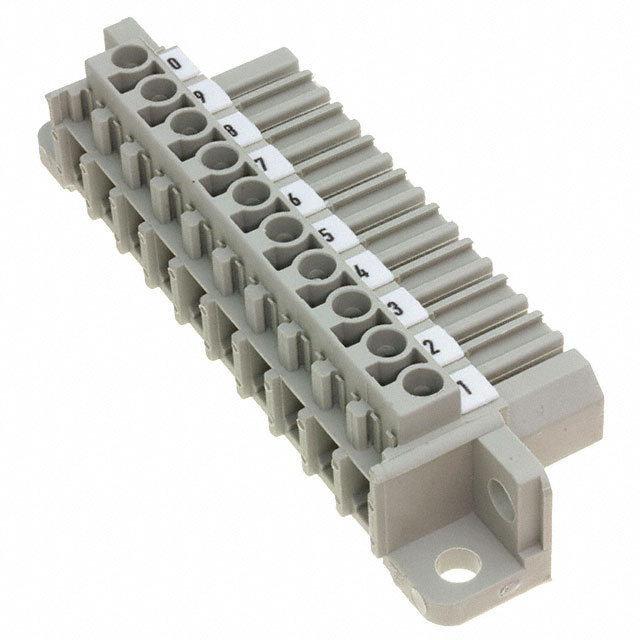
The Weidmüller 1612200000 is a 10-position terminal block plug with blade sockets, 0.276" (7.00mm) pitch, and 90° wire entry. This component is part of the Powermate STV series and is classified as obsolete. Due to its obsolete status, equivalent substitute parts from active product lines are necessary to maintain system compatibility and ensure continued availability for new installations and replacements.
Substiute Parts
Key Parameters
| Parameter | Value |
|---|---|
| Manufacturer Part Number | 1612200000 |
| Manufacturer | Weidmüller |
| Category | Terminal Blocks |
| Number of Positions | 10 |
| Pitch | 0.276" (7.00mm) |
| Plug Wire Entry | 90° |
| Termination Style | Screw - Clamping Yoke (Tension Sleeve) |
| Mounting Type | Free Hanging (In-Line) |
| Current - IEC | 32A |
| Voltage - IEC | 1 kV |
| Wire Gauge Range | 12-22 AWG (0.5-4mm²) |
| Operating Temperature | -50°C ~ 100°C |
| Product Status | Obsolete |
Substitute Part Grouping Explanation
Substitution of the 1612200000 is based on the following critical parameters that must be maintained or exceeded:
- Number of Positions: 10 positions required
- Termination Style: Screw - Clamping Yoke (Tension Sleeve) required
- Mounting Type: Free Hanging (In-Line) required
- Electrical Performance: Current and voltage ratings must meet or exceed IEC 32A / 1 kV
- Wire Gauge Compatibility: Must accommodate 12-22 AWG (0.5-4mm²) wire range
- Operating Temperature Range: Must support -50°C ~ 100°C minimum
- Material Compliance: UL94 V-0 flammability rating and RoHS compliance required
The Weidmüller 1929820000 qualifies as a substitute part because it maintains the core functional requirements: 10-position configuration, screw-clamping termination, free-hanging mounting, and equivalent electrical performance. Differences in pitch (0.300" vs 0.276"), wire entry angle (180° vs 90°), and contact type (female sockets vs blade sockets) represent design variations that must be evaluated for mechanical and electrical compatibility within the specific application circuit.
Parameter Comparison
| Parameter | 1612200000 (Main Part) | 1929820000 (Substitute) |
|---|---|---|
| Manufacturer | Weidmüller | Weidmüller |
| Category | Terminal Blocks | Terminal Blocks |
| Number of Positions | 10 | 10 |
| Positions Per Level | 10 | 10 |
| Number of Levels | 1 | 1 |
| Pitch | 0.276" (7.00mm) | 0.300" (7.62mm) |
| Plug Wire Entry | 90° | 180° |
| Type | Plug, Blade Sockets | Plug, Female Sockets |
| Termination Style | Screw - Clamping Yoke (Tension Sleeve) | Screw - Clamping Yoke (Tension Sleeve) |
| Mounting Type | Free Hanging (In-Line) | Free Hanging (In-Line) |
| Current - IEC | 32A | 57A |
| Voltage - IEC | 1 kV | 1 kV |
| Current - UL | 25A | 40.5A |
| Voltage - UL | 600V | 600V |
| Wire Gauge Range - AWG | 12-22 AWG | 8-24 AWG |
| Wire Gauge Range - mm² | 0.5-4mm² | 0.2-10mm² |
| Color | Gray | Black |
| Operating Temperature | -50°C ~ 100°C | -50°C ~ 125°C |
| Contact Mating Finish | Silver | Tin |
| Material Flammability Rating | UL94 V-0 | UL94 V-0 |
| Ingress Protection | IP20 | IP20 |
| Screw Size | M3 | M3 |
| Torque - Screw | 0.5-0.6 Nm (4.4-5.3 Lb-In) | 0.5-0.6 Nm (4.4-5.3 Lb-In) |
| Wire Strip Length | 9mm | 12mm |
| Contact Material | Copper Alloy | Copper Alloy |
| Product Status | Obsolete | Active |
| RoHS Status | RoHS Compliant | Not specified in data |
| ECCN | EAR99 | EAR99 |
| HTSUS | 8536.90.4000 | 8536.90.4000 |
Engineering Selection Recommendations
The Weidmüller 1929820000 is an active-status substitute for the obsolete 1612200000. Both components share identical termination methodology (screw-clamping yoke), mounting configuration (free-hanging in-line), and core electrical ratings (1 kV voltage class). The 1929820000 provides enhanced electrical capacity (57A IEC vs 32A IEC) and extended operating temperature range (-50°C to 125°C vs -50°C to 100°C), making it suitable for applications requiring higher current handling or elevated temperature environments.
Key differences requiring circuit-level evaluation:
- Pitch Variation: 0.300" (7.62mm) vs 0.276" (7.00mm) affects PCB layout and mating connector spacing
- Wire Entry Angle: 180° (straight) vs 90° (right-angle) impacts cable routing and installation geometry
- Contact Type: Female sockets vs blade sockets determines mating interface compatibility
- Wire Gauge Range: Expanded range (8-24 AWG vs 12-22 AWG) accommodates larger and smaller conductors
Selection of the 1929820000 is appropriate when the application circuit accommodates the pitch and wire entry angle differences, and when the mating connector interface is compatible with female socket termination. Both components meet UL94 V-0 flammability requirements and EAR99 export classification.
Frequently Asked Questions (FAQ)
Q: Can the 1929820000 directly replace the 1612200000 without circuit modification?
A: Direct replacement requires verification of three factors: (1) PCB layout compatibility with the 0.300" pitch spacing, (2) cable routing accommodation for 180° wire entry versus 90° entry, and (3) mating connector compatibility with female socket termination. If the existing circuit uses blade socket receptacles and 90° wire entry, mechanical and electrical interface changes are necessary.
Q: What is the significance of the pitch difference between 7.00mm and 7.62mm?
A: Pitch determines the center-to-center spacing between terminal positions. A 0.62mm increase affects PCB footprint dimensions and mating connector alignment. Circuits designed for 7.00mm spacing require layout modification to accommodate 7.62mm spacing.
Q: Does the 1929820000 support the same wire gauge range as the 1612200000?
A: The 1929820000 supports an expanded range: 8-24 AWG (0.2-10mm²) versus 12-22 AWG (0.5-4mm²). This means the substitute accommodates both smaller (8-11 AWG) and larger (23-24 AWG) conductors. The original wire gauge range (12-22 AWG) remains fully supported.
Q: Are there compliance or certification differences between these parts?
A: Both components carry UL94 V-0 flammability rating, IP20 ingress protection, and EAR99 export classification. The 1612200000 is explicitly RoHS compliant; RoHS status for the 1929820000 is not specified in the provided data. Verify RoHS compliance requirements with the manufacturer if regulatory compliance is mandatory.
Q: What is the impact of the extended operating temperature range on component selection?
A: The 1929820000 operates to 125°C versus 100°C for the 1612200000. This extended range is beneficial for high-temperature applications but does not restrict use in standard temperature environments. Selection should be based on actual application temperature requirements.
Q: How do the contact mating finishes (Silver vs Tin) affect performance?
A: Silver provides superior electrical conductivity and corrosion resistance; tin offers cost efficiency and adequate performance for standard industrial applications. Contact finish selection depends on application voltage, current, and environmental exposure requirements.
Alternative Parts

SJ6012L2TP
Littelfuse Inc.
6 Alternative Parts

JMK107BBJ476MA-RE
Taiyo Yuden
10 Alternative Parts

GMK107BBJ475MA-T
Taiyo Yuden
5 Alternative Parts
SJ6020N2ARP
Littelfuse Inc.
3 Alternative Parts
SJ6025R2ATP
Littelfuse Inc.
4 Alternative Parts

2474-05L
API Delevan Inc.
1 Alternative Parts

4590R-684K
API Delevan Inc.
1 Alternative Parts

CM6560R-334
API Delevan Inc.
1 Alternative Parts

CM6460-104
API Delevan Inc.
1 Alternative Parts

5526-12
API Delevan Inc.
1 Alternative Parts