


Request Quote
(Ships tomorrow)
Amphenol RF 112659 BNC Right Angle PCB Jack - Equivalent & Substitute Parts
Part Overview
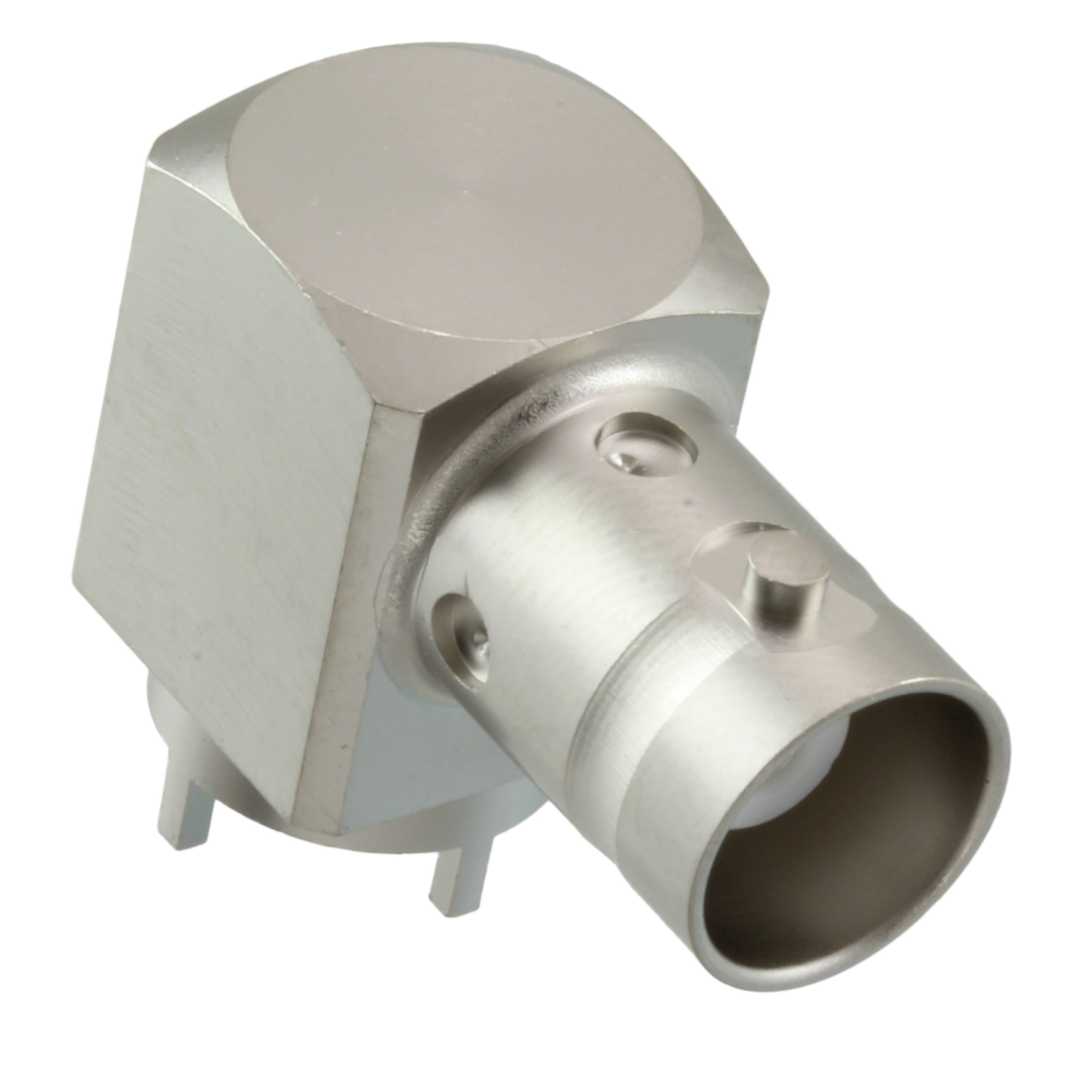
The Amphenol RF 112659 is a BNC connector jack (female socket) designed for 50-ohm coaxial RF applications with through-hole, right-angle PCB mounting. This active product provides bayonet-lock termination suitable for frequencies up to 4 GHz and solder-based contact and shield termination. Substitute components are identified to address inventory availability, extended operating temperature ranges, or specific procurement requirements while maintaining core electrical and mechanical compatibility.
Substiute Parts
Key Parameters
| Parameter | Specification |
|---|---|
| Connector Style | BNC |
| Connector Type | Jack, Female Socket |
| Impedance | 50 Ohms |
| Mounting Type | Through Hole, Right Angle |
| Contact Termination | Solder |
| Shield Termination | Solder |
| Fastening Type | Bayonet Lock |
| Frequency - Max | 4 GHz |
| Body Material | Brass |
| Body Finish | Nickel |
| Dielectric Material | Polytetrafluoroethylene (PTFE) |
| Number of Ports | 1 |
| Voltage Rating | 500 V |
| RoHS Status | ROHS3 Compliant |
| Moisture Sensitivity Level (MSL) | 1 (Unlimited) |
Substitute Part Grouping Explanation
Substitute part identification for the Amphenol RF 112659 is based on the following critical parameters that define functional equivalence:
- Connector Style & Type: BNC jack, female socket configuration
- Impedance: 50 ohms (mandatory for RF signal integrity)
- Mounting: Through-hole, right-angle PCB mounting
- Termination Method: Solder-based contact and shield termination
- Fastening: Bayonet lock mechanism
- Frequency Range: 4 GHz maximum operating frequency
- Dielectric Material: PTFE composition
- Body Material & Finish: Brass body with nickel finish
- Compliance: RoHS/REACH certification status
The Hirose Electric Co Ltd BNC-LR-PC-3(40) satisfies all core electrical and mechanical substitution criteria. Variations in center contact material (phosphor bronze vs. beryllium copper) and operating temperature range do not compromise substitutability for standard RF applications within the specified frequency and impedance parameters.
Parameter Comparison
| Parameter | Amphenol RF 112659 | Hirose BNC-LR-PC-3(40) |
|---|---|---|
| Manufacturer | Amphenol RF | Hirose Electric Co Ltd |
| Connector Style | BNC | BNC |
| Connector Type | Jack, Female Socket | Jack, Female Socket |
| Impedance | 50 Ohms | 50 Ohms |
| Mounting Type | Through Hole, Right Angle | Through Hole, Right Angle |
| Contact Termination | Solder | Solder |
| Shield Termination | Solder | Solder |
| Fastening Type | Bayonet Lock | Bayonet Lock |
| Frequency - Max | 4 GHz | 4 GHz |
| Number of Ports | 1 | 1 |
| Body Material | Brass | Brass |
| Body Finish | Nickel | Nickel |
| Dielectric Material | Polytetrafluoroethylene (PTFE) | Polytetrafluoroethylene (PTFE) |
| Housing Color | Silver | Silver |
| Operating Temperature Range | -65°C to 165°C | -55°C to 85°C |
| Voltage Rating | 500 V | Not Specified |
| Mating Cycles | 500 | 5000 |
| RoHS Status | ROHS3 Compliant | RoHS Compliant |
| Moisture Sensitivity Level (MSL) | 1 (Unlimited) | 1 (Unlimited) |
| ECCN | EAR99 | EAR99 |
| HTSUS | 8536.69.4010 | 8536.69.4010 |
Engineering Selection Recommendations
Primary Component - Amphenol RF 112659: Select this part when extended operating temperature capability (-65°C to 165°C) is required. The ROHS3 compliance status provides confirmation of the most stringent RoHS certification level. Suitable for applications demanding higher mating cycle resilience is not a primary differentiator given the 500-cycle specification.
Substitute Component - Hirose BNC-LR-PC-3(40): This alternative provides equivalent RF performance and mechanical compatibility within the -55°C to 85°C operating temperature window. The component delivers superior mating cycle durability (5000 cycles vs. 500 cycles), making it suitable for applications requiring frequent connector engagement/disengagement. RoHS compliance is confirmed; REACH compliance status is not specified in available documentation.
Selection between these components should be determined by operating temperature requirements and expected mating cycle frequency within the application environment.
Frequently Asked Questions (FAQ)
Q: Can the Hirose BNC-LR-PC-3(40) be used in place of the Amphenol RF 112659 in all applications? A: The Hirose substitute is compatible for RF and mechanical functionality when the operating temperature range of -55°C to 85°C is acceptable. Applications requiring operation below -55°C or above 85°C require the Amphenol RF 112659.
Q: What is the significance of the 500-cycle vs. 5000-cycle mating specification? A: Mating cycles specify the number of times a connector can be engaged and disengaged while maintaining electrical and mechanical performance. The Hirose component sustains 10 times more cycles, making it appropriate for field-deployable or frequently reconfigured systems.
Q: Are the center contact materials electrically equivalent? A: Phosphor bronze (Amphenol RF 112659) and beryllium copper (Hirose BNC-LR-PC-3(40)) both provide acceptable contact resistance and RF performance in 50-ohm BNC applications. Material selection does not affect substitutability for standard RF signal integrity within the 4 GHz frequency specification.
Q: What compliance differences exist between the two components? A: Both components are RoHS compliant and classified as EAR99 export category. The Amphenol RF 112659 carries ROHS3 certification (highest RoHS level). The Hirose component does not specify REACH status in available documentation, which may be relevant for applications in REACH-regulated markets.
Q: Are packaging differences significant for assembly integration? A: The Amphenol RF 112659 packaging is not specified in available documentation. The Hirose BNC-LR-PC-3(40) is supplied in bulk packaging. Confirm tape-and-reel or alternative packaging availability with suppliers if automated assembly integration is required.
Alternative Parts

SJ6012L2TP
Littelfuse Inc.
6 Alternative Parts

JMK107BBJ476MA-RE
Taiyo Yuden
10 Alternative Parts

GMK107BBJ475MA-T
Taiyo Yuden
5 Alternative Parts
SJ6020N2ARP
Littelfuse Inc.
3 Alternative Parts
SJ6025R2ATP
Littelfuse Inc.
4 Alternative Parts

2474-05L
API Delevan Inc.
1 Alternative Parts

4590R-684K
API Delevan Inc.
1 Alternative Parts

CM6560R-334
API Delevan Inc.
1 Alternative Parts

CM6460-104
API Delevan Inc.
1 Alternative Parts

5526-12
API Delevan Inc.
1 Alternative Parts