>
>


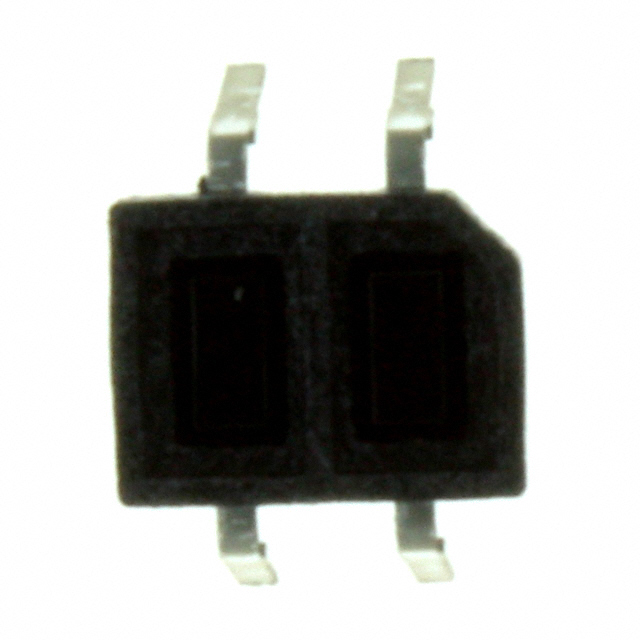
Product overview: GP2S28 Sharp Microelectronics reflective photointerrupter
The GP2S28 from Sharp Microelectronics operates as a reflective photointerrupter, integrating both an infrared emitter and a phototransistor detector within a single, unified housing. This internal alignment enables the device to utilize the principle of reflection: emitted infrared light is projected toward a detection zone, and any object passing within this area reflects energy back into the receiver. The phototransistor responds proportionally, generating a signal indicative of object presence or absence. Critical to its underlying mechanism is the sensitivity of the phototransistor to the reflected wavelength, which is optimized for infrared, ensuring immunity to most visible ambient light and minimizing false positives in typical application environments.
Component architecture plays a pivotal role in stability and repeatability. The GP2S28’s through-hole construction is augmented by specific alignment aids—snap-mount hooks and a dedicated position pin—that deliver secure, repeatable placement during PCB assembly. These features streamline installation, reduce positional error, and offer consistent optical axis orientation, which is essential for uniform sensor behavior across multiple units. In automated high-volume production lines, where cycle times and yield are key metrics, such features have demonstrated value in maintaining both assembly efficiency and device reliability. The robust package and reinforced leads further contribute to stability under mechanical stress, extending operational durability.
In typical application scenarios, the GP2S28 excels in non-contact detection for object presence, position, or motion sense. Its reflective sensing mechanism eliminates the need for direct interruption, allowing for detection in constrained or hard-to-reach areas—common in printers, copiers, ticket dispensers, or automated gates. In motion control systems, the sensor’s response characteristics can be precisely tuned via circuit-level current limiting or signal conditioning, which optimizes switch thresholds for specific reflective surfaces or distances. Fine-tuning the reflective area and optimizing ambient-light shielding have been shown to elevate detection reliability, especially in environments with variable backgrounds or high particulate loads, such as industrial automation equipment.
Significantly, attention to integration details yields improved deployment outcomes. For instance, ensuring that the PCB layout accommodates recommended component clearance prevents optical crosstalk, while implementing firmware-level debounce filtering addresses spurious signals arising from edge-case reflections. Application-specific testing with a full range of target surface materials and colors is critical, as reflectivity variance can substantially impact accuracy. Leveraging the GP2S28's form factor for modular sensor arrays enables scalable, synchronous multi-point object tracking, opening routes for advanced conveyor control or interactive robotics.
Ultimately, the GP2S28 exemplifies a balance of straightforward optical sensing and robust physical integration, supporting both basic and complex applications where consistent, low-latency object detection is required. When combined with thoughtful system design—both in circuitry and mechanical implementation—it offers a cost-effective solution that adapts well across many sectors demanding reliable, maintainable non-contact detection.
Key features and functional principles of the GP2S28
The GP2S28 is engineered as an integrated reflective photointerrupter, leveraging a precisely matched emitter-phototransistor pair. Its fundamental sensing mechanism relies on modulated infrared emission: once an IR source directs light forward, a reflective target within the calibrated geometry returns a portion of the energy, which is captured by the phototransistor’s sensitive surface. This reflective architecture eliminates direct contact, conferring inherent advantages in terms of mechanical durability and protection against particulate ingress, which are chronic issues in environments such as precision printers, automatic feeders, and disc scanning assemblies.
When laying out detection logic, the device's optical pathway is optimized for an object-to-sensor spacing of 6 mm, with robust response characteristics extending from 3 mm up to 14 mm. This detection window is defined by the spatial profile of the emitted and received light cones, as well as by device-specific lensing and package design. Overstepping these parameters introduces a nonlinear drop-off in signal amplitude and an escalation in background interference, highlighting the importance of strict adherence to mechanical tolerancing for consistent performance.
The package presents notable integration features: snap-mounting hooks enable high-throughput, automated assembly and precise alignment without tools, while a position pin ensures repeatability of installation. In practice, these mechanical cues contribute directly to faster production line velocity and mitigate error states linked to sensor displacement—such as missed edge detections or ghost triggering—which is critical for long-term deployment across heavily cycled mechatronic systems.
Field applications commonly exploit the GP2S28's sharp response curve and stable sensitivity to implement cost-effective object presence or edge-detection subsystems. Example use-cases include sheet-fed paper detection where contaminants must be avoided, or index-point referencing on rotary discs. In such installations, proper mounting orientation, black/white contrast management, and controlled environmental lighting are regularly optimized for noise immunity and repeatable results.
A unique insight in deployment involves overdesigning mechanical clearances around the sensor’s field-of-view—slightly narrowing the reflective target size yields a sharper electronic threshold, reducing susceptibility to dust accumulation or reflective background drift. Additionally, including a modestly sloped surface in the reflectance target allows for self-cleaning during cyclic actuation, contributing to lower maintenance frequency and longer device service lives.
An engineering-centric approach recognizes the GP2S28 not merely as a component, but as a repeatable building block for contactless object verification where mechanical integrity, mounting throughput, and environmental resilience are critical. Its architecture favors modular production workflows, while judicious application design ensures stability over large operating intervals, even within high-contamination or vibration-prone machinery.
Electrical characteristics and performance parameters of the GP2S28
Examining the electrical characteristics of the GP2S28 yields a foundational understanding essential for integrating this reflective photointerrupter into precision sensing circuits. The phototransistor output module is engineered to provide seamless interfacing with both digital logic and analog front-ends, supporting straightforward thresholding or continuous signal processing. Key absolute maximum ratings—including forward current for the emitter LED, collector-emitter voltage of the phototransistor, and total package power dissipation at 25 °C—form the boundary conditions for safe and reliable operation, guarding against thermal and electrical overstress in long-term deployments.
An authoritative grasp of the current transfer ratio (CTR) is central, as this parameter links the input drive current to the output phototransistor response and establishes the detection sensitivity in application. Variations in CTR under changing supply voltages and ambient temperatures demand circuit-level compensation strategies. For instance, maintaining stable reference voltages and implementing temperature drift correction circuitry elevates robustness in fluctuating industrial or outdoor environments. Characteristic graphs mapping response time define the module’s bandwidth, directly influencing maximum object speed recognition and filtering capabilities within control loops.
Phototransistor collector current dependency on object distance highlights practical design trade-offs between sensing threshold, field of view, and potential interference. Empirical adjustment of emitter current optimizes signal-to-noise ratio as environmental reflectance or target geometries change. In circuit validation stages, dynamic testing across specified object distances validates both detection repeatability and immunity to ambient light or background reflectors, steering component placement and housing design choices throughout prototyping and scaling.
RoHS compliance and a lead-free build are not merely regulatory matters but also facilitate streamlined procurement and integration into global manufacturing supply chains. With the GP2S28, leveraging comprehensive performance curves for pre-layout simulations and post-assembly tuning ensures adaptive detection profiles, minimizing design iterations. System architects consistently achieve lower defect rates and tight parameter matching through disciplined analysis of these granular data points, embedding the device within high-reliability automation, robotics, or optical counting solutions.
A nuanced insight emerges when balancing specification fidelity with in-field variability: deploying programmable thresholds or adaptive analog filtering effectively mitigates uncertainties introduced by part-to-part variations or environmental perturbations. In advanced applications, feedback from initial deployment informs iterative calibration strategies, subtly shifting performance profiles to align with real-world operating envelopes. Layered engineering discipline—starting from device physics, moving through parameter optimization, and ending at system-level integration—unlocks full utility from the GP2S28, elevating sensing reliability and expanding its application landscape.
Mechanical design, mounting, and handling considerations for the GP2S28
The mechanical integration of the GP2S28 optoelectronic sensor requires precise coordination of case geometry, mounting features, and handling processes to ensure stable operation across diverse system environments. The enclosure exhibits a reinforced structure, with contoured surfaces and an internal layout engineered to resist mechanical stresses such as vibration, torsion, and moderate impact. Such robustness is essential for maintaining calibration integrity and reducing susceptibility to misalignment over extended service intervals. The device’s compact footprint—measuring 12.8 mm × 9.3 mm × 5.4 mm—directly facilitates the development of densely packed PCB configurations, which is increasingly vital for compact digital assemblies and miniaturized industrial modules.
In production, the presence of snap-mount hooks and precision-molded position pins streamlines installation, enabling automated or manual placement with repeatable alignment accuracy. These physical features mitigate lateral shifts and rotational misplacements, which, if unaddressed, can degrade detection thresholds and introduce signal artifacts. Consistency in part orientation during assembly is enhanced by the clear tactile and visual cues incorporated into the package; such design details are critical in high-throughput environments or during rework cycles where reliability hinges on precise re-insertion.
Operational performance is tightly coupled to the management of ambient optical interference. The GP2S28’s sensing face must be shielded from direct exposure to stray environmental light sources, as uncontrolled illumination can raise false positives or reduce sensor sensitivity. In practice, optimal placement involves orienting the sensor so that its active window faces only the intended detection region, and not toward open spaces or external light emitters. Additional mechanical barriers, such as overhanging enclosures or opaque baffles, can be integrated into surrounding housing for further protection, especially in installations exposed to fluctuating lighting conditions.
Connection to control circuitry is straightforward due to standardized pinout labeling on the device body, which accommodates rapid visual verification and reduces wiring errors. The emitter and detector terminals—respectively assigned anode/cathode and collector/emitter—can be linked using conventional processes without requiring specialized instruction. Experience indicates that maintaining sufficient lead clearance and strain relief during soldering not only prevents cold joints but also safeguards the sensor against micro-fracturing at interface points, a recurrent issue in applications involving dynamic mechanical loads.
Incorporating the GP2S28 into advanced systems reveals its value beyond basic photointerrupter duties. Its resilience against mechanical and optical noise makes it a preferred choice for iterative motion feedback in tightly engineered assemblies, such as precision actuators or robotics. The layered strategy of combining sound mechanical design, targeted optical shielding, and disciplined PCB integration elevates overall reliability and directly supports scalable engineering—reflecting an appreciation for integrated sensor handling that transcends minimal requirements and anticipates operational challenges encountered in field deployments.
Environmental compliance and reliability of the GP2S28
The GP2S28 optoelectronic sensor is designed to meet prevailing electronic industry standards with a rigorous emphasis on environmental compliance and operational resilience. At the chemical and materials level, the device demonstrates full adherence to the RoHS directive, actively excluding hazardous elements such as lead, mercury, and regulated brominated flame retardants. Manufacturing protocols are tightly controlled; all production steps avoid ozone-depleting agents and any substances restricted under RoHS, reducing both the environmental footprint and regulatory risk during procurement and deployment.
From a reliability engineering perspective, the device’s longevity pivots on the performance of the embedded infrared emitter (IRED). The component’s operational profile exhibits a predictable degradation curve: under continuous operation, the IRED output is projected to decline approximately 50% over a five-year horizon. This aging mechanism stems from gradual material fatigue and junction-level thermal stress inherent to semiconductor emitters. In applied scenarios, such output attenuation introduces calibration drift or reduced sensitivity, which can subtly affect system performance over time. Proactive maintenance scheduling and judicious selection of operating duty cycles in system design mitigate the impact of photonic decay, enhancing effective device lifetime while maintaining specified detection thresholds.
When deploying GP2S28 in real-world applications, the sensor’s environmental and reliability profile makes it ideal for integration within consumer electronics, office automation products, and industrial process monitoring, where maintenance cycles and access are routine and system-criticality is moderate. For deployments requiring elevated reliability—such as safety control, medical diagnostics, or continuous-process automation—the inherent output degradation and material limits require careful system-level analysis. Engineering teams should integrate redundancy, real-time performance diagnostics, or supplementary sensor modules to secure fault tolerance and maintain operational continuity. Notably, the sensor’s robust compliance characteristics streamline global product certification and supply chain management, but application fit must always be validated for context-dependent reliability objectives.
Strategically, leveraging GP2S28 in environments aligned with its durability and compliance profile ensures optimal lifecycle cost and regulatory conformity. The convergence of engineered materials selection and device-level reliability informs best practices for sensor integration—highlighting the priority of empirical degradation metrics and their translation into actionable system maintenance policies. Embedded within this approach is the insight that, while regulatory compliance prevents many failure modes related to hazardous materials, successful long-term operation demands close attention to photonic emitter behavior and its intersection with application-specific thresholds.
Manufacturing, assembly, and cleaning guidelines for the GP2S28
Manufacturing, assembly, and cleaning of the GP2S28 entail specific controls to preserve device integrity and ensure consistent optical sensor performance. The fundamental restriction on reflow or preheat processes is rooted in the thermal sensitivity of the GP2S28’s package construction—exposure to excessive or uneven heat can induce internal stress, resulting in phototransistor misalignment, encapsulant deformation, or lens clouding. Manual soldering therefore remains the only viable interconnection technique, necessitating tight process discipline: strictly limiting contact to a peak of 260 °C for no more than five seconds per terminal. Overstepping this thermal envelope, or applying mechanical pressure before the solder joint stabilizes, risks micro-cracking or delamination in the highly localized solder zone.
Flux selection presents another critical engineering decision-point. Flux residues—especially those containing halides or aggressive organic acids—may catalyze corrosion or leaching along exposed metal leads, and certain adhesives or coatings may physically compromise the resin enclosure. Proven, non-reactive fluxes, previously characterized for optoelectronic compatibility, mitigate these risks. Practical experience indicates that avoiding no-clean or water-soluble fluxes with high alkalinity reduces optical window hazing and premature surface dulling.
Component cleaning, whether solvent or ultrasonic-based, demands further process validation. Solvent cleaning introduces a thermal and chemical load; it is essential to limit bath temperature to ≤45 °C and the immersion time to under three minutes. Proven solvents—ethyl alcohol, methyl alcohol, and isopropyl alcohol—offer reliable cleaning efficacy without swelling or cracking the device housing, provided vapor exposures remain brief. Ultrasonic cleaning, while effective for fine flux removal, creates microcavitation forces that can propagate fissures into delicate interfaces—application-specific trials at reduced ultrasonic power often reveal an acceptable process window, but this step must be individualized for each board stack-up and fixture design. Residual moisture post-cleaning, if not sufficiently removed, may result in long-term reliability losses due to ionic conduction paths.
High-volume assembly lines benefit from the GP2S28’s ESD-protective shipment in partitioned anti-static packaging, which minimizes handling incidents and lateral impact damage during tray-to-tray transitions. Anti-static cushions constrain both device movement and triboelectric charging, addressing failure modes encountered when packaging is neglected for optoelectronic parts.
A subtle bottleneck in aerial yield often emerges from cumulative minor deviations during handling, soldering, or cleaning. Continuous process monitoring—incorporating thermocouple profiling, solder joint visual inspection, and surface contaminant testing—serves to quickly identify and arrest yield loss. Real-world deployment has consistently shown that organizations prioritizing concurrent validation of assembly and cleaning parameters attain both higher line throughput and device field reliability, underlining the importance of disciplined materials and process selection throughout the GP2S28’s integration chain.
Potential equivalent/replacement models for the GP2S28
Selecting potential equivalents or replacements for the GP2S28 reflective photointerrupter requires rigorous comparison at both the component and system integration levels. The underlying operation of the GP2S28 centers on transmissive optical sensing, where the reflected infrared beam modulates an output in response to obstructions in the detection field. Equivalents from Sharp and other manufacturers, such as the Omron EE-SY1200 or Lite-On LTR-559ALS, must respond with similar electrical signatures and comparable switching thresholds to ensure plug-and-play compatibility or minimize PCB redesign.
Device selection begins with analysis of the sensing range and detection accuracy. The GP2S28 typically features a specified operating distance (e.g., 3–7 mm). Alternatives should operate within this envelope with minimal deviation to maintain detection reliability and reduce calibration overhead in production. Output configurations—open collector versus push-pull—demand matching to the system logic voltage and input impedance, reducing the risk of downstream logic errors or interface rework. Electrical ratings, including maximum forward current and collector-emitter voltage, must support the intended drive circuitry, especially in high-frequency switching applications.
Mechanical integration presents another critical evaluative layer. The mounting pitch, profile height, and slot dimensions directly influence placement tolerances and the manufacturability of the assembly. When footprint variance exists, minor PCB layout adjustments may suffice, but attention to housing retention features and the optical path alignment is necessary to avoid performance degradation. Regulatory compliance, such as RoHS and REACH, ensures continued support throughout product lifecycles, especially in global markets where certification gaps can disrupt supply.
Practical deployment often reveals subtle differences among replacement models. For instance, minor variations in phototransistor response time can influence system bandwidth in high-speed counting or encoding applications. In environments with elevated ambient light or significant EMI, models with integrated daylight filters or shielded housings yield substantially better noise immunity—a factor sometimes underappreciated in initial specification. Batch-to-batch consistency, ensured through collaboration with reputable suppliers, underpins long-term field reliability.
A well-structured equivalency analysis does not merely match datasheet numbers but also anticipates small variances in real-world conditions. Detailed cross-evaluation, prototyping, and validation under typical use cases—such as motor speed feedback, paper edge detection, or optical slot counting—help uncover nuanced behaviors that otherwise remain latent. Early identification of secondary sources and validation of alternative models do more than hedge supply risk: they streamline cost optimization efforts and preserve design momentum under variable market conditions.
Analyzing and validating substitutes must be an ongoing process, not a one-time exercise. Continuous monitoring of sourcing channels, coupled with advance qualification of at least two component variants, fortifies supply chain resilience. Such habitual flexibility becomes a strategic advantage, enabling platforms to adapt quickly to evolving market or regulatory requirements without sacrificing performance or manufacturability.
Conclusion
The GP2S28 reflective photointerrupter features a compact system architecture, optimizing both emitter and detector alignment through its integrated package. The internally shielded phototransistor and infrared LED are positioned to maximize sensitivity and reduce false triggering from ambient light or optical crosstalk, securing consistent detection thresholds. Implementation hinges on understanding the device’s reflective sensing mechanism: the emitted infrared beam returns only when an object enters the designated sensing plane, imposing a distinct logic transition at the photodetector output. This response profile can be fine-tuned by adjusting the drive current and receiver load, enabling precise adaptation for materials with varying surface reflectance and geometries.
Within surface-mount or modular assemblies, the GP2S28 accommodates streamlined production by maintaining stable performance over a broad temperature and humidity envelope. Its housing isolates sensitive elements from environmental stress and contamination, aligning with REACH and RoHS directives for restricted substances. Integration workloads benefit from standard pinout and mechanical dimensions, facilitating immediate compatibility with automated placement and wave soldering processes. To mitigate potential alignment drift, embedding the sensor into rigid frames or employing fiducial marks is recommended during PCB layout and enclosure design.
Typical deployment scenarios span document and media handling machines, industrial positioners, and vending modules. In these contexts, reliable object presence detection reduces maintenance cycles and improves fault diagnostics. Field experience shows that the GP2S28 sustains low failure rates over extended operating periods, especially when supported by surge protection and supply voltage regulation. Persistent performance can be ensured by specifying reflectance targets with controlled diffusive finishes and minimizing direct exposure to high-intensity light sources in equipment interiors.
Selecting the GP2S28 leverages a balance between cost, lifecycle reliability, and integration scalability. Strategic use of its optical characteristics unlocks application flexibility, permitting customization without sacrificing assembly throughput. Proprietary improvements in photointerruption accuracy—such as combinative signal filtering and enhanced mechanical jigs—further position the GP2S28 as a robust node in embedded object sensing. The device’s documentation and long-term supply outlook furnish design assurance, supporting risk-managed procurement and repeatable system validation across divergent manufacturing lines.