


 >
>


Product overview
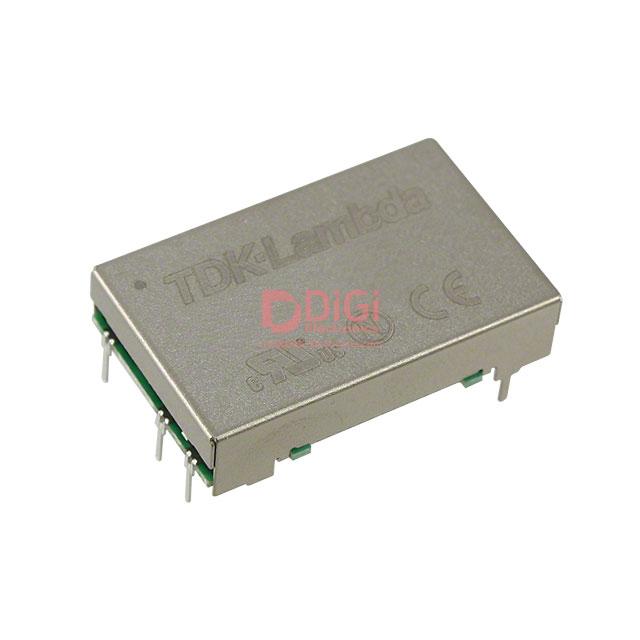
The TDK-Lambda CC10-2403SF-E isolated DC-DC converter addresses the pressing need for efficient, reliable power delivery in space-constrained electronic assemblies. This 10W module, operating over an 18V to 36V DC input with a regulated 3.3V, 2.5A output, integrates power conversion, galvanic isolation, and thermal management within a durable encapsulated package. The design leverages advanced planar magnetic topologies to minimize parasitic elements, supporting high power density while maintaining low conducted and radiated emissions. In practical layouts, the compact footprint and board-mount form factor facilitate close placement near critical loads, reducing voltage drop on low-voltage rails and ensuring signal integrity in sensitive analog or mixed-signal designs.
Internally, the converter employs synchronous rectification and optimized switching frequency to strike a balance between efficiency and EMI compliance, key considerations in both industrial control and demanding instrumentation platforms. The choice of galvanic isolation and robust design ensures resilience under variable environmental stressors and enhances system safety where functional or reinforced isolation is mandated. Input undervoltage lockout, output overcurrent, and thermal shutdown protections are built-in, boosting system-level fault tolerance and reducing external circuit requirements, streamlining BOM and PCB real estate during the design phase.
Selecting the CC10-2403SF-E over alternatives in the 10W class hinges on operational reliability across temperature extremes, documented MTBF statistics, and third-party safety certifications aligned with global standards. Its conservative thermal derating curves and compliant EMC behavior—achievable through standard filtering—mitigate design risk in regulatory submissions. In field deployments, converters of this class routinely demonstrate tight voltage regulation even during input voltage transients or fluctuating load currents typical of edge computing, sensor aggregation nodes, or communications subassemblies.
Application scenarios extend from distributed I/O modules and compact PLCs to sensor power backplanes and remote terminal units. The converter’s robust isolation and EMI profile simplify integration in multi-domain signal environments, enabling mixed-voltage, low-noise operation without the penalty of added shielding or complex ground partitioning.
When specifying power architecture, lifecycle longevity, ease of replacement, and supplier stability provide additional layers of risk mitigation. The sustained availability of the CC-E series and the manufacturer’s transparent documentation pipeline have proven critical in deployed systems facing regulatory or certification-driven redesigns. Insights gleaned from repeated design-in cycles demonstrate that investing in modules with superior thermal conduction and conservative component rating results in reduced in-service failures and simplified thermal management, especially when deployed in sealed or passively cooled enclosures.
Overall, the CC10-2403SF-E exemplifies a strategic convergence of electrical robustness, application flexibility, and integration efficiency. Its underlying architecture and field performance data reinforce the importance of harmonizing specification, compliance, and supply assurance when architecting resilient embedded power solutions.
Key technical specifications of the TDK-Lambda CC10-2403SF-E
The TDK-Lambda CC10-2403SF-E is engineered to address critical requirements in compact, high-reliability power conversion scenarios, relying on well-defined performance metrics and robust electrical isolation. At its core, the CC10-2403SF-E operates with an input voltage tolerance ranging from 18V to 36V DC, specifically optimized for integration into standard 24V DC-bus architectures common in industrial automation, instrumentation, and communications systems. This broad input range mitigates supply variability and transient disturbances, strengthening compatibility across diverse installation environments.
Fundamentally, the module presents an isolated, tightly regulated single 3.3V output capable of delivering up to 2.5A continuously, equating to 8.25W of output power. This configuration caters to logic, low-voltage processor rails, sensor interfacing, and other sensitive loads requiring precise voltage and current management. Output regulation is maintained within ±3%, minimizing deviation under dynamic load and input fluctuations. Low ripple and noise, typically at 40mV for the 3.3V channel, ensure clean power delivery essential for noise-sensitive analog and digital circuits, supporting deterministic system behavior in signal processing and communication nodes.
With a typical efficiency of 84%, the module brings substantial value for thermal and energy management in dense layouts. Efficient conversion reduces dissipated heat, simplifying thermal design and enabling closer component placement, without compromising operational integrity across the specified temperature range of –40°C to +85°C. Careful derating is employed above 60°C ambient, balancing power capabilities with longevity and reliability. Practical implementation reveals that, when mounted on forced convection-cooled surfaces or thermally conductive PCB layers, the CC10-2403SF-E maintains stable operation even under high cycling loads—an attribute often leveraged within distributed power systems and panel-mounted controllers.
A cornerstone of this product's appeal is its reinforced 500Vac isolation, extending between input-to-output, input-to-case, and output-to-case circuits. This feature not only provides intrinsic fault containment and limits the propagation of surges but also facilitates compliance with global safety protocols, including IEC and UL standards. Such isolation is instrumental when deploying the module in mixed-voltage architectures, harsh environments, or in functional safety circuits where galvanic separation protects both equipment and signal integrity.
Operational experience consistently demonstrates the module's resilience to supply disturbances and electromagnetic interference when installed with appropriate filtering and layout discipline. Designers usually exploit the compact mechanical footprint and fully encapsulated form factor to maximize PCB utilization, integrate with industrial bus connectors, and accelerate system certification. Strategic use of the CC10-2403SF-E in modular system designs underscores a core insight: favoring isolated power conversion not only improves reliability and safety but also elevates flexibility in redesign or late-stage customization.
Through disciplined engineering, the CC10-2403SF-E exemplifies a balance between electrical accuracy, system protection, and application versatility. Its specification and proven deployment in the field have established it as a reference solution for scalable, high-integrity DC-DC power conversion within tightly constrained installation domains.
Design features and operational advantages of the TDK-Lambda CC10-2403SF-E
The TDK-Lambda CC10-2403SF-E exemplifies advanced power module engineering for rigorous industrial and embedded environments. At its core, the unit employs a robust five-sided metal enclosure, an architectural choice that attenuates radiated electromagnetic interference at the source. This EMC-centric design eliminates the need for complex downstream shielding or board-level countermeasures, streamlining compliance with increasingly stringent system-level regulations and accelerating certification cycles.
Physical integration is optimized through a compact 1.4" × 0.89" × 0.33" mechanical profile. This geometry, paired with a vertical PCB mounting approach, enables efficient use of board real estate and supports the development of high-density systems where space constraints are paramount. In multi-rail or modular architectures, such a form factor facilitates parallel placement and ease of thermal zoning, mitigating localized hot spots and promoting system reliability.
Remote on/off functionality further elevates operational flexibility. The active-low interface simplifies power sequencing, supporting coordinated system startup and rapid power-down without the necessity for external relays or FET switches. In power-sensitive deployments or distributed architectures, this mechanism enables granular management of module activation, reducing overall quiescent draw and supporting advanced energy states such as sleep or deep standby. The absence of a minimum load condition eliminates design bottlenecks where dynamic loads or intermittent peripherals can momentarily drop output demand below legacy converter thresholds, ensuring output stability across the full operating envelope.
Overcurrent protection is implemented via a hiccup-mode methodology, balancing fault tolerance with device safeguarding. Unlike conventional current limiting, hiccup protection cycles the output in response to persistent overloads, minimizing thermal buildup within both module and downstream loads. This approach prevents permanent damage or latchup scenarios, improving system recoverability in the field. The elimination of internal potting is another distinctive characteristic, directly impacting thermal management and mechanical mass. With improved heat transfer to the user’s heatsinking infrastructure and reduced weight, system designers gain additional flexibility in meeting both thermal and mechanical constraints in space-limited installations.
Thermal performance distinguishes the CC10-2403SF-E in high-power-density contexts. Operation up to 85°C ambient with derating curves superior to traditional encapsulated units ensures usable output even in densely populated chassis or sealed enclosures. This attribute is critical when forced-air cooling is impractical, or airflow pathways are obstructed by proximate subsystems or cabling.
From an application perspective, the module’s feature set aligns with the stringent uptime and EMC requirements found in telecom, process automation, and mission-critical IoT infrastructure. In practice, the low EMI signature simplifies rack- or panel-level integration, especially where mixed-signal or RF domains must coexist. The flexible load-handling capability supports variable draw scenarios common in sensor-centric and intermittently powered node designs.
A key insight is the synergy between mechanical form factor and electronic resilience: by integrating structural EMI control, robust fault management, and superior thermal paths, the CC10-2403SF-E advances reliability and lowers system design friction. It enables direct translation of theoretical protections and efficiencies to real-world deployments, minimizing the need for iterative shielding, board modification, or operational compromise. This convergence of electrical, thermal, and mechanical optimizations positions the module as a foundational element in next-generation, high-reliability power subsystems.
Series variations and selection flexibility in the TDK-Lambda CC-E family
Series variations within the TDK-Lambda CC-E family demonstrate targeted engineering for precision power regulation and integration flexibility. The CC-E product range, exemplified by entries like the CC10-2403SF-E, offers output powers scalable from 1.5W up to 10W, supporting input voltages spanning 4.5V to 76V. Such extensive input tolerance underpins compatibility with both battery-powered low-voltage systems and industrial environments where transients or wide supply rails are prevalent. Output configurations include both single and dual channels, with voltage selections covering standard 3.3V rails through to 15V, and up to 30V by series-connecting the dual outputs. This architectural diversity empowers designers to optimize for current sharing or voltage stacking, streamlining multi-rail systems and facilitating expansion without board redesign.
Mounting format options—through-hole, surface-mount, and SIP—address the full spectrum of PCB layout strategies, accommodating rapid prototyping and volume manufacturing alike. Engineers deploying these modules can selectively balance thermal management, mechanical stability, and assembly throughput. For instance, SIP modules minimize footprint while retaining ease of insertion, a practical advantage where board real estate is at a premium but accessibility is necessary. Surface-mount packages integrate tightly into automated assembly, supporting high-density layouts and consistent soldering results, critical for scaling production without sacrificing reliability.
A fundamental capability across all CC-E variants is the presence of trim terminals for output voltage adjustment. This function enables real-time calibration according to load demands or environmental drift, reducing line regulation uncertainties and simplifying system qualification. Subtle refinements in voltage setpoints via trim adjustment can directly mitigate downstream component stress or instability, enhancing long-term system robustness. For scenarios demanding higher voltage outputs, the dual-output models allow series operation. By selecting and wiring output pins appropriately, a single module can serve both low voltage regulation or deliver combined outputs for elevated rail requirements. This feature reduces supply inventory complexity and allows legacy PCB designs to remain serviceable with minimal modification.
In practical deployment, engineers frequently exploit this internal flexibility during iterative prototyping, adapting voltage rails to match sensor arrays, microcontrollers, or analog subsystems. The capacity to fine-tune outputs prevents the necessity for additional linear regulators or voltage dividers, lowering both bill-of-materials cost and potential points of failure. In dynamic environments—such as industrial automation panels or distributed edge computing nodes—these adjustments offer superior control of startup behavior and transient response, especially when applications evolve from initial concept to production.
A key observation in the CC-E family is strategic convergence: modularity does not compromise electrical performance. The design achieves persistence of low ripple, stable isolation, and consistent regulation across selectable voltages and power ratings. This approach ensures seamless migration between models as system requirements grow. Such stability underpins confidence in power subsystem scalability, permitting direct migration from prototype to field deployment without extensive electrical redesign. The embedded adaptability in mounting and electrical configuration confirms the CC-E series as a reliable platform for diverse application layers, ranging from telecom datalines to precision instrumentation and remote sensor networks—each benefitting from its layered flexibility and restrained complexity.
Suitable applications for the TDK-Lambda CC10-2403SF-E
The TDK-Lambda CC10-2403SF-E occupies a strategic position in modern power subsystem design, attributed to its isolated DC-DC topology, robust electrical reliability, and carefully engineered mechanical footprint. The device’s output voltage precision and low noise characteristics ensure compatibility with sensitive IT and commercial equipment, delivering stable power rails that are both isolated and resilient to input supply variations. These qualities are essential in network switches, data acquisition interfaces, and edge computing nodes where voltage anomalies or ground loops can induce unpredictable logic behavior or data corruption.
In industrial environments, the predominance of 24V bus architectures makes the CC10-2403SF-E’s input range and isolation barrier well-matched for factory automation, distributed I/O modules, and programmable logic controller subsystems. Here, the converter’s ability to maintain output regulation across wide input fluctuations and temperature swings safeguards critical process controls from erratic downtime, even in electrically noisy, thermally dynamic enclosures. Field implementations have underscored the value of its rigorous EMI suppression—designers have consistently achieved CE and FCC compliance margins without excessive reliance on supplementary input filtering or shielding.
Telecom and test instrumentation notably benefit from the module’s minimized conducted and radiated emissions paired with a dependable transient response. The isolation between power source and load is crucial in protecting low-level analog front-ends from both high-energy disturbances and cross-channel interference. As mixed-signal boards grow in density, the CC10-2403SF-E’s surface-mount configuration and thermal performance support congested layouts, promoting modular architecting and facilitating progressive, board-embedded power distribution—mitigating the risks of hot spots and voltage droop at distant load points.
Compact embedded platforms present unique integration challenges, often governed by restrictive space and weight limitations. In such systems, decentralized power conversion is instrumental in achieving higher system efficiency and resilience. The CC10-2403SF-E’s compact form factor and high conversion efficiency permit close placement to critical load circuits, reducing trace parasitics and alleviating the derating pressure on downstream regulators. Real-world designs show that embedding converters of this class directly onto mezzanine or sensor boards improves scalability and shortens product development cycles.
Scenarios imposing strict EMI and thermal constraints require a converter not just with low emissions but also rigorous validation across extended temperature ranges. The CC10-2403SF-E’s design incorporates advanced switching and layout optimizations to harmonize electromagnetic performance with minimal self-heating, supporting error-free operation in both controlled and harsh environments. Such thermal and EMC robustness directly translates to higher system reliability—a recurring theme in safety-critical and mission-oriented equipment where predictive maintenance is favored over post-event rectification.
A key insight in leveraging the CC10-2403SF-E lies in its dual utility as both a drop-in solution for off-the-shelf platforms and a building block for scalable, customized power architectures. The converter’s intrinsic versatility streamlines both initial design and long-term support, reducing non-recurring engineering overhead and simplifying inventory management for evolving product lines. Through careful selection and placement, the CC10-2403SF-E can extend beyond a traditional DC-DC converter role, underpinning resilient, scalable systems that are robust against evolving operational demands and regulatory standards.
Potential equivalent/replacement models for the TDK-Lambda CC10-2403SF-E
Evaluating alternative models to the TDK-Lambda CC10-2403SF-E demands a rigorous approach rooted in both technical performance and practical deployment flexibility. The core requirement centers on sustaining key electrical parameters: 3.3V output at 2.5A, robust isolation, and wide input voltage compatibility. Alternatives within the same CC-E series, such as the CC10-2405SF-E or CC10-2412SF-E, extend the voltage output range, providing options for layouts demanding higher voltage rails, thus facilitating seamless design modifications without sacrificing footprint consistency or architectural integrity.
When broadening the scope to cross-vendor substitutes, each candidate must be dissected for more than just headline specifications. The focus shifts to matching the input voltage tolerance, verifying high conversion efficiency—particularly critical for thermal management in dense assemblies—and confirming the unit's capability to sustain tightly regulated output under fluctuating load conditions. Only converters engineered to industrial-grade reliability standards, such as those bearing appropriate UL or EN certifications, should be shortlisted. This ensures resilience to transient spikes and electromagnetic interference, preserving circuit stability in real-world environments, including those subjected to vibration, wide temperature swings, or aggressive EMC profiles.
Mechanical compatibility is an axis that often gets underestimated in quick replacement scenarios. Pinout arrangements and enclosure form factors govern the ease and cost of retrofitting, with mismatches potentially triggering PCB redesign or operational disruptions. Experienced practitioners will scrutinize datasheets and, if available, evaluate sample units for fit and performance inside running prototypes, thereby detecting subtle issues before full-scale production.
An integrated weighing of protection feature sets—encompassing input undervoltage lockout, output overcurrent/short-circuit protection, and thermal shutdown—directly impacts operational safety and lifecycle longevity. Engineering teams accustomed to iterative stress-testing know that nuanced differences in these safeguards can result in diverging failure mode profiles across alternatives, influencing the mean time between failures and support burden.
A unique perspective emerges when considering the modularity and scalability of the chosen converter within evolving architectures. Selecting substitutes that support incremental expansion, such as paralleled operation or easy voltage adjustment, can yield significant downstream advantages in future product revisions. This forward-looking consideration typically proves invaluable, especially when designing platforms that might later diversify power rail requirements or tighten space constraints.
Through such a layered assessment strategy—first mapping electrical fidelity, then scrutinizing mechanical and reliability aspects, and finally accounting for long-term system evolution—optimal replacement solutions can be systematically identified, significantly minimizing technical risk and streamlining product transitions under shifting supply chain landscapes.
Package, installation options, and mechanical considerations of the TDK-Lambda CC10-2403SF-E
The TDK-Lambda CC10-2403SF-E module is engineered for reliable integration within demanding power conversion environments, leveraging a standardized through-hole 7-DIP configuration measuring 35.6mm × 22.6mm × 8.5mm. Its compact footprint facilitates efficient use of board real estate while accommodating robust power delivery. The all-metal enclosure is not merely an external shell—it is instrumental in providing electromagnetic shielding and enhancing mechanical durability. This housing attenuates both radiated and conducted noise, minimizing the risk of EMI-induced performance degradation at the system level.
Critical attention to pinout configuration is required when designing PCB footprints. Variations in layout alignment can lead to assembly inconsistencies or signal path errors, potentially undermining electrical integrity and impeding automatic soldering efficiency. Careful mapping of the pin sequence improves not only assembly yield but also minimizes potential for stray capacitance or inductive coupling in high-frequency switching regimes. Advanced CAD tools allow for precise pad alignment and support increased reliability during manufacturing by reducing susceptibility to cold joints, especially when higher layer count boards are involved.
Thermal management remains a central consideration for maintaining operational longevity and consistent performance. The CC10-2403SF-E is specified for continuous operation at altitudes up to 2000m and humidity levels below 95% (non-condensing), reflecting a focus on application versatility. In actual deployment, system architects frequently implement airflow strategies—both natural convection and forced cooling—depending on power density and ambient conditions. Analysis of thermal profile during prototyping—including infrared imaging and strategic thermistor placement—enables fine-tuning of heatsinking options and ventilation layout. Such empirical adjustments contribute to greater margin against thermal derating and reduce maintenance intervals.
The CC-E series extends options beyond the DIP module, incorporating surface-mount and SIP alternatives across varying power ratings. This modular approach supports flexible PCBA design, accommodating both fully automated assembly flows and hybrid processes. In practice, selection between surface-mount and through-hole variants is often driven by mechanical anchoring requirements, anticipated vibration loads, and ease of field replacement. Integration across mixed package types necessitates detailed planning of board stackup to avoid thermal shadowing and ensure signal integrity.
A key insight is the value of treating mechanical and electrical design constraints as interconnected systems rather than isolated elements. Optimizing the balance between shielding, pin assignment, and heat management not only streamlines assembly and reliability but also preserves the module’s high-efficiency conversion capability in real-world operating scenarios. Thoughtful adoption of flexible mounting options aligns with evolving PCB manufacturing techniques, enhancing adaptability for prototyping and volume production alike.
Environmental and regulatory compliance of the TDK-Lambda CC10-2403SF-E
Environmental and regulatory compliance of the TDK-Lambda CC10-2403SF-E hinges on its RoHS conformity and REACH unaffected designation, streamlining certification workflows and expediting cross-border deployment. RoHS compliance directly addresses lead, mercury, cadmium, and flame retardants, reducing hazardous substance management overhead while simplifying the bill of materials vetting process for OEMs. REACH unaffected status signals the absence of SVHCs, obviating the need for ongoing substance tracking or complex reporting protocols, particularly relevant for manufacturers shipping into the EU or regions with harmonized chemical regulations.
The module’s full certification under IEC/UL/CSA/EN 62368-1 supports seamless integration in diverse electronic and IT system architectures. The presence of CE and UKCA markings eliminates a significant testing burden during subsystem evaluation, shrinking time-to-market and circumventing costly field failures tied to regulatory mismatches. These markings also reflect a verified assessment of insulation, touch safety, and fire hazard mitigation, anchoring the design risk analysis phase with recognized metrics.
Operational robustness extends across ambient extremes, with the thermal envelope engineered to support both convection and conduction cooling in high-density enclosures or field environments. This broad temperature resilience aligns with design practices that demand minimal derating and facilitate rapid system qualification under variable deployment conditions. The five-year warranty is not merely a commercial statement but a proxy for deeply embedded lifecycle validation, including accelerated aging, failure mode engineering, and root cause analytics that preempt common degradation pathways.
In practice, integrating the CC10-2403SF-E into regulated applications—such as industrial controls or medical diagnostics—yields measurable process efficiencies. Documentation requirements are compressed, supplier assessments are simplified, and procurement delay risk is reduced. The continuity of compliance is embedded in both device and process layers, making the module a catalyst for both rapid product launch and sustained regulatory conformity. A recurrent insight emerges: leveraging components with comprehensive compliance portfolios results in quantifiable reductions in non-conformance incidents and enhances total cost-of-ownership metrics, extending the value proposition from design through operational maturity.
Conclusion
The TDK-Lambda CC10-2403SF-E through-hole DC-DC converter demonstrates a convergence of high efficiency and resilient galvanic isolation, rooted in a carefully engineered topology that prioritizes energy transfer and thermal management. The isolation barrier, realized through advanced transformer construction and PCB layout strategies, not only mitigates ground loop and transient risks but also assures operational stability across variable load and input scenarios. This mechanism underpins the converter’s suitability for environments where electromagnetic interference and voltage differentials must be stringently controlled.
Its compact through-hole package streamlines board integration, reducing footprint while enabling robust mechanical bonding essential for vibration-prone industrial contexts. The mounting methodology leverages standard pinouts and spacing, facilitating drop-in replacement and incremental system upgrades without extensive board redesign. The physical design also accommodates heat dissipation paths, enabling consistent performance under sustained load cycles—a critical factor for applications with dense component assemblies or limited airflow.
From an electrical perspective, the CC10-2403SF-E offers wide input voltage compatibility, allowing deployment within both legacy infrastructure and new platforms. This flexibility extends into power scaling, as the converter forms part of the modular CC-E series, which supports parallel and serial configurations. Engineers can confidently architect distributed power systems, ensuring seamless expansion for future requirements while maintaining uniform interface and compliance characteristics. Such modularity supports application scenarios ranging from PLC backplanes to remote sensor clusters, where adaptation and reconfiguration are frequent.
The converter’s regulatory adherence, including rigorous safety and EMC certifications, streamlines qualification cycles and reduces risk in audit-driven procurement processes. Environmental ratings span broad temperature and humidity profiles, aligning with industry needs for reliability in harsh or remote installations. These parameters result in reduced maintenance intervals and predictable lifecycle metrics, supporting sustained system uptime.
Practical experience with the CC10-2403SF-E highlights rapid prototyping advantages and minimal derating under operational stress, reinforcing its value in design validation and accelerated time-to-market. Configuration options—such as alternate output voltages or custom pin maps—enhance utility for engineers requiring tailored solutions without sacrificing standardization or supply chain continuity. This level of adaptability, coupled with consistent production quality, positions the CC10-2403SF-E as a foundational element in both incremental upgrades and new builds.
The design philosophy employed by TDK-Lambda reflects an understanding of evolving power conversion challenges, where integration, reliability, and regulatory certainty intersect. The CC10-2403SF-E, with its layered capabilities, serves not only immediate technical requirements but also anticipates future expansion and system diversification, fostering a coherent and scalable approach to board-level DC-DC power design.


