>
>


Product overview: Sharp PC942 optoisolator series
The Sharp PC942 series represents a robust optoisolator solution engineered for reliable signal isolation in power electronics. By integrating an advanced gallium-arsenide infrared LED on the input side with a high-gain phototransistor output stage, the PC942 achieves efficient optical coupling while maintaining minimal electrical interaction between input and output. This architecture provides critical galvanic isolation, enabling up to 5000Vrms withstand voltage—a level sufficient to protect control logic from hazardous transients typical in high-voltage switching systems.
The 8-DIP molded package is optimized for automated assembly and long-term durability under thermal and mechanical stress. Dual-channel variants further extend application flexibility, allowing compact implementation of multiple isolated signal paths. In power transistor driver circuits—especially IGBT and MOSFET gate drivers in motor control inverters or switched-mode power supplies—the ability to deliver sharp, noise-immune transitions without compromising isolation is essential. The PC942 precisely addresses these requirements with consistent CTR (current transfer ratio) performance over temperature, rapid switching characteristics, and assured creepage distances in accordance with safety regulations.
Practical field deployment reveals that the PC942 maintains stable operation even in aggressively noisy environments. Its low input trigger threshold current aids in reducing drive circuit power consumption, while the phototransistor’s fast saturation and recovery time facilitate precise timing control for high-frequency switching. These attributes minimize propagation delay mismatches—a common source of inefficiency and excessive device stress in PWM topologies. Additionally, the reinforced insulation structure supports reliable long-term function even under repetitive surges, a frequent stressor in industrial drives.
A nuanced advantage is the series’ resilience to common-mode voltage swings, ensuring control integrity across variable ground references. With mounting options compatible with standard footprints, the transition from legacy isolator designs to the PC942 can proceed with minimal board rework. Design experience demonstrates that optimal performance is achieved when pay attention is given to input current limiting, PCB layout for optimal isolation, and derating for worst-case thermal loading. Selecting the PC942 series streamlines compliance with global safety standards while delivering the solid-state reliability necessary for mission-critical industrial control and automation systems.
PC942 technical specifications and features
At the core of the PC942’s robust technical offering is its rated isolation voltage of 5000 Vrms, establishing a critical safeguard in environments subject to high transient voltages or stringent safety regulations. This specification directly addresses isolation requirements in industrial control and power electronics, mitigating risks of ground loops and voltage surges between high and low voltage domains. The PC942’s single-channel configuration reflects a careful balance between circuit simplicity and functional isolation, minimizing the need for complex routing while enabling precise, point-to-point signal transfer where reliability is non-negotiable.
The internal architecture combines an OPIC (Optical IC) detector with a phototransistor, forming a tightly integrated signal path that ensures robust optical-to-electrical conversion. The OPIC detector exhibits low variance in response characteristics, ensuring stability even under fluctuating input conditions or in the presence of electrical noise. This intrinsic stability enhances signal fidelity, allowing the optoisolator to serve as a dependable isolation interface in feedback loops for power supplies or gate drive circuits for IGBT/MOSFET modules. By preserving sharp signal edges and minimizing propagation delay, the device enables designers to maintain tight timing control in rapidly switching environments.
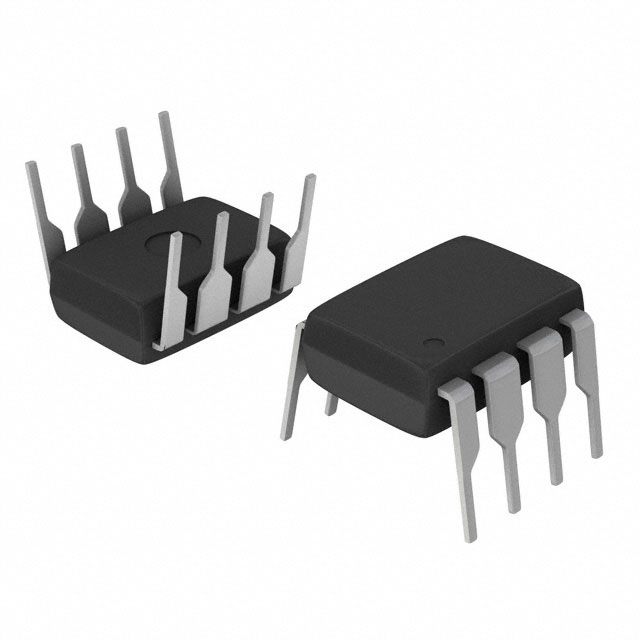
Physically, the 8-DIP package streamlines assembly and maintenance procedures, with ample pin spacing that supports higher creepage and clearance distances—critical for meeting safety standards such as UL or IEC specifications. This packaging choice aligns with industry trends for modular, serviceable hardware, simplifying replacement and troubleshooting. In practical deployment, the PC942 demonstrates consistent performance during solder reflow and wave soldering, with its mechanical tolerances supporting automated insertion processes—a vital consideration during scale-up from bench prototypes to high-volume manufacturing lines.
From an electrical standpoint, the input side accommodates standard LED drive currents, enabling seamless integration with logic-level control circuits or microcontroller outputs. The output phototransistor’s current transfer ratio (CTR) and response time parameters are engineered for compatibility with a range of load impedances, allowing direct interfacing with digital or analog circuits without extensive buffering. This makes the device an ideal fit for interfacing microcontroller logic with relay drivers, motor controllers, or isolated sensor front-ends, where both signal integrity and electrical safety are equally critical.
In practical use, engineers often leverage the PC942’s consistent switching characteristics to suppress cross-domain interference, especially in mixed-signal environments where analog precision and digital noise coexist. Its high isolation strength not only supports fail-safe operation in electrically noisy settings, but also opens the door to more compact PCB layouts by obviating the need for excessive physical separation between voltage domains. When rapid prototyping or system modifications are required, the conventional 8-DIP footprint allows quick socket swaps, facilitating iterative development cycles and system debugging without the risk of damaging sensitive components.
The PC942 thus exemplifies an optoisolator engineered not only for raw isolation but also for versatility and real-world integration. Its combination of electrical robustness, signal clarity, and mechanical compatibility positions it as a foundational building block in both established and emerging electronic control architectures. Well-considered design choices—such as the OPIC detector and single-channel footprint—signal an understanding of the nuanced tradeoffs between performance, manufacturability, and system reliability, a theme that increasingly shapes the direction of isolation component selection in modern engineering practice.
Engineering applications of the PC942 optoisolator
Engineers deploy the PC942 optoisolator in circuit topologies requiring robust electrical isolation between control logic and high-voltage domains. Its underlying operation rests on efficient optoelectronic signal transmission, where an internal LED emits photons that trigger a phototransistor, maintaining isolation up to several kilovolts. This physical separation of input and output paths inherently suppresses conductive interference and supports compliance with IEC and UL standards for safety-critical applications.
Within switching power supply designs, the PC942 serves to gate drive MOSFETs or IGBTs without forming dangerous ground connections. Integration in these environments takes advantage of the device’s fast propagation times and high common-mode transient immunity, enabling precise pulse shaping even when power stages operate at hundreds of volts. Engineers often select the PC942 for AC-DC or DC-DC converter circuits, knowing its performance is stable across thermal cycles—an essential characteristic in high-frequency or temperature-variable systems.
In motor control architectures, isolation requirements intensify due to noise generated by high-current switching and risk of overvoltage faults. The PC942’s ability to withstand differential surges protects low-voltage microcontroller units and sensor arrays, preserving functional integrity during both nominal operation and transient fault scenarios. Actual implementations commonly pair the PC942 with gate driver ICs, constructing multi-stage isolation layers to achieve redundancy and meet functional safety analysis targets.
Isolation extends beyond power; communication pathways in industrial automation benefit significantly. Galvanic separators using the PC942 impede ground loop formation, which in distributed control networks can induce unpredictable analog offsets or data corruption. Such optoisolators become critical in signal level shifters bridging PLCs and high-voltage actuators, particularly when safety regulations enforce clear demarcation between operator-accessible and hazardous areas. Effective placement within RS-232, Modbus, or proprietary communication links reduces electromagnetic coupling, reflected in stable bit rates and minimal frame errors.
Several deployment experiences highlight the importance of PCB layout when leveraging the PC942. Wide dielectric spacing and careful routing around critical tracks optimize isolation, while adequate decoupling near the input LED maintains switching fidelity. It has also been observed that long-term reliability is increased where surge-handling is enhanced via coordinated use of TVS diodes and robust optoisolator models.
Strategic selection of optoisolators like the PC942 often signals a commitment to upstream system protection rather than downstream fault tolerance. This proactive design choice enhances EMI resilience, reduces service interventions, and extends operational lifespans in high-demand environments. The layering of isolation—between signal, control, and power circuit segments—remains a core method for achieving both functional and regulatory success in modern electrical engineering infrastructure.
Key considerations for product selection and implementation
A comprehensive product selection process for the PC942 demands a multifaceted technical evaluation, anchored in both electrical and physical compatibility. The first layer centers on electrical interfacing: scrutinizing the PC942’s OPIC photodetector input thresholds and output drive capabilities against the system's signal environment. Parameter alignment is essential, as mismatched logic levels or current limits can lead to erratic control or rapid failure, especially in designs leveraging edge-triggered or high-speed switching architectures. Application scenarios involving diverse microcontroller families or gate driver ICs further highlight the importance of reference measurements and waveform validation during initial prototypes.
Beyond purely electrical concerns, thermal and mechanical integration emerges as a critical axis. The PC942’s 8-DIP package must seamlessly align with the target PCB footprint, accounting for trace width planning for power dissipation and any required copper pours to manage localized heating. Elevated junction temperatures accelerate aging phenomena such as optoisolator CTR degradation, making heat mitigation strategies—like proper pad layout, thermal vias, or forced convection airflow—central to maintaining long-term system reliability, particularly where sustained switching or high current density is present.
Regulatory compliance interlocks directly with insulation and safety mandates. The PC942’s creepage, clearance, and dielectric withstand ratings must be mapped explicitly to the relevant application class—for instance, reinforced insulation in industrial controllers or solid insulation in appliance interfaces. Validating these attributes early circumvents design iterations for safety certification and provides confidence when transitioning from engineering build to mass production.
In reliability engineering, statistical field and accelerated aging data underpin predictions of mean time between failures (MTBF). Environments characterized by high humidity, temperature cycling, or voltage transients necessitate extra scrutiny of device endurance. Dual-sourcing from globally vetted, traceable distributors mitigates risks of supply chain variance, counterfeit infiltration, and post-deployment support gaps—experience shows that even minor discrepancies in PCN handling between batches can ripple into systemic debugging cycles or field replacements.
Switching speed and drive strength must scale precisely with the gate charge and base drive characteristics of downstream switching devices. Undersizing these parameters can bottleneck transient performance, inducing excess turn-on losses in IGBTs or MOSFETs, exacerbating EMI issues, or forcing compensatory overspecification of snubbers and filters. Robust design practice includes iterative SPICE modeling, gate waveform oscilloscope validation, and thermal ramp stress testing under realistic load transients, extracting actionable insights for final device selection and tuning.
Each of these interlocking layers contributes directly to a resilient, manufacturable system design. Applying disciplined product screenings, rooted in both component datasheets and empirical field measurements, is central to optimizing implementation of the PC942 in advanced control architectures. System-level robustness and maintainability can often be traced back to disciplined, detail-focused choices at the optoisolator selection stage.
Potential equivalent/replacement models for Sharp PC942
Identification of suitable equivalent or replacement models for the Sharp PC942 optoisolator demands a rigorous approach anchored in electrical, mechanical, and regulatory criteria. Lifecycle management for optoisolators often hinges on supply reliability and revision protocols, where direct component substitution can mitigate risks stemming from obsolescence or single-source dependency. The transition is not trivial; nuanced differences in device architecture and performance necessitate a granular analysis to safeguard design integrity.
At the core, comparison begins with electrical isolation ratings—the primary safeguard against voltage transients. The Sharp PC942 typically offers isolation levels tailored for industrial control logic interfaces, so replacements must deliver equivalent or superior withstand voltages and insulation distances. Failure to match these core parameters can result in compromised safety margins or non-compliance with system-level certification requirements. Packaging format also exerts pronounced influence; optoisolators such as the PC942 commonly feature 8-DIP footprints compatible with automated PCB assembly processes. Substitutes must not only match pin-out and mechanical dimensions but also exhibit comparable thermal dissipation characteristics to ensure long-term operational reliability.
Performance benchmarking extends to channel configuration—most industrial controllers interface via single or dual channels per package. Signal input-output response, propagation delay, and CTR (current transfer ratio) consistency become vital when timing precision and load regulation are mandatory. Variations in these specifications, even within identical package forms, can disrupt logic sequencing or introduce unpredictable switching behaviors. Certification compliance should not be overlooked; the role of product standards such as UL, VDE, and RoHS carries implications for global regulatory approval, field safety audits, and contractual adherence. Substitutes from established manufacturers must demonstrate documented conformity to these benchmarks, including longevity evaluations under extended temperature and humidity stress.
In day-to-day engineering practice, seamless proof-of-compatibility arises from comprehensive datasheet cross-referencing and preliminary breadboard validation. Deploying functional equivalents from suppliers like Vishay, Toshiba, or Everlight often involves prototype swaps where subtle differences in input LED thresholds or phototransistor saturation voltages must be empirically tuned. For critical installations, field testing under worst-case load scenarios preempts failure modes that datasheets alone cannot predict. Experienced practitioners recognize that supply continuity extends beyond parameter matching; supply chain resilience from secondary sources and revision-control documentation ensure scalable, future-proof design ecosystems.
Stability in replacement decisions benefits from maintaining robust parametric margins and promoting dual-sourcing strategies early in platform design. Vacuum-tight adherence to documentation is insufficient; inter-component compatibility testing, reliability forecasting under harsh environments, and continuous validation against published standards power robust change management protocols. Iterating through candidate models and evaluating secondary effects—such as electromagnetic interference immunity and surge recovery—enables resilient control architectures. This approach unlocks both operational continuity and iterative design agility in evolving industrial electronic platforms.
Conclusion
The Sharp PC942 optoisolator series demonstrates a well-calibrated approach to high-voltage isolation challenges in power transistor driver ecosystems. At the core, deployment of advanced OPIC (Optical IC) detector technology enables precise current transfer characteristics and fast switching, supporting effective signal integrity even in electrically noisy environments. The 5000 Vrms isolation voltage serves not only to protect sensitive logic-side circuits from high-energy transients but also satisfies stringent safety requirements common to industrial power supply and inverter applications.
Encapsulation in the standard 8-DIP package simplifies both design-in and mechanical integration, facilitating automated handling and reliable soldering during assembly. This format also supports straightforward PCB layout, allowing for optimal creepage and clearance distances mandated by international standards. The robust leadframe design minimizes internal stress and susceptibility to vibration, contributing to long-term operational stability.
Engineers consistently leverage the PC942’s high CTR (Current Transfer Ratio) stability across a wide temperature range, which is critical for maintaining predictable gate drive timing and limiting switching losses in IGBT and power MOSFET applications. Practical field deployment—such as within switch-mode power supplies or motor drives—has shown that the PC942 not only reduces failure rates due to insulation breakdown but also streamlines compliance with isolation regulatory norms, lowering certification timelines.
While exploring device selection, consideration of legacy dual-transistor optocouplers versus the integrated OPIC solution reveals the latter’s superior common-mode transient immunity and reduced device-to-device variation, minimizing design margin stacking. The direct impact is seen in simplified gate driver circuits, where design margin can be confidently pushed closer to limits without sacrificing reliability.
Balancing technical requirements, application targets, and potential alternatives like digital isolators, the PC942 maintains relevance by delivering consistent optical isolation performance without the susceptibility to high-frequency electromagnetic interference. In systems with multi-kilovolt standoff, the operational envelope provided by this optoisolator series anticipates future demands for miniaturization and reliability, reinforcing its role as a foundational component in precision power electronics design.