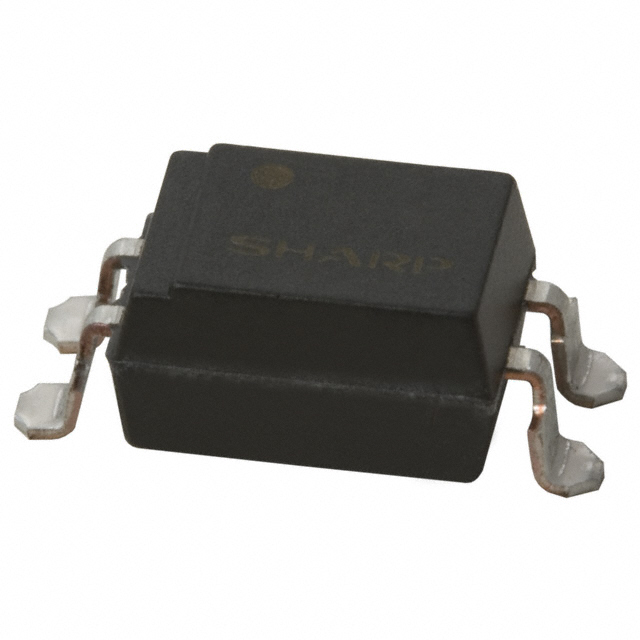
PC733H >
PC733H
Sharp Microelectronics
OPTOISO 5KV TRANS W/BASE 6DIP
3476 Pcs New Original In Stock
Optoisolator Transistor with Base Output 5000Vrms 1 Channel 6-DIP
Request Quote (Ships tomorrow)
*Quantity
Minimum 1
PC733H Sharp Microelectronics
5.0 / 5.0 - (455 Ratings)

PC733H

Product Overview

7930132

DiGi Electronics Part Number

PC733H-DG
PC733H

Description

OPTOISO 5KV TRANS W/BASE 6DIP

Inventory

3476 Pcs New Original In Stock
Optoisolator Transistor with Base Output 5000Vrms 1 Channel 6-DIP
Quantity
Minimum 1

Purchase and inquiry

Quality Assurance

365 - Day Quality Guarantee - Every part fully backed.

90 - Day Refund or Exchange - Defective parts? No hassle.

Limited Stock, Order Now - Get reliable parts without worry.

Global Shipping & Secure Packaging

Worldwide Delivery in 3-5 Business Days

100% ESD Anti-Static Packaging

Real-Time Tracking for Every Order

Secure & Flexible Payment

Credit Card, VISA, MasterCard, PayPal, Western Union, Telegraphic Transfer(T/T) and more

All payments encrypted for security

In Stock (All prices are in USD)
  • QTY Target Price Total Price
  • 1 0.1644 0.1644
Better Price by Online RFQ.
Request Quote (Ships tomorrow)
* Quantity
Minimum 1
(*) is mandatory
We'll get back to you within 24 hours

PC733H Technical Specifications

Category Optoisolators, Transistor, Photovoltaic Output Optoisolators

Manufacturer Sharp Microelectronics

Packaging -

Series -

Product Status Obsolete

Number of Channels 1

Voltage - Isolation 5000Vrms

Current Transfer Ratio (Min) 20% @ 100mA

Current Transfer Ratio (Max) 80% @ 100mA

Turn On / Turn Off Time (Typ) -

Rise / Fall Time (Typ) 4µs, 3µs

Input Type AC, DC

Output Type Transistor with Base

Voltage - Output (Max) 35V

Current - Output / Channel 80mA

Voltage - Forward (Vf) (Typ) 1.4V

Current - DC Forward (If) (Max) 150 mA

Vce Saturation (Max) 200mV

Operating Temperature -25°C ~ 100°C

Mounting Type Through Hole

Package / Case 6-DIP (0.300", 7.62mm)

Supplier Device Package 6-DIP

Datasheet & Documents

HTML Datasheet

PC733H-DG

Environmental & Export Classification

RoHS Status RoHS non-compliant
Moisture Sensitivity Level (MSL) 1 (Unlimited)
ECCN EAR99
HTSUS 8541.49.8000

Additional Information

Other Names
425-1432-5
Standard Package
50

Reviews

5.0/5.0-(Show up to 5 Ratings)
Séjour***oleillé
December 02, 2025
5.0
Leurs tarifs accessibles, associés à leur philosophie écologique, font de DiGi Electronics un choix responsable et avantageux.
銀***り部
December 02, 2025
5.0
注文してから発送までのスピードに感動しました。急ぎだったので大変助かりました。
Brig***uest
December 02, 2025
5.0
The staff's professionalism makes every support experience positive and reassuring.
Celes***lFlow
December 02, 2025
5.0
DiGi Electronics' pricing makes high-end technology more reachable.
Ra***rop
December 02, 2025
5.0
The range of products is extensive, and all are of superior quality.
Sil***Sky
December 02, 2025
5.0
Fast shipping and superb craftsmanship—my top choice for electronics.
Harm***cFlow
December 02, 2025
5.0
Their friendly customer support made the entire shopping process feel personal and trustworthy.
Publish Evalution
* Product Rating
(Normal/Preferably/Outstanding, default 5 stars)
* Evalution Message
Please enter your review message.
Please post honest comments and do not post ilegal comments.

Frequently Asked Questions (FAQ)

Can the PC733H be used as a direct replacement for obsolete PC817 or PC817X optocouplers in existing PCB designs, and what are the key design-in risks?

While the PC733H shares a similar 6-DIP through-hole footprint and general optoisolator function with the PC817 and PC817X, direct replacement carries engineering risks. The PC733H has a base pin for the output transistor, enabling improved switching speed control—this is absent in PC817 variants. If the original design lacks base biasing components, replacing with PC733H may result in unpredictable turn-off delays or increased temperature sensitivity. Additionally, the PC733H’s higher CTR range (20–80% at 100mA) may require reevaluation of input drive current to avoid saturation or signal distortion. Always verify compatibility with existing pull-up resistors and microcontroller logic thresholds, and ensure base pin is properly terminated (typically via a 100kΩ resistor to emitter) to maintain stable performance.

How does the RoHS non-compliant status of the PC733H impact long-term reliability and compliance in new industrial designs?

The RoHS non-compliant status of the PC733H means it contains restricted substances such as lead, which may violate environmental regulations in commercial or consumer products targeting EU or similar markets. While this doesn't degrade electrical performance, using the PC733H in new designs increases compliance risk and may disqualify the end product from certification. For industrial or internal-use equipment where RoHS exceptions apply, the PC733H offers robust 5000Vrms isolation and stable CTR performance, but designers must document and justify exemption use. Given its 'Obsolete' status, supply chain longevity is also limited—consider mitigating obsolescence with inventory stocking or transitioning to RoHS-compliant modern alternatives like the LTV-356T, with careful attention to CTR and speed differences.

What are the critical thermal design considerations when operating the PC733H near its 100°C maximum temperature in high-isolation industrial applications?

Operating the PC733H near its 100°C upper limit—common in industrial power supplies or motor drives—requires careful thermal management due to CTR degradation at high temperatures. CTR can drop up to 50% over temperature even within datasheet ranges, leading to output signal loss if not compensated. Increase input current margin (e.g., drive at 8–10mA instead of 5mA) or add temperature derating in firmware. Also ensure adequate PCB copper for heat dissipation, especially since the through-hole 6-DIP package has limited thermal conductivity. Avoid placing near high-power components or enclosed areas without ventilation, and consider long-term reliability impact: high temperatures accelerate LED aging, reducing isolation lifetime. Periodic testing or predictive maintenance may be needed in critical systems.

In what situations should the base pin on the PC733H output transistor be actively controlled, and how does improper handling affect circuit performance?

The base pin on the PC733H output transistor provides control over switching speed and sensitivity—critical in high-noise or high-speed feedback circuits (e.g., SMPS feedback or PLC I/O). Leaving the base floating increases susceptibility to EMI, leading to false triggering or erratic switching. For general-purpose use, tie the base to the emitter via a 100kΩ resistor to improve noise immunity. For faster turn-off, use a lower base resistor (10kΩ–47kΩ) or even active pull-down in digital signaling applications. However, excessive base current can reduce effective CTR and increase power dissipation. Improper base handling in precision analog applications—like linear feedback loops—can distort linearity and gain stability. Always include base biasing in layout, even if passive, to ensure predictable behavior across temperature and aging.

How does the PC733H compare to the H11AA1 in zero-crossing and AC sensing applications, and what are the key application limitations?

While both the PC733H and H11AA1 are 6-DIP optoisolators, the H11AA1 integrates dual back-to-back LEDs ideal for direct AC and zero-crossing detection, whereas the PC733H has a single input LED requiring external circuitry (e.g., bridge rectifier) for AC operation. Using the PC733H in zero-crossing circuits increases component count and board space, reducing efficiency. Additionally, the H11AA1 is specifically designed for phase-angle control and dimming, with matched LED sensitivity in both directions—PC733H lacks this symmetry. However, PC733H offers lower Vce(sat) (200mV max) and higher output current (80mA), making it better for DC switching loads. For new AC sensing designs, H11AA1 is preferred; replacing H11AA1 with PC733H risks erratic triggering and missing zero-cross points without careful input conditioning.

Quality Assurance (QC)

DiGi ensures the quality and authenticity of every electronic component through professional inspections and batch sampling, guaranteeing reliable sourcing, stable performance, and compliance with technical specifications, helping customers reduce supply chain risks and confidently use components in production.

Quality Assurance
Counterfeit and defect prevention

Counterfeit and defect prevention

Comprehensive screening to identify counterfeit, refurbished, or defective components, ensuring only authentic and compliant parts are delivered.

Visual and packaging inspection

Visual and packaging inspection

Electrical performance verification

Verification of component appearance, markings, date codes, packaging integrity, and label consistency to ensure traceability and conformity.

Life and reliability evaluation

DiGi Certification
Blogs & Posts
PC733H CAD Models
productDetail
Please log in first.
No account yet? Register