>
>


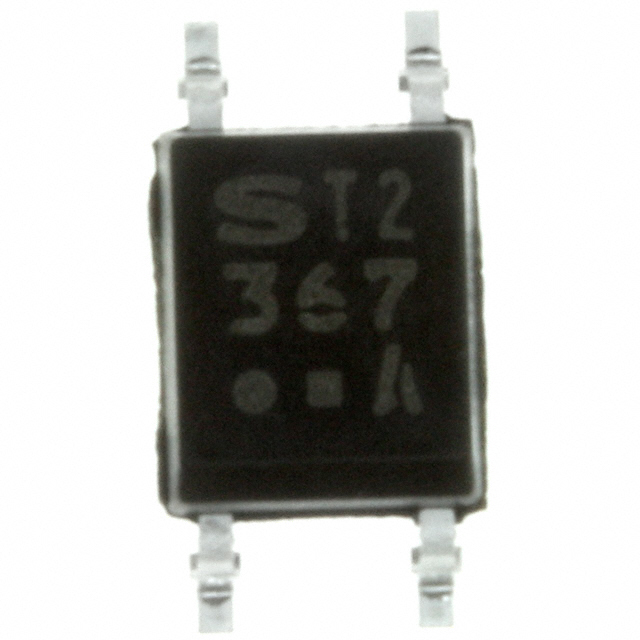
Product Overview: Sharp PC357NT Optoisolator
Optoisolators function as an essential mechanism for galvanic isolation in mixed-voltage ecosystems, minimizing risk for sensitive signal paths by channeling information across an internal optical barrier. The Sharp PC357NT leverages a high-efficiency infrared LED and phototransistor pair, encapsulated within a 4-mini-flat package, to convert electrical input signals into optical emissions. On the receiving end, the phototransistor reconstructs the signal with negligible propagation delay and minimal energy loss, ensuring system integrity under dynamic load conditions. The package’s footprint—measuring approximately 2.54 mm pitch—enables high-density board layouts, allowing for integration into compact designs including consumer electronics, industrial controllers, and medical interface modules.
Taking circuit boundary management into account, the PC357NT’s input-output isolation rating of 3750 Vrms (for 1 minute) ensures resilience against transient high-voltage events and direct surges during fault conditions. The transfer characteristics, with typical current transfer ratios (CTR) between 50% and 600% at specified forward input currents, provide flexible signal coupling for both digital switching and analog bridging. In practice, precise CTR selection supports bit error minimization in communication buses and stable switching in power sequencers, allowing tailored use within noise-prone environments. The device’s output transistor, characterized by fast response and low output capacitance, is apt for shunt and open collector configurations in interface logic, drive circuits, and microcontroller I/O expansion.
Thermal stability and process compatibility dictate placement strategies. The PC357NT’s lead-free construction and high-temperature soldering resilience support automated reflow, making it suitable for high-throughput SMT production lines without cross-contamination risks. Designers observed consistently low parameter drift after stress-testing in high-IP environments, reflecting robust design margins against thermal cycling and voltage spikes. PCB designers routinely favor this optoisolator for consolidating isolated control signals onto common ground planes, a strategy that mitigates ground loop formation and improves EMI resistance.
Notably, the PC357NT strikes a balance between cost and reliability that often evades more specialized emitter-detector pair solutions. When used as part of an input isolation barrier on motor drive boards, signal jitter under high dV/dt transients is commonly suppressed to levels below critical digital error thresholds. Fast switching speeds support high-frequency communication protocols, such as those seen in isolated UART, CAN, and SPI interfaces. Incorporation within feedback loops for power supplies and inverter controllers routinely results in improved mean-time-between-failure rates, driven by solid optoelectronic isolation and consistent output behavior under varied external loading.
When specifying the PC357NT in design documentation, evaluation against alternatives such as Toshiba TLP354 or Vishay 4N35 reveals subtle trade-offs in CTR spread, package robustness, and supply chain continuity. Yet, the PC357NT’s optimized design, proven device longevity in field deployments, and simplified sourcing often outweigh the marginal gain offered by competing components. Strategic component selection that centers on system isolation requirements, integration density, and long-term reliability will find the PC357NT occupying a preferential position in diverse applications, from industrial automation to compact IoT node assembly.
Distilling lessons from widespread deployment, the choice of optoisolator can establish the boundary for signal cleanliness and operational protection. Meticulous attention to isolation voltage, propagation timing, and packaging geometry enables confident, repeatable system architecture. By integrating the PC357NT into isolation-critical segments, engineers gain both enhanced electrical safety and streamlined assembly, supporting agile development and robust production within competitive environments.
Key Features and Technical Specifications of Sharp PC357NT
The Sharp PC357NT series optoisolators operate at the intersection of high-voltage isolation technology and compact system design. Leveraging a galvanic isolation rating of 3750 Vrms, these devices form a robust barrier for digital interfaces, protecting logic circuits from transients such as voltage surges, ground loops, and electromagnetic interference. The underlying mechanism centers around an integrated LED-phototransistor pair, which transduces signals by converting electrical input into optical energy and then back to electrical output. This process ensures that no direct electrical path exists between input and output, mitigating risk of noise ingress and cross-domain faults.
The form factor—embodied in the 4-mini-flat package—addresses constraints in PCB layout by minimizing footprint and clearance requirements. This facilitates dense component placement, critical when scaling to multi-channel applications in control systems or distributed I/O modules. The single-channel construction provides granular deployment options, whether used to isolate one line or nestled into arrays for parallel processing tasks. This architecture aligns with prevailing trends toward modularity and reconfigurable systems in industrial automation.
Transistor output configuration brings versatility for interfacing. The provided output can sink or source current, compatible with TTL or CMOS logic levels as well as analog signaling paths. Engineers report consistent switching thresholds and low signal distortion, even under variable load conditions or where supply rail stability is challenged. The fast response times, coupled with minimal propagation delay, ensure integrity in applications where timing precision is imperative—such as feedback loops in motor controllers or sensor isolation for safety-critical equipment.
From practical deployment experience, the PC357NT excels in roles where high-voltage sections must be isolated from control logic, frequently in embedded power management circuits and communication interfaces bridging fieldbus systems. The optoisolator demonstrates resilience under continuous operation in high-noise environments; false triggering and data corruption events rarely manifest when using appropriately matched external bias resistors and shielding layout techniques. Design iterations often benefit from its well-characterized thermal profile, which supports stable operation in elevated ambient conditions without derating the isolation barrier.
A distinctive strength emerges from the synergy of compactness and electrical robustness—enabling both miniaturization and stringent compliance with international safety standards. Incorporating the PC357NT into designs fosters a transition toward more intelligent, distributed architectures, where reliability and size are critical. This device exemplifies how judicious integration of optoelectronic isolation can elevate system resilience without sacrificing PCB space or design flexibility, responding to the evolving needs of automation and high-density electronics.
Typical Applications for Sharp PC357NT Optoisolator
The Sharp PC357NT optoisolator operates at the intersection of electrical isolation and signal fidelity, offering a combination of fast switching, low input currents, and robust insulation that anchors its relevance in precision circuit design. At its core, the device employs an infrared LED and a phototransistor separated by an optical barrier, enforcing galvanic isolation between input and output. This intrinsic isolation rating—often up to several thousand volts—prevents dangerous ground loops and mitigates high-voltage transients that can compromise microcontroller lines or data acquisition modules.
In mixed-voltage systems, the optoisolator’s transistor output supports seamless interface between logic levels, facilitating communication between low-voltage digital domains and high-voltage power sections. When integrated within motor drive control circuits or industrial automation equipment, its reliable response time enables feedback loops essential for real-time operation, ensuring that erratic power fluctuations do not propagate into critical control channels. This attribute is particularly valuable in automation environments prone to surges, where isolators must not only prevent noise coupling but also maintain deterministic timing.
Deployments in switching power supplies illustrate how the PC357NT contributes to closed-loop regulation. Its optically isolated feedback mechanism precisely relays error signals from the secondary to the primary control side, sustaining output stability while adhering to safety standards. In practical designs, subtle tradeoffs arise when balancing isolation voltage, propagation delays, and output load characteristics. Experience shows that careful attention to LED drive current and collector-emitter load conditions can improve response linearity and longevity, reducing maintenance cycles in fielded automation gear.
Emerging application trends place increasing emphasis on compact, high-density equipment operating in electrically noisy consumer and industrial landscapes. The PC357NT’s compact footprint allows densely packed PCBs while maintaining requisite creepage and clearance, especially in space-constrained sensor or relay panels. Moreover, its use in input signal detection often extends beyond basic voltage separation, providing diagnostic traceability and fault isolation in modular architectures. Such nuanced roles highlight a shift from simply isolating two domains to actively shaping the reliability and serviceability of advanced electronic systems.
Integrating optoisolators demands recognizing their dual role as both safety enablers and dynamic circuit elements. Beyond basic datasheet parameters, iterative prototyping reveals that isolator placement and PCB layout substantially affect transient immunity and long-term durability, underlining the relationship between device selection and system-level integrity. When isolation is paired with fast signal transfer and robust output drive, as achieved with the PC357NT, design flexibility increases—enabling more complex mixed-voltage ecosystems without sacrificing reliability.
Engineering Considerations in Deploying Sharp PC357NT
Deploying the Sharp PC357NT optocoupler within board-level designs involves a chain of interrelated engineering decisions, each impacting the device’s reliability, signal integrity, and compliance with safety regulations. The integration process starts with understanding the optoelectronic isolation mechanism. The PC357NT employs a high-efficiency gallium arsenide infrared LED optically coupled to a phototransistor. This topology creates an electrical barrier for high-voltage domains, essential in industrial automation, power management, and communication interfaces. The internal isolation capability, when paired with adequate PCB layout practices, forms the foundation for meeting established safety standards such as UL and IEC 60950, 61010, or 62368.
Attention to layout is critical, particularly in high-density assemblies. The optocoupler’s 4-mini-flat package reduces parasitic capacitance, allowing high signal fidelity at the edges of digital pulses. However, densely-packed layouts must not compromise PCB clearance and creepage distances. Maintaining these metrics above regulatory thresholds ensures insulation integrity under environmental stress and surge conditions. In practical board designs, extending copper pours and optimizing trace routing around the device further lowers noise coupling and enhances common-mode transient immunity.
Voltage and current margins are engineered from both device and system perspectives. The LED input of the PC357NT requires precise forward current limitation—typically through series resistors engineered with derating for ambient temperature and expected power dissipation. Overdriving the LED, intending to shrink propagation delay or sharpen transitions, leads to premature luminous decay, directly impacting long-term reliability. Input driving schemes should employ staged pull-up or constant current drivers to maintain consistent activation over a wide supply range. On the output side, the phototransistor’s collector-emitter voltage and load configuration demand careful biasing. Selection of collector resistors, taking into account the maximum load current and desired switching speed, restores output levels while avoiding transistor saturation.
Thermal management, though often underappreciated in low-power logic isolation, becomes significant in scenarios with compounded device density or elevated ambient temperatures. Thermal calculations integrate LED power dissipation and output transistor conduction losses. Board-level experience shows that spacing optocouplers to enable airflow, as well as leveraging inner copper layers as thermal planes, curtails localized heating and sustains parametric stability.
The single-channel nature of the PC357NT enhances architectural adaptability. System designers can isolate only critical signal paths, yielding modular configurations and noise-tight subsystem partitioning. This flexibility is particularly useful in mixed-voltage backplanes, isolated gate driving, or precision sensor interfaces, where selective isolation limits ground loop propagation and electromagnetic interference.
In practice, consistent device qualification across multiple lots is essential, as subtle variations in forward voltage or CTR (Current Transfer Ratio) can alter board-level timing and logic compatibility. Empirical testing under worst-case input/output boundary conditions establishes margins for field operation. When scaling up to multi-channel isolation, the single-channel form factor supports selectable channel placement, prevent crosstalk, and simplifies failure analysis.
Viewed holistically, the deployment of the Sharp PC357NT demands a multidimensional approach: intrinsic optoelectric properties, system-level layout and safety, application-specific driving, and robust assembly practices all interplay to achieve enduring and compliant signal isolation. This synthesis, when achieved, results in both technical reliability and design economy across complex electronic systems.
Potential Equivalent/Replacement Models for Sharp PC357NT
When addressing the selection of alternatives to the Sharp PC357NT optoisolator, a thorough examination of critical specifications is instrumental. The isolation voltage rating, particularly the 3750Vrms threshold, forms the core of safety and regulatory compliance for signal isolation in industrial and consumer-grade applications. Transistor output configuration impacts not only interfacing logic but also dictates switching speed and input impedance, factors directly influencing system response and operational reliability. The 4-mini-flat package offers significant advantages in automated assembly, thermal management, and high-density PCB layouts, thus replacement candidates should maintain identical footprint and standoff metrics.
A layered cross-reference approach, beginning with Sharp’s extended product families—such as the PC357 series variants—facilitates streamlined procurement with minimal requalification overhead. Transitioning to alternative manufacturers, candidates from Toshiba (TLP354/357) and Vishay (VO617A), for instance, retain comparable electrical and dimensional parameters. Detailed datasheet analysis reveals subtleties such as variations in CTR (current transfer ratio) stability, input LED forward current tolerance, and propagation delay. Discrepancies in CTR curves under low input drive present practical challenges in analog signal fidelity and output swing, necessitating empirical validation for noise immunity and margin analysis under real-world operating conditions.
Further, substitution protocols should prioritize maintaining regulatory certifications such as UL, VDE, or CSA, embedded in component selection—especially for medical, automotive, or high-voltage signal monitoring environments. Documentation of isolation distance—from input to output pads—and material composition of the encapsulant contributes not only to safety but also to long-term moisture resistance and reliability. Integrating model selection into automated parametric search tools and leveraging supplier comparison matrices can significantly expedite component approval cycles and minimize human error in specification entry.
It is advantageous to evaluate not merely equivalency but potential upgrades in response times, CTR linearity, and input sensitivity when supply chain pressures demand alternatives. For example, opting for a model exhibiting superior temperature coefficient performance can extend operational durability in demanding environments, resulting in fewer field failures. Practical experience underscores the necessity of requalification of at least one lot through functional bench testing, especially when manufacturer substitutions entail materials or design process changes.
The iterative engineering perspective suggests embedding optoisolator choice within a broader risk management strategy: anticipating lifecycle shifts, obsolescence trends, and regional supply volatility. Systems built with forward-looking component flexibility enable streamlined adaptation, ensuring the intrinsic integrity of isolation barriers while maintaining scaling and integration pathways. This approach preserves organizational agility and delivers technical robustness, positioning design efforts for sustainable advancement amid shifting procurement landscapes.
Conclusion
The Sharp PC357NT optoisolator exemplifies an effective approach to isolated signal transmission, combining an isolation voltage rating often exceeding 3750Vrms with a compact, single-channel surface-mount footprint. Its internal architecture leverages a gallium arsenide infrared LED coupled with a phototransistor, forming a rapid and noise-immune optical link that reliably blocks transient voltages between control and power subsystems. This design minimizes parasitic capacitance and propagation delay, supporting use in circuits where both speed and isolation integrity are essential, especially within industrial automation and switched-mode power supplies.
Integration into design workflows benefits from the PC357NT's consistent switching characteristics and broad collector-emitter voltage range, allowing flexible adaptation to either logic-level or analog interfaces. Electrical engineers frequently employ this device to decouple microcontroller I/O from high-voltage actuation signals, preventing potential ground loops and safeguarding sensitive processing nodes. Its packaging enables automated PCB assembly and reflow compatibility, streamlining production for both high and low-volume applications.
In specification-driven environments, careful evaluation of CTR (current transfer ratio) tolerances and switching speed variance is essential to maintain stable logic thresholds and avoid timing bottlenecks, especially in densely populated boards. Experienced practitioners recognize that opting for models with tailored CTR windows can optimize noise margins, while parallel optoisolator deployment is sometimes used to boost interface redundancy in critical systems.
Proactive selection of cross-compatible alternatives—such as Toshiba TLP183 or Lite-On LTV-357T—mitigates supply disruptions and aligns procurement strategy with long-term scalability requirements. It is advantageous to maintain secondary qualified sources to enhance responsiveness amid changing market availability, ensuring that system upgrades and maintenance cycles proceed without unexpected delays.
The interplay between optical isolation performance, integration convenience, and sourcing flexibility proves pivotal in achieving robust system architectures. Leveraging the strengths of the PC357NT in controlled application environments—while methodically reviewing adjacent part families—increases operational reliability and supports forward-looking electronic design strategies.