 >
>


Product Overview: KSZ9563RNXI-TR Gigabit Ethernet Switch
The KSZ9563RNXI-TR is a compact, feature-rich 3-port Gigabit Ethernet switch engineered for high-performance industrial networking applications. At its architectural core, it integrates a Layer 2+ managed switch engine alongside two PHYs and a configurable MAC port. This tight integration not only streamlines system design but also optimizes power and board space—critical factors for embedded and control systems where thermal budgets and form factors are constrained.
Compliance with IEEE 802.3 standards ensures baseline interoperability and reliability across diverse network topologies. The device supports multiple interface standards, including RGMII, MII, and RMII, which facilitates seamless connectivity to a wide variety of processors and FPGAs. The flexibility of the third MAC port, which can be configured for management or network expansion, underpins advanced control schemes and enables deterministic data flows within distributed industrial systems.
Timing precision is a fundamental requirement for measurement and automation networks. The KSZ9563RNXI-TR offers robust IEEE 1588v2 time stamping and synchronization capabilities, which are essential for real-time systems demanding low latency and high accuracy. Engineers routinely leverage these features for packet-level timing, especially in scenarios such as synchronized robotic operations or substation automation, where strict nanosecond-level coordination drives system reliability.
Energy efficiency is addressed through advanced power management states and support for Energy Efficient Ethernet (EEE). In practical deployment, properly tuning these features minimizes excess dissipation—crucial for installations in thermally challenged enclosures. Experience shows that utilizing built-in PHY auto-negotiation and dynamic link status detection substantially reduces standby consumption without sacrificing link integrity, particularly in sensor gateways or remote monitoring nodes.
Configuration and diagnostics are facilitated via standardized management interfaces and accessible registers, which integrate smoothly into prevailing fieldbus and SCADA frameworks. Leveraging these features during commissioning and maintenance enables granular monitoring and rapid diagnosis of link faults, markedly improving uptime and serviceability. Practical usage confirms that the highly visible link/LED indicators and software-accessible port statistics help both initial setup and ongoing performance monitoring.
In complex automation environments, predictable Quality of Service and VLAN support are pivotal. The KSZ9563RNXI-TR's Layer 2+ control extends to traffic prioritization, port-based VLAN partitioning, and MAC filtering. These mechanisms are invaluable for segmenting networks, isolating control loops, and meeting cybersecurity requirements. Implementing these advanced features has proven their efficacy in plants where deterministic communication and secure, isolated data flows are mandated by operational standards.
The device’s 64-VQFN package further distinguishes it for dense, multi-board designs, allowing high-speed routing and effective ground plane utilization. Engineers routinely exploit this layout flexibility when integrating the KSZ9563RNXI-TR into modular industrial PCs, compact edge controllers, or DIN-rail mountable gateway devices.
Overall, the KSZ9563RNXI-TR embodies a sophisticated intersection of robust switching capability and system-level integration, providing solutions that scale across plant networks, measurement instrumentation, and real-time control domains. Its careful balance of advanced features and versatile interfacing serves as a cornerstone for resilient industrial communications, empowering design teams to address evolving requirements in Ethernet-based automation.
Key Features and Functional Advantages of KSZ9563RNXI-TR
The KSZ9563RNXI-TR integrates a high-performance, non-blocking wire-speed Ethernet switching core, a critical foundation for deterministic, congestion-free data transfer in modern embedded and industrial networks. This architecture minimizes internal queuing delays and packet loss even under sustained high-throughput conditions, making it well-suited for demanding use cases such as machine vision, data aggregation nodes, and process control systems where uninterrupted communication is mandatory.
At the hardware interface level, the inclusion of two 10/100/1000BASE-T fully integrated PHYs and a third, flexible MAC port elevates system-integration potential. The third port’s configurability for host, switch, or external PHY attachment supports modular topologies—either as a standalone edge device or as part of a daisy-chained network, offering scalability for both compact and distributed architectures. Direct, low-latency links to processors or backplane switches enable rapid data transfer, facilitating real-time packet inspection or protocol conversion when required.
A defining asset of the KSZ9563RNXI-TR is its full-stack, hardware-accelerated IEEE 1588v2 Precision Time Protocol (PTP) support, which empowers sub-microsecond timestamping accuracy across interfaces. In tightly controlled automation environments, this deterministic synchronization is essential for coordinated motion planning, distributed sensor arrays, or power grid teleprotection. The offloaded PTP engine reduces processor overhead and ensures timing precision remains uncompromised even as network load fluctuates, a decisive advantage in mission-critical, time-aware systems.
Sophisticated packet classification and traffic management features form the backbone of network robustness and security. The switch supports advanced ACLs for granular, layer 2/3/4 filtering, enabling precise policy enforcement at the edge. Enhanced Quality of Service (QoS), per-port prioritization, and standards-based VLAN tagging sharpen packet delivery guarantees for latency-sensitive flows, such as audio, industrial control, or IP telephony. Port mirroring facilitates streamlined diagnostics and compliance validation, while jumbo packet support (up to 9000 bytes) optimizes bandwidth for bulk data transfers, minimizing fragmentation overhead in storage or video surveillance installations.
Integration flexibility reflects in multiple management interfaces—SPI, I2C, MIIM, and in-band management—allowing seamless adaptation to existing control planes, whether in deeply-embedded MCUs or Linux-based industrial computers. Adopting the optimal interface minimizes engineering complexity while maximizing control granularity and system responsiveness. System-level manageability, including remote diagnostics and firmware upgrades, is directly enabled by these versatile interfaces.
A major differentiator lies in the device’s EtherGreen™ energy management suite. Inclusion of IEEE 802.3az Energy Efficient Ethernet allows dynamic adjustment of PHY power based on link utilization, while per-port power-down functions enable aggressive reduction of inactive port consumption. These features make the KSZ9563RNXI-TR an optimal choice for energy-sensitive designs, such as battery-backed wireless gateways or remote data loggers, where long-term operational sustainability is non-negotiable.
Accumulated engineering practice demonstrates the device’s resilience and interoperability in complex mixed-vendor deployments. Its deterministic switching, robust isolation mechanisms, and comprehensive standards compliance streamline initial network commissioning and reduce post-deployment troubleshooting effort. A particularly valuable insight is the importance of hardware-based time synchronization in minimizing control-loop jitter across interconnected industrial controllers, which consistently translates to tangible improvements in process efficiency and system reliability.
Ultimately, the KSZ9563RNXI-TR combines deterministic switch performance with advanced time-precision, security, and energy management capabilities, positioning it as a foundation for the next generation of deterministic, scalable industrial and embedded Ethernet networks. Its feature mix anticipates growing requirements for converged data, control, and time-aware traffic, providing a resilient, future-ready core building block.
Application Scenarios for KSZ9563RNXI-TR
The KSZ9563RNXI-TR represents a robust solution tailored for industrial Ethernet networks, adhering to the stringent demands of protocols such as Profinet, MODBUS, and Ethernet/IP. Its core architecture centers on deterministic switching mechanisms, leveraging hardware-based queue management and cut-through forwarding to maintain minimal latency and predictable packet delivery. Integrated support for IEEE 1588v2 Precision Time Protocol (PTP) further strengthens synchronization capabilities, essential for distributed control systems requiring sub-microsecond timing alignment.
Engineered for resilience, the device offers industrial-grade reliability, with temperature ratings spanning -40°C to +85°C. This prepares the switch for deployment in environments subject to thermal stress, electromagnetic interference, or mechanical vibration—conditions typical in industrial control panels, factory floors, and automated test systems. The extended operating range ensures zero compromise on uptime, directly supporting mission-critical applications where network downtime leads to significant productivity losses.
The switch's feature set includes advanced traffic prioritization and virtual LAN support, enabling segmentation of sensitive measurement streams from generic sensor traffic. This architecture fosters network determinism, a requirement for automation tasks such as robotics coordination, precision measurement instrumentation, and multi-axis motion control. The device’s high port-count flexibility allows compact integration into space-constrained panels, and enables modular scaling in distributed equipment racks.
Practical deployment often leverages the KSZ9563RNXI-TR’s integrated MAC and PHY layers for simplified board layout, reducing both electromagnetic emissions and the bill of materials. In networking test benches, its rapid convergence and robust error handling minimize packet loss during transient conditions, facilitating reliable validation of industrial protocols and custom measurement topologies. By embedding support for management frames and diagnostics features, the switch streamlines maintenance cycles and assists in quick fault isolation—critical in environments with limited access or high operational tempo.
A unique advantage is the device’s balance of cutting-edge features with ease of integration, which accelerates development cycles for OEMs delivering next-generation industrial automation. The internal architecture is well-optimized for deterministic performance without excessive resource or power overhead, which can be observed through consistent link behavior and predictable throughput under varying network loads. This reliability has been repeatedly demonstrated in environments where high-frequency, low-latency messaging underpins safety-critical operations and real-time feedback loops.
In summary, the KSZ9563RNXI-TR switch addresses the multidimensional needs of industrial Ethernet networks by combining time-sensitive data handling, environmental robustness, and flexible system integration. Its deterministic operation and synchronized communication form the backbone of advanced automation platforms, positioning it as a pivotal building block in contemporary industrial connectivity solutions.
Switch Architecture and Interface Details of KSZ9563RNXI-TR
The KSZ9563RNXI-TR employs a robust switch architecture, characterized by a non-blocking forwarding engine, which leverages a 4096-entry MAC address table to support extensive local area network segmentation. This lookup engine enables rapid frame forwarding and flooding control, critical for deterministic performance in time-sensitive industrial networks. The integrated 128 kByte shared frame buffer optimizes packet queuing and minimizes latency under heavy traffic, providing consistent throughput even during bursts typical of converged OT/IT environments.
Port architecture on the KSZ9563RNXI-TR addresses both flexibility and deployment scalability. Two integrated 10/100/1000BASE-T PHYs support standard copper links with auto-negotiation and auto-MDI/MDI-X, streamlining interconnect complexity and mitigating cabling errors during installation. Built-in LinkMD® diagnostics contribute a pragmatic edge, enabling real-time detection and localization of cable faults—an asset in field-maintenance scenarios where rapid fault isolation accelerates network recovery.
The device’s third port exemplifies architectural versatility, offering a configurable MAC interface that interoperates with host processors, FPGAs, or cascaded switches via RGMII, MII, or RMII. Selection of interface mode is programmable, allowing seamless alignment with system latency and bandwidth requirements. This modularity supports both single-chip switch deployments and designs where the switch participates as part of a larger switching fabric. Noteworthy in high-reliability or FPGA-centric architectures, the capacity to tune timing and interface standards ensures robust integration without signal integrity issues.
Digital I/O supports multi-voltage domains at 1.8V, 2.5V, or 3.3V logic levels, increasing compatibility with diverse processor ecosystems. This feature removes the need for level shifters, reducing BOM costs and simplifying PCB routing—a critical factor in compact or power-constrained designs. Practical deployment shows that multi-voltage support substantially streamlines bring-up cycles, especially in systems where interface standards evolve over generations.
Comprehensive management is facilitated by a tri-modal configuration interface, encompassing high-speed 50 MHz SPI, I2C, and MIIM protocols. These out-of-band control paths coexist with in-band management via any switch port, which provides deferred system integration decisions and firmware upgradability. From a system engineering viewpoint, this decoupling of management traffic from data paths fortifies security and allows incremental feature deployment post-production. For example, SPI management is favored in latency-sensitive industrial automation nodes, while I2C enables efficient stacking with minimal pin count in space-limited modules.
With regard to practical design strategy, de-risking integration hinges on judicious utilization of the device’s store-and-forward mechanism and its flexible port interface. Leveraging the robust diagnostics and voltage agility, architectures can be designed for both zero-downtime maintenance and seamless extension as network demands evolve. The KSZ9563RNXI-TR’s focus on interface configurability and resilient management access aligns with contemporary requirements for adaptable yet deterministic networking infrastructure in embedded and edge-critical systems.
Switch Management and Advanced Networking Capabilities of KSZ9563RNXI-TR
KSZ9563RNXI-TR leverages a robust switch architecture designed for deterministic, scalable Ethernet deployments. At its core, frame buffering and address lookup are optimized to minimize latency and ensure effective routing during congestion, preventing packet drops and reducing jitter in high-volume environments. Each port operates with programmable queue management, allowing fine-grained traffic prioritization according to dynamic application demands. Rate limiting enables precise bandwidth control, helping to provision resources and prevent broadcast storms within tightly coupled network clusters.
Security integration adheres to IEEE 802.1X, enabling port-based authentication for granular network access control. Extensive ACLs provide deep packet inspection and selective forwarding, supporting both policy enforcement and isolation of critical assets. This structural approach facilitates compliance with enterprise-grade security standards without compromising throughput.
Reliability is engineered through full hardware support for rapid spanning tree and multiple spanning tree protocols. These protocols, when deployed in dense topologies, guarantee rapid convergence and resilient loop prevention, maintaining uptime even under complex reconfiguration scenarios. Port mirroring functions aid in real-time diagnostics, capturing traffic anomalies and assisting in deployment troubleshooting, critical for minimizing downtime in automation contexts.
Audio Video Bridging (AVB) capabilities, backed by IEEE 802.1AS and 802.1Qav support, underpin real-time communication requirements. Precise time synchronization and traffic shaping ensure ultra-low latency and consistent stream delivery—a necessity for distributed control, synchronized sensing, and industrial robotics. Experience indicates that leveraging AVB in mixed-media environments reduces cross-domain interference and assures fault-tolerant synchronization regardless of network distance.
Protocol-layer enhancements include IGMP/MLD snooping for efficient multicast forwarding—significantly reducing unnecessary traffic and optimizing network utilization in video broadcasting and sensor networks. Dual-stack IPv4/IPv6 parsing and QoS mapping allow prioritized service delivery, supporting separation of critical control data from bulk service flows. This results in predictable performance for converged operational technology overlays.
A layered strategy—starting with hardware-level data handling, advancing through dynamic resource management, robust security enforcement, and encompassing protocol intelligence—positions KSZ9563RNXI-TR as a core component for future-ready, industrial-grade Ethernet infrastructure. Experience shows that designs utilizing the full switch feature set offer demonstrably higher availability and lower maintenance demands, evidencing the device's value in environments where uptime and deterministic service delivery are non-negotiable. The integration of these features enables seamless adaptation to evolving network standards while maintaining backward compatibility, making KSZ9563RNXI-TR suited for both legacy migration and new installations.
Power Management and Environmental Considerations for KSZ9563RNXI-TR
Power management in the KSZ9563RNXI-TR builds on an architecture that integrates several advanced energy efficiency techniques at both silicon and system level. Leveraging IEEE 802.3az Energy Efficient Ethernet (EEE), the switch actively transitions physical-layer transceivers to low-power idle states during traffic silences, sharply decreasing dynamic power draw while maintaining connectivity readiness. This behavior is critical in edge network deployments where traffic patterns are inherently bursty, and effective utilization of EEE capability directly correlates with sizable operational savings over extended periods.
Further granularity in power control is realized through energy-detect power-down. Here, the PHYs autonomously sense cable activity and automatically disable ports with absent link partners. This not only eliminates unnecessary leakage and static currents but also simplifies network management by freeing host processors from continuous port status polling. Complementing this, per-port software control enables selective shutdown of unused interfaces. Such flexibility supports scenarios like modular network appliances or densely populated industrial clusters, where active ports may vary dynamically based on configuration or task.
Dynamic clock gating underpins internal power optimization, where the device selectively disables unused functional blocks, ensuring minimal baseline current for idle devices. The addition of a global software power-down mode enables fast transitions toward ultra-low-power states in service windows or during brown-outs, suitable for applications subject to intermittent power availability or backup battery operation. Notably, the switch retains sufficient context during these state changes, enabling rapid link re-establishment without full hardware re-initialization. Real-world deployment shows that these design choices stabilize power budgets, extend device longevity, and decrease operating costs, especially in environments with stringent power constraints, such as remote data aggregators or solar-powered edge devices.
Environmental robustness is inherent, with operation supported over the full industrial temperature envelope (-40°C to +85°C), ensuring thermal stability and MTBF in demanding installations like outdoor enclosures or factory automation lines. The device tolerates thermal cycling, vibration, and voltage variation, integrating protection features such as ESD tolerance and voltage supervisors. This hardening is critical where environmental unpredictability could otherwise lead to premature failure or network lapses.
Integrating power management capabilities with wide-range environmental compliance, the KSZ9563RNXI-TR aligns with both regulatory requirements and market-driven demands for sustainable networking infrastructure. Its extensible feature set enables system architects to precisely match power and reliability profiles to deployment needs, forming a resilient backbone suitable for the evolving industrial and edge network landscape.
Package and Integration Information of KSZ9563RNXI-TR
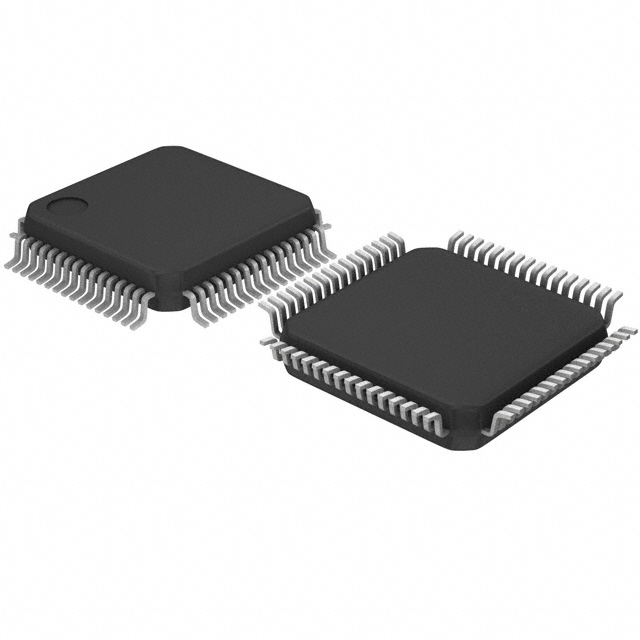
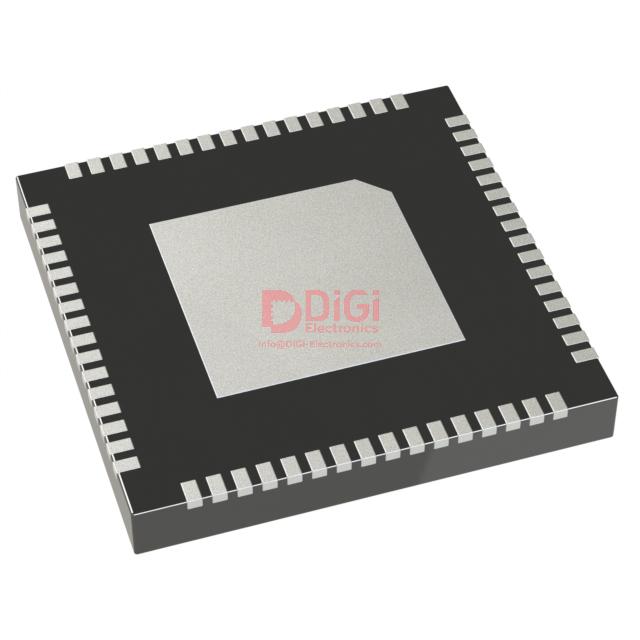
The KSZ9563RNXI-TR integrates a high-port-count Ethernet switch within a compact 64-lead, 8x8 mm Very Thin Quad Flat No-Lead (VQFN) package, enabling efficient PCB area allocation. The form factor directly supports the miniaturization of networking systems, addressing board real estate limitations in dense multiport designs such as industrial Ethernet hubs, embedded gateways, and space-constrained switch modules. The minimal profile and flat geometry promote compatibility with automated surface-mount assembly methods, reducing pick-and-place errors and supporting high-throughput device population.
Underlying package mechanics leverage the array of perimeter leads and a large center thermal pad. The latter acts as a low-impedance heat conduction path to the board, essential given the device's internal power dissipation during sustained data throughput. Effective heat transfer relies on meticulous PCB layout. For maximum performance, the exposed pad should be soldered directly to a similarly sized copper area on the PCB’s top layer. This copper region—connected to an internal ground plane by a matrix of tented or filled vias—ensures both electrical grounding and robust thermal transfer, mitigating temperature rises that otherwise degrade switching performance or reliability.
Application of assembly best practices is critical during board integration. Solder stencil apertures must be carefully designed to control paste volume, preventing voids under the exposed pad which would undermine thermal contact. Empirical results have shown that via tenting, compared to open vias, minimizes solder wicking and supports uniform pad reflow. For high-cycle reflow environments, consistency in thermal relief patterning across production lots further ensures tight parameter distributions in system-level validation.
Routing high-frequency signals, such as MII or RGMII traces, adjacent to the device demands controlled-impedance layout techniques. Key traces should avoid closely paralleling via arrays beneath the exposed pad to prevent signal integrity degradation induced by return path discontinuities. Power and ground planes should prioritize low inductance paths to diminish the risk of core ground bounce during burst switching events.
The VQFN’s well-engineered land pattern conforms to contemporary industry standards, but tailoring pad geometries to accommodate manufacturer-specific tolerances yields further gains in assembly yield. Subtle optimization, such as slightly increased pad widths or specifically profiled solder mask apertures, markedly enhances process robustness when integrating higher pin-count QFNs onto multi-layer, high-aspect-ratio boards.
Practical deployment patterns reflect that, in fielded designs, thermal monitoring near the pad-attachment site provides early warning for atypical power or environmental events, directly informing maintenance decisions in mission-critical applications. Integrated switch performance metrics remain tightly correlated with both the uniformity of solder coverage and the integrity of the thermal interface, reinforcing the value of rigorous attention to assembly and layout guidance detailed in the manufacturer’s application notes.
In sum, the KSZ9563RNXI-TR’s packaging enables densely populated layouts without sacrificing thermal or electrical integrity. Leveraging disciplined board design and assembly execution yields system-level gains in reliability, bandwidth, and integration density, accelerating time-to-market for compact, robust Ethernet-enabled solutions.
Potential Equivalent/Replacement Models for KSZ9563RNXI-TR
Selecting an optimal equivalent or replacement for the KSZ9563RNXI-TR involves careful scrutiny of architectural features, functional integration, and protocol compliance. The underlying mechanism focuses on the KSZ9563’s unique configuration: its integrated dual PHYs streamline board layout and reduce bill-of-material complexity, while the adaptable third MAC port offers implementation flexibility in diverse networking topologies. This approach allows direct access to copper or fiber links and supports advanced management functions, including IEEE 1588v2 Precision Time Protocol (PTP), which is critical in synchronization-sensitive industrial automation or real-time control scenarios.
When exploring the KSZ9xxx family, attention must shift to switch ICs that maintain consistency in Gigabit port allocation and extend support for PTP hardware timestamping. Devices such as the KSZ9567 or KSZ9893 offer similar managed switch features, with incremental improvements in port scalability, memory buffers, and enhanced QoS management. However, matching internal register maps, interrupt schemes, and configuration sequences remains imperative to minimize firmware adaptation effort. Hardware engineers must validate default PHY behaviors, startup timings, and low-power sleep modes, ensuring the candidate device fits seamlessly into existing power budgeting and thermal design constraints.
Expanding the search to offerings from manufacturers like Marvell or Realtek, the evaluation pivots to cross-vendor abstraction layers and the fidelity of IEEE 1588v2 support. Variance in management packet processing, link negotiation methods, and hardware reset procedures demands that design teams prototype substitutes in controlled environments. Subtle behavioral disparities—such as timing skew losses during cascaded switch topologies, or the handling of multicast filtering tables—often reveal during bring-up and interoperability testing, informing iterative PCB and driver adjustments.
Procurement risk can be reduced by maintaining up-to-date cross-reference databases and forging supplier relationships with transparent information on product life-cycle and revision histories. It is advisable to leverage modular firmware design, exploiting abstraction in MDIO/MII routines, register-level transaction scripts, and diagnostic code blocks; this enables more agile migration between switch IC models in response to supply chain volatility.
Ultimately, converging on the most effective alternate model requires not only datasheet alignment but also empirical assessment through prototype validation, pinout analysis, and regression testing under target operating conditions. A layered evaluation, progressing from system-level functional requirements toward physical pin compatibility and bus protocol intricacies, yields the highest probability for seamless substitution of high-integration managed Ethernet switches.
Conclusion
Assessing the KSZ9563RNXI-TR predominantly involves understanding its integration of triple-speed Ethernet switching with advanced time synchronization and management mechanisms. At the hardware level, its non-blocking architecture is optimized for wire-speed packet handling, supporting both legacy and gigabit connectivity—a necessity in industrial PLCs, robotics, and intelligent sensor modules. The integrated IEEE 1588v2 PTP support enables deterministic packet delivery and precise time alignment, which is critical for synchronizing distributed processes in automation cells or time-sensitive networking scenarios.
The chipset’s reliability is underpinned by extensive EMI protection, industrial-grade temperature tolerance, and hardware-level fault recovery. These attributes fortify deployments against electrical disturbances and ambient extremes common in factory automation and outdoor infrastructure. Embedded energy-saving features such as power-down modes and dynamic link adaptation reduce thermal strain and lifecycle cost, addressing sustainability mandates without sacrificing throughput.
Application flexibility surfaces through programmable VLANs, multi-layer QoS, and managed switch capabilities. These elements allow nuanced traffic segmentation and prioritization—an imperative when handling mission-critical control signals alongside bulk sensor data. Experience shows that integrating the KSZ9563RNXI-TR often streamlines interoperability across legacy fieldbus systems and modern Ethernet backbones due to its wide protocol support and configuration options.
A design-in approach leveraging onboard diagnostic and remote management functions yields tangible benefits in post-deployment maintenance, accelerating fault isolation and minimizing system downtime. The feature synergy unlocks a pathway to converged network architectures where security, resilience, and real-time control coexist. For procurement teams, the part’s extended AVL presence and support ecosystem reduce supply chain risk, facilitating rollout of scalable industrial networks.
Ultimately, the capability set of the KSZ9563RNXI-TR positions it as an optimal foundation for next-generation deterministic Ethernet systems, particularly in scenarios demanding high-precision coordination, modular expansion, and long-term dependability. Tapping into its full potential requires a design perspective that prioritizes interoperability, resilience, and dynamic control—yielding robust networked infrastructure tailored for evolving industrial demands.