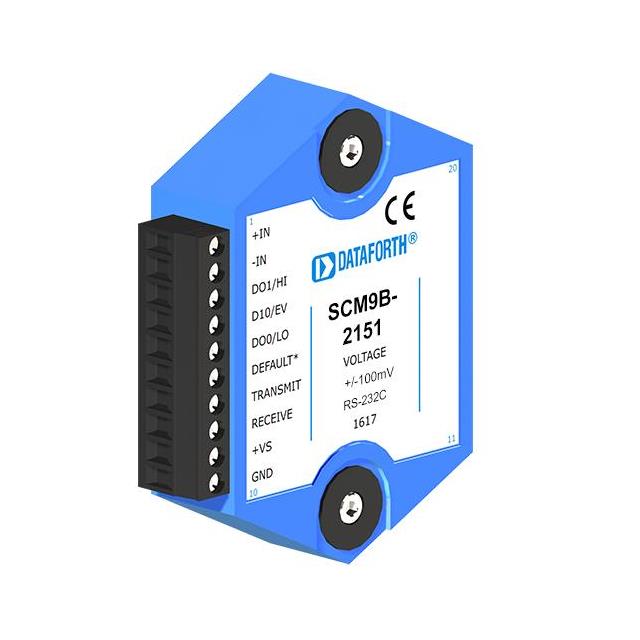
>
>


Product Overview: SCM5B37E Non-Linearized Thermocouple Module
The SCM5B37E from DATAFORTH represents a purpose-built module for direct thermocouple interfacing where non-linearized output responses are required. Underpinning its functionality is a robust analog front-end that captures low-level thermocouple signals with high fidelity. By leveraging precision instrumentation amplifiers within the module, the device maintains low noise performance and excellent common-mode rejection, which is essential for accurate measurement in electrically noisy industrial environments.
At the core, the SCM5B37E performs signal amplification tailored to unconditioned thermocouple signals, omitting built-in linearization to maintain measurement specificity. This design choice addresses applications where external cold junction compensation or post-processing linearization routines are preferred, granting engineers flexibility in custom measurement algorithms or legacy system compatibility. The class-leading galvanic isolation separates the sensor input from the output, effectively safeguarding downstream equipment from ground loops and transient events, a critical reliability factor in both distributed control systems and data acquisition networks.
Thermal stability across a wide ambient temperature spectrum is engineered through tightly specified passive component selection and precision reference circuitry. In demanding environments—such as those with significant temperature swings or high electromagnetic interference—the module’s stability maintains measurement traceability and system uptime. Experience shows that in large-scale deployments, the SCM5B37E’s consistent channel-to-channel performance and immunity to cross-talk are key in ensuring system-wide measurement uniformity, especially when integrating arrays of thermocouples across process lines or test stands.
Within application scenarios, the module excels in process automation, laboratory instrumentation, and test/measurement installations where the sensor signal must be transferred across long cable runs and through substantial electrical infrastructure. Its through-hole mounting format permits straightforward PCB integration, providing physical robustness ideal for industrial-grade installations. Furthermore, in retrofit scenarios where existing signal conditioning requires non-linearized inputs for backward compatibility, the SCM5B37E provides a direct upgrade path without introducing conversion errors.
Unique value emerges when the device is deployed in modular instrumentation chassis: the absence of in-module linearization streamlines multi-sensor calibration routines, and centralized compensation algorithms can be refined without hardware constraints. Insights gathered from real-world implementation demonstrate that preservation of the native thermocouple transfer function allows for advanced diagnostic routines, such as drift trending and material integrity analysis, within the host system’s software. The overall design ethos champions flexibility, ruggedness, and signal integrity, positioning the SCM5B37E as a foundational building block for precision thermocouple measurement in engineering systems focused on adaptability and long-term reliability.
Functional Characteristics and Operating Principle of SCM5B37E
The SCM5B37E module is architected to deliver precision signal amplification specifically tailored to thermocouple sensor applications. The module supports direct interface with thermocouple outputs in their raw, unlinearized voltage form, enabling native measurement integrity by eliminating any premature signal transformation or compensation. This signal conditioning approach is geared toward distributed systems and multipoint measurement infrastructures, where aggregation and sophisticated linearization are executed centrally at a later processing stage.
Internally, the device implements galvanic isolation across input, output, and power domains, a vital mechanism for disrupting ground loops and suppressing common-mode noise. This fundamental design choice ensures that low-level thermocouple signals remain untainted by external interference, thus maintaining signal purity throughout the analog conditioning path. The amplification stage is engineered with transfer functions precisely aligned to thermocouple sensitivity and type, guaranteeing that output voltages are proportional, highly accurate, and conform with standardized process automation interfaces.
The SCM5B37E distinguishes itself with a high input impedance front-end, specifically to counteract the tendency of thermocouple circuit resistances to introduce loading errors. By minimizing the electrical interaction between sensor and conditioning module, long-term stability and repeatability are improved, an important consideration in large deployments where channels must remain consistent despite environmental or wiring variations. Furthermore, the module’s robust output stage drives industry-standard analog signals, ensuring seamless compatibility with downstream analog-to-digital conversion or legacy industrial automation equipment.
Integrating this module into measurement chains enhances modularity and maintainability. For expansive applications, such as scalable data acquisition systems or adaptive process controllers, the SCM5B37E’s functional decoupling of amplification from linearization supports user-defined calibration routines and regulatory compliance without locked-in vendor constraints. In practice, system integrators select this topology to centralize computational resources while distributing only essential analog signal interfacing, optimizing both operational agility and cost.
In environments notorious for industrial electrical noise or where sensor networks traverse considerable distances, the isolation and impedance characteristics of the SCM5B37E mitigate classic pitfalls like crosstalk or drift-induced inaccuracies. These attributes, combined with its straightforward input compatibility for various thermocouple types, reduce commissioning overhead and troubleshooting complexity. Empirically, system robustness is observed to increase in deployments where sensor modularity and signal chain transparency are prioritized, illustrating the value of clean signal separation at the hardware level.
This engineering strategy, which decouples sensitive signal interfacing from complex transformation, reflects a broader principle in scalable instrumentation: by allocating specialized tasks to dedicated hardware modules and centralizing algorithmic or calibration routines, system performance and adaptability are both maximized. The SCM5B37E exemplifies this modular, flexible paradigm, serving as a stable foundation for precise, noise-resistant thermocouple signal acquisition within advanced measurement ecosystems.
Mechanical and Electrical Specifications of SCM5B37E
The SCM5B37E module integrates robust mechanical and refined electrical characteristics tailored for high-reliability sensor signal conditioning within demanding industrial infrastructure. Its through-hole packaging ensures secure and vibration-resistant board anchoring, addressing rigidity requirements frequently encountered in control panels, distributed I/O systems, and test fixtures. The mechanical layout not only promotes optimal solder joint integrity but also facilitates straightforward rework during iterative prototyping and field maintenance, which becomes especially valuable during lifecycle management of instrumentation systems.
Electrically, the SCM5B37E’s architecture is optimized for high-resolution sensor amplifier performance. The input and output voltage ranges are precisely defined to enable direct interfacing with a wide spectrum of industrial sensors, while its low intrinsic noise floor safeguards measurement accuracy even in electrically noisy plant environments. Inherent galvanic isolation, implemented through optimized opto-couplers and transformer-based techniques, substantially mitigates risks of ground loops and common-mode transients—challenges pervasive in large-scale interconnected automation networks. This isolation also extends the utility of the module into mixed-signal environments where analog and digital domains coexist with disparate ground references.
Attention to pin allocation and electrical ratings allows seamless drop-in compatibility with standardized analog front-end layouts and simplifies schematic integration for PCB designers. The wide allowable supply voltage window provides flexibility in power distribution architectures, supporting both centralized and distributed power schemes typical of modular instrumentation racks. The specification envelope is tightly constrained to ensure consistent performance across environmental extremes, such as thermal stress or supply sag—parameters often encountered in continuous process monitoring scenarios.
Practical deployment of the SCM5B37E demonstrates resilience under repeated thermal cycling and electrical transients, supporting longevity in both retrofit projects and greenfield installations. Experience reveals that careful attention to grounding strategy and trace routing on the application PCB further enhances the module’s noise immunity, amplifying the benefits engineered into its core design. Incremental gains in overall measurement reliability can be achieved by leveraging the device’s isolation features to segment sensitive analog loops from high-current actuation domains.
Strategically, the SCM5B37E exemplifies a design paradigm where mechanical and electrical robustness coalesce to streamline signal integrity management at the sensor interface tier. By engineering the module around both industry-standard footprints and operational benchmarks, the solution minimizes integration overhead and reduces time-to-deployment. Such attributes prove vital in projects prioritizing system uptime and measurement confidence in electrically aggressive and mechanically dynamic environments.
Integration and Application Scenarios for SCM5B37E
The SCM5B37E signal conditioning module is engineered to streamline direct interface with thermocouples, omitting onboard linearization to align with architectures favoring centralized or post-processing signal management. Its core analog front-end isolates and amplifies low-level thermocouple signals, thus preserving sensor integrity while suppressing high-frequency noise—an essential function for robust operation in electrically noisy industrial environments. By providing galvanic isolation between input and output, the module enhances safety and minimizes ground loop interference, facilitating integration into both legacy and modern control infrastructures.
The design's adaptability is evident in multi-channel measurement platforms where aggregation of raw thermocouple outputs is centralized and custom compensation, correction, or linearization algorithms are hosted within programmable controllers or data acquisition systems. Processing accuracy is improved as all environmental and nonlinearity adjustments can be applied uniformly, avoiding discrepancies stemming from distributed, module-based digital corrections. This workflow is particularly advantageous in applications like thermal profiling of industrial furnaces, reaction chambers, and large-scale HVAC systems, where cross-comparison of temperature data from hundreds of points is critical and must respond to a single calibration reference.
For system designers, the standardized form factor and interface protocols ensure straightforward retrofitting into a wide spectrum of environments—ranging from PLC-driven production lines to laboratory-temperature mapping arrays. The module’s compatibility with popular hardware platforms and flexible thermocouple type support expedites project scaling from prototyping to full deployment. Selection and wiring processes are simplified by unified connector standards and clear polarity markings, reducing commissioning time and facilitating reliable maintenance or future upgrades.
The architecture is structured to facilitate practical innovation. For example, embedding the SCM5B37E within distributed control networks enables simultaneous acquisition of unprocessed thermocouple data, which can then be transmitted over fieldbuses or Ethernet to a central SCADA server. Here, application-specific algorithms—addressing sensor aging, ambient temperature drift, or calibration offsets—can be applied dynamically, decoupling module choice from computational strategies. This decoupling ensures the longevity of sensor harnesses and signal paths, while offering the flexibility needed to integrate advanced analytics or AI-based temperature anomaly detection in evolving automation frameworks.
A distinctive feature of this integration strategy arises in scenarios where legacy systems are updated with minimal impact. Selection engineers faced with strict downtime constraints and varied thermocouple standards benefit from the SCM5B37E’s broad sensor compatibility and plug-and-play mounting, which collectively reduce switchover complexity. This robustness in system design, combined with high signal fidelity, yields consistent measurement performance essential for regulatory compliance and predictive maintenance regimes.
Continued deployment of SCM5B37E modules supports a modular design philosophy, future-proofing capital assets and providing engineering teams the latitude to iterate on signal processing approaches as operational requirements evolve. This layered adaptation, from sensor physical integration through to high-level data utilization, illustrates the value of architecting signal chains for both current function and future innovation.
Key Engineering Considerations and Selection Guidance for SCM5B37E
SCM5B37E module selection demands a methodical approach centered on system-level integration and performance optimization. At the underlying circuit design level, the absence of integrated linearization positions the SCM5B37E as a versatile interface for thermocouple signals, while shifting the responsibility for cold-junction compensation and non-linear response handling to firmware or higher-level processing. This delegation enables deployment in applications utilizing digital compensation algorithms, where software-based calibration routines can offset channel-specific deviations, enhance long-term accuracy, and facilitate automated field recalibration cycles. Engineers can thus leverage the device’s raw signal path flexibility to tune compensation strategies according to deployment environment and expected sensor drift profiles.
From an input interface perspective, the SCM5B37E’s input range and input impedance must align with the thermocouple types in use, ensuring sensor output voltages are accurately amplified without introducing offset or scaling artifacts. The module’s galvanic isolation rating serves as a design anchor for noise resilience and ground-loop suppression, supporting robust analog front-end operation in high-interference or multi-grounded industrial installations. Selection of isolation voltage should reflect maximum expected common-mode potentials, as well as regulatory mandates tied to system safety and EMI/EMC performance.
Attention to mechanical and layout constraints is critical for seamless board-level integration. Standardized pinouts and compact form factor contribute to PCB layout efficiency, but tolerance matching and thermal considerations often require empirical verification. In scenarios involving high-density sensor arrays or limited enclosure volume, thermal dissipation and clearance guidelines should be confirmed through physical prototyping and thermal imaging, especially under maximum load conditions.
Evaluating the module’s certification matrix is essential for applications governed by IEC, UL, or other quality benchmarks. Alignment with such standards not only influences procurement qualification but streamlines system qualification and documentation for end-of-line testing and external audits. Industrial deployment further obliges a check on environmental specifications—including shock, vibration, and humidity—relative to installation locale and expected maintenance cycles.
Failure modes and integration friction must be assessed early. For example, introducing software-based compensation can increase initial development workload and system complexity, but it enables adaptive accuracy improvement over time and simplifies remote diagnostic routines. Careful review of power budgeting, startup sequencing, and hot-swap tolerance can prevent integration pitfalls during later product lifecycle stages.
Ultimately, modular signal processing driven by the SCM5B37E matches well with architectures emphasizing customization, iterative calibration, and longevity within firmware-upgradable platforms. Edge cases, such as deployment in variable ambient temperature zones or within legacy signal chains, benefit from the additional control surface granted by host-managed linearization. This integration strategy can yield both immediate and lifecycle accuracy enhancements, supporting differentiated system architecture for demanding measurement environments.
Potential Equivalent/Replacement Models for SCM5B37E
Evaluating potential substitutes for the SCM5B37E requires precise alignment of non-linearized thermocouple amplification properties. The primary technical criteria center on input range, output compatibility, sensor interface accuracy, and electrical isolation integrity. Non-linearized modules—often preferred for systems with external linearization routines—must mirror the native thermocouple response without onboard signal correction. Such units typically provide raw millivolt outputs that demand careful downstream conditioning, emphasizing the relevance of input impedance and common-mode rejection capabilities to minimize thermocouple error sources.
A targeted examination of the broader DATAFORTH catalogue reveals several analog conditioning modules configured for through-hole installation and compatible thermocouple classes. Cross-referencing these models involves scrutinizing their bandwidth, offset stability, and channel-to-channel isolation voltages. Select third-party devices, from brands specializing in sensor interfacing, may also satisfy baseline electrical and mechanical requirements; nevertheless, proprietary isolation architectures—such as transformer-coupled versus optically isolated designs—could introduce subtle yet significant differences in noise immunity and transient robustness at the system level.
Mechanical integration presents a distinct layer of complexity. Standardized form factors, like the classic through-hole package, facilitate drop-in replacements. Even so, dimensional tolerances, pinout conventions, and enclosure constraints necessitate physical prototyping to preclude unexpected interference in high-density sensor arrays. Experience shows that modules with rigid adherence to IPC standards and MIL-PRF tolerances demonstrate superior interchangeability and long-term reliability, notably in mission-critical environments.
Signal integrity considerations amplify the importance of shielded connectors, grounding strategies, and thermal gradients across mounting surfaces. Laboratory benchmarking, comparing noise floors and step response times across candidate modules, frequently uncovers latent deviations—especially under wide ambient temperature swings—where only the most robust designs maintain consistent thermocouple tracking.
Throughout the selection process, a layered approach yields optimal system reliability. Initiating with electromagnetic compatibility and advancing through logical isolation barrier assessment, engineering teams incrementally validate electrical and mechanical congruence. Embedded within this methodology is the insight that true equivalence transcends advertised specifications, leaning critically on contextual performance, integration friction, and field-proven resilience. Thus, rigorous analysis coupled with empirical validation ensures the chosen replacement not only matches datasheet metrics but also sustains functional parity under extended operational scenarios.
Conclusion
The SCM5B37E non-linearized thermocouple module from DATAFORTH exemplifies a robust component engineered for critical signal conditioning in demanding industrial and scientific environments. At its core, the device provides high-fidelity sensor amplification, harnessing differential input architecture paired with galvanic isolation. This architecture mitigates ground loop interference and shields downstream circuitry from harsh common-mode transients, ensuring measurement integrity even amidst substantial environmental noise and electrical disturbances common in both discrete manufacturing and continuous process control systems.
Unlike modules that perform integrated linearization, the SCM5B37E outputs a directly amplified raw thermocouple signal. This design choice enables system architects to decouple analog front-end conditioning from software- or hardware-based linearization strategies further downstream. Such decoupling is particularly valuable in multi-channel or multi-sensor platforms, where sensor types or temperature ranges differ, and centralized post-processing can be tightly tailored to application-specific algorithms. The physical isolation provided by the module facilitates scalable board-level integration. This allows for dense packaging within modular data acquisition systems without cross-channel interference or floating ground complications.
Practical deployment of the SCM5B37E often reveals distinct advantages when addressing scenarios with non-standard thermocouple calibrations or legacy equipment interfacing. For instance, when retrofitting existing process infrastructure, the absence of fixed linearization allows seamless adaptation to non-uniform sensor sets or proprietary correction tables. Moreover, system validation and troubleshooting benefit from direct access to the unaltered sensor signal, permitting rapid cross-verification against reference instrumentation or alternative front-end designs.
A unique perspective emerges when considering the SCM5B37E as a modular building block in the context of rapidly evolving industrial automation requirements. By delegating linearization to configurable external systems, the architecture embraces ongoing advances in digital signal processing and edge analytics. This forward-compatible approach ensures that hardware investments maintain long-term relevance, accommodating evolving algorithms, calibration curves, or diagnostics without necessitating wholesale board replacement.
The SCM5B37E ultimately establishes a foundational layer in the sensor processing chain, where precision, noise immunity, and integration flexibility converge. Its role extends beyond simple amplification, actively shaping the system’s adaptability and lifecycle efficiency in sophisticated measurement and control ecosystems.