>
>


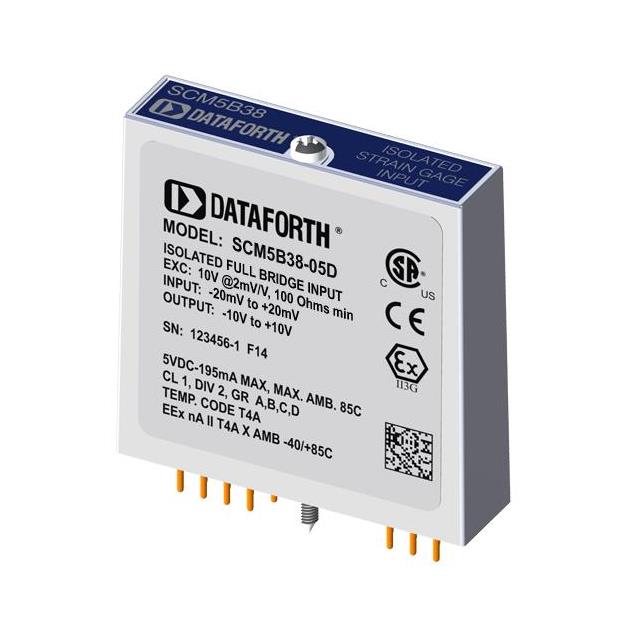
Product overview: SCM5B37B non-linearized thermocouple signal conditioning module
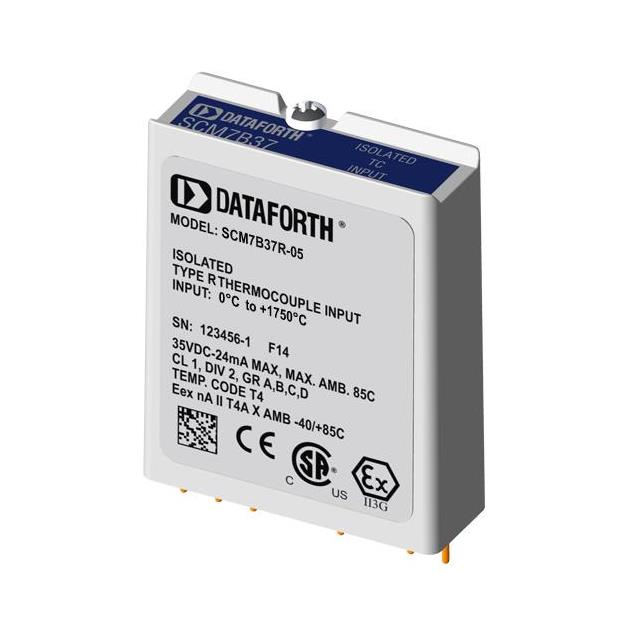
The SCM5B37B module represents a specialized solution for thermocouple signal conditioning, engineered to accommodate the irregular, non-linear response characteristics inherent in raw thermocouple outputs. Operating without onboard linearization, the SCM5B37B focuses on delivering high-fidelity analog signal amplification and robust galvanic isolation. This approach preserves the authenticity of the thermoelectric signal, enabling downstream systems, such as programmable logic controllers or data acquisition modules, to implement bespoke linearization routines tailored to application-specific calibration standards.
At the core of the module is a precision instrumentation amplifier optimized for low-level microvolt signals, which addresses common issues of electromagnetic interference and noise susceptibility associated with long sensor leads in industrial environments. Integral isolation barriers further prevent ground loop artifacts and cross-channel interference, facilitating deployment in distributed measurement architectures where sensor integrity and plant safety are paramount. The module’s through-hole packaging supports straightforward integration into legacy backplanes or new customized I/O boards, reinforcing its suitability for both retrofit and greenfield projects.
System designers often encounter challenges when scaling thermocouple arrays or interfacing mixed sensor types within process control networks. The SCM5B37B’s modular topology directly addresses these barriers by offering interchangeable channels and uniform signal conditioning across diverse thermocouple calibrations, simplifying both initial setup and ongoing maintenance. A practical benefit observed in temperature mapping for batch reactors is the module’s high channel density, which streamlines cabinet wiring and reduces panel space compared to discrete amplification circuits.
A key insight lies in leveraging module-level non-linearized output for applications where temperature algorithms demand real-time polynomial correction or where site-specific reference junction compensation is not standardized. This choice offloads complexity to centralized, programmable resources—balancing hardware performance with software agility. Additionally, because the conditioning is performed immediately adjacent to the sensor terminals, system reliability improves due to the reduction in analog transmission length, substantially mitigating drift and external noise pickup.
Optimization of measurement accuracy with the SCM5B37B thus hinges on harmonizing sensor deployment, signal routing, and centralized digital processing. The architecture excels in contexts where transparency of signal path and configurability of measurement routines outweigh the convenience of fixed, module-level linearization. The module’s flexibility aligns with evolving industrial digitalization trends, supporting adaptive automation strategies while maintaining deterministic analog performance.
Key features and specifications of the SCM5B37B series
The SCM5B37B series is optimized for interfacing with non-linearized thermocouple outputs, leveraging a precision analog front end that encompasses high-gain amplification, well-defined signal filtering, and high input impedance architecture. This high impedance prevents signal degradation from sensor loading, an essential parameter when dealing with low-output, high-impedance thermocouple sources. Signal integrity is preserved at the initial acquisition stage, circumventing issues like voltage drop and measurement distortion that can compromise data accuracy in high-resolution DAQ chains.
From a mechanical perspective, the through-hole packaging aligns with conventional assembly lines, offering drop-in compatibility with established PCB layouts and maintaining reliability under mechanical stress. The robust construction meets the demands of industrial-grade backplane installations, minimizing long-term failure rates under vibration or repeated thermal cycling.
Noise immunity is engineered into both circuit topology and layout, targeting resilience against EMI commonly encountered in factory automation, power generation, and process monitoring. The deployment of internal shielding, differential signal paths, and aggressive filtering combats both common-mode and differential-mode interference, supporting uninterrupted acquisition even in high-noise environments. In practice, installations adjacent to motor drives or switch-mode power supplies retain stable thermocouple readings with minimal downtime for recalibration—a critical factor for mission-critical control systems.
Temperature stability is achieved through meticulous component selection and calibration protocols. Internal reference sources and precision resistor networks minimize gain and offset drift across the specified operational range, avoiding the need for frequent field recalibration. This trait is demonstrated in applications where measurement reliability must be sustained through wide temperature excursions, such as outdoor process facilities or engine test benches.
Signal isolation serves as both a safety and fidelity mechanism. High common-mode voltage tolerance and galvanic isolation prevent ground loop artifacts and protect both the SCM5B37B and downstream systems from electrical transients. This isolation is especially relevant in installations with distributed thermocouples across different ground potentials or where long cable runs would otherwise induce data corruption.
Flexibility in handling multiple thermocouple types is inherent to the series; users can adapt the same interface to a spectrum of measurement points without hardware redesign, streamlining inventory and supporting scalable sensor networks. The deliberate absence of built-in linearization is a strategic design choice, transferring compensation algorithms to the host system. This enables advanced implementations such as real-time polynomial fitting, lookup table corrections, or integration with adaptive filtering, all tailored to the unique requirements of high-performance process control. This modularity accelerates deployment timelines and enables precise calibration routines to be managed centrally, reducing per-channel complexity and facilitating future upgrades.
Such architectural choices demonstrate a preference for distributed signal conditioning tightly coupled with centralized data processing. This partitioning not only extends hardware longevity but also positions the instrumentation chain for scalability, robustness, and ease of maintenance in evolving industrial automation ecosystems.
Functional applications and integration scenarios for SCM5B37B
The SCM5B37B thermocouple input module delivers critical functionality in applications demanding precise, noise-immune temperature measurements with galvanic isolation. Its architecture is engineered to reject common-mode noise and minimize ground loop interference, ensuring data integrity in electrically noisy environments such as large-scale manufacturing plants and power generation facilities. The signal conditioning topology, incorporating linearization and cold-junction compensation, enables accurate digitization across broad temperature ranges for Type J, K, T, and E thermocouple types. Internally, robust isolation barriers decouple field-side thermocouple inputs from system-side outputs, permitting flexible integration with differential or single-ended data acquisition architectures without compromising channel-to-channel isolation.
Deployment within distributed control panels leverages the module’s modular form factor and standardized pinout, which align with established signal conditioning racks and DIN-rail systems. This compatibility facilitates straightforward expansion to high channel counts required for multi-point temperature monitoring, while also supporting hot-swapping during maintenance cycles and minimizing system downtime. In equipment monitoring scenarios, the SCM5B37B enables predictive maintenance algorithms by delivering stable, repeatable data to supervisory controllers and SCADA nodes. Its resilience to electromagnetic disturbances ensures consistent operation even in proximity to heavy machinery or variable frequency drives.
In laboratory and test automation frameworks, the SCM5B37B expedites setup and reconfiguration due to its self-contained signal conditioning and isolation. The module’s ability to interface directly with legacy through-hole backplanes allows seamless retrofitting of existing installations, reducing system overhaul costs and logistical complexity. Where stringent regulatory or safety standards apply, the reinforced isolation safeguards both signal fidelity and personnel, particularly in applications with hazardous voltage differentials.
Practical experience highlights the importance of meticulous wiring practices and reference junction management when integrating the SCM5B37B into high-density panels. Attention to cable routing, proper shielding, and the use of low-thermal EMF connectors further amplify measurement stability. Reliability under thermal and mechanical stress has been validated in both fixed and mobile process units, revealing the module’s suitability across diverse operational environments. Notably, the design lends itself to future-proofing: as control networks or DAQ systems migrate toward higher bandwidths or distributed topologies, the SCM5B37B’s modularity enables incremental system scaling without costly reengineering. This modular signal conditioning approach not only fosters rapid system adaptation but also underpins a unified maintenance strategy, streamlining spare parts management and reducing inventory burdens.
Holistically, the SCM5B37B’s blend of mechanical compatibility, robust electrical isolation, and versatile signal processing addresses the core requirements of precision thermocouple measurement in contemporary automation and instrumentation landscapes. These attributes position the module as a strategic building block in both legacy upgrade projects and next-generation smart facilities, where measurement accuracy, safety, and scalability must coexist seamlessly.
Engineering considerations for deploying the SCM5B37B
Evaluating the deployment of the SCM5B37B signal conditioning module requires a systematic approach that begins with a thorough understanding of its core operational principles. The SCM5B37B is optimized for thermocouple signal interfacing but intentionally omits integrated linearization circuitry. This non-linearized design grants flexibility for custom calibration routines; however, it places responsibility on system-level software or firmware to implement accurate post-processing linearization algorithms. Successful integration of the module, therefore, depends on the precision of these computational routines, which should be tailored to the specific thermocouple type and target measurement range. In practice, utilizing high-precision floating-point calculations and careful lookup table management yields significant accuracy improvements, especially when dealing with complex signal profiles and wide temperature gradients.
Signal fidelity is tightly coupled with sensor selection and field installation techniques. Selecting thermocouples with appropriate construction (junction type, sheath material, wire diameter) ensures compatibility with both the SCM5B37B's input range and the intended application environment. Installation procedures directly impact measurement stability; minimizing localized thermal gradients at connection points, mitigating mechanical vibration, and ensuring secure terminal contact collectively reduce noise and drift. Attention to cable routing is paramount, as even moderate EMI or ground loops can degrade low-level thermocouple signals. Employing shielded twisted pair cables with single-point grounding and managing cable separation from high-voltage or switching lines substantially improves common-mode rejection and channel-to-channel isolation.
Thermal management strategies influence both the module’s baseline drift and long-term reliability. Situating the SCM5B37B in enclosures with regulated ambient temperatures and controlled airflows reduces temperature-induced offset errors and extends module lifespan. Thermal coupling between modules should be minimized; strategic placement and thermal pads can prevent hotspots and allow uniform module temperature profiles. These approaches enhance measurement repeatability over diverse duty cycles and environmental transients.
PCB layout and grounding demand targeted attention during system design. Routing sensor signals differentially with controlled impedance, away from digital or high-frequency traces, minimizes cross-talk and preserves analog integrity. Star-grounding the module’s analog and digital sections and enforcing isolated analog returns mitigate low-frequency noise injection and ground potential differences. When deploying multiple SCM5B37B units, power supply decoupling and careful management of ground references protect against ripple-induced disturbances, a crucial detail in multi-channel, high-density systems.
Scaling measurement systems introduces additional coordination challenges. Multiple SCM5B37B modules should be maintained under consistent thermal and electrical conditions to preserve inter-channel precision. Environmental variations, such as airflow gradients or localized electromagnetic sources, can introduce systematic error differentials that compound with channel count. Synchronizing maintenance schedules and recalibration cycles further ensures sustained channel alignment. In industrial settings, establishing SOPs for installation, troubleshooting, and module replacement leads to more predictable system behavior and mitigates unforeseen drift or failure modes.
A key insight is the necessity of holistic signal chain optimization: the SCM5B37B’s performance envelope is determined not solely by its internal specifications, but by the interplay between signal source, installation practice, environmental control, and downstream processing. Superior results emerge when these elements are engineered as a unified system, with feedback paths for iterative calibration and fault detection built into the control architecture. This approach, while demanding upfront rigor and attention to detail, establishes measurably higher confidence in data quality and system uptime—a decisive advantage in mission-critical process control and advanced data acquisition scenarios.
Potential equivalent/replacement models for the SCM5B37B
The process of identifying suitable equivalents or replacements for the SCM5B37B begins at the level of signal conditioning requirements. Sensor modules in the SCM5B family, and analogous offerings from competing manufacturers, operate on principles involving input signal compatibility, isolation strategies, and functional integration.
Modular signal conditioners typically address input types—thermocouple, RTD, voltage, or current—by employing precision analog front ends tailored to sensor characteristics. For thermocouple signals, linearization circuits or embedded microcontrollers translate nonlinear sensor outputs into standardized analog or digital formats. Models supporting built-in thermocouple linearization, such as the SCM5B36-xx series, bypass the need for external compensation algorithms, accelerating system deployment and lowering firmware complexity. Expanded channel density options, available in rack-based multi-channel conditioners, utilize internal multiplexers and channel-to-channel isolation, supporting high node-count installations while maintaining signal fidelity through opto-isolated or transformer-coupled stages.
Form factor selection directly impacts space utilization and assembly workflow. Surface-mount modules shrink PCB real estate, promoting high-density layouts found in test instrumentation or OEM embedded controls. Conversely, DIN rail or plug-in styles emphasize maintenance accessibility and rapid module replacement in distributed process monitoring networks. Practical integration hinges on matching signal conditioner characteristics—input impedance, bandwidth, rejection ratios—to sensor specs and system noise profiles.
A refined selection methodology weighs isolation voltage ratings versus environmental transients, connector geometries against cabinet constraints, and supported calibration protocols for traceability or regulatory targets. Real-world deployments reveal the criticality of module self-diagnostics and hot-swap capabilities, minimizing downtime in continuous process environments. Integrated features such as automatic cold-junction compensation or configuration via standard fieldbus interfaces streamline commissioning and reduce the potential for field errors.
Ultimately, competitive solutions—whether within the SCM5B lineup or broader industry catalogs—must align with project-specific integration priorities. Encapsulating analog precision, robust isolation, and modularity, signal conditioners function as enablers for scalable sensor infrastructure. Attention to nuanced requirements, such as simultaneous support for multiple sensor types or compliance with advanced IEC or UL standards, ensures optimal module selection—not merely as functional replacements but as value-adding components within evolving automation and data acquisition architectures.
Conclusion
The DATAFORTH SCM5B37B thermocouple signal conditioning module presents a targeted amplification solution for thermal sensor applications where uncompromising precision and EMI isolation are demanded. The device's modular construction leverages through-hole interface technology, streamlining assembly and facilitating straightforward upgrades or maintenance within legacy and contemporary system architectures. This approach is vital for environments where rapid signal path reconfiguration and minimal downtime are priorities.
At the signal path level, the non-linearized output architecture of the SCM5B37B stands out. Rather than imposing a fixed transfer function, the module preserves the raw thermocouple response, granting system designers latitude in downstream algorithm development. This design decision enables tailored linearization, compensation, or calibration routines that align with application-specific requirements, notably benefiting process control platforms needing granular data access for thermal profiling, feedback loops, or fault-tolerant measurements.
Electrically, the module delivers high input impedance and galvanic isolation, combined with noise rejection capabilities that ensure consistent signal integrity even within high-voltage industrial sites or EMC-sensitive laboratory setups. Field deployment often reveals the value of robust isolation—signal artifacts resulting from ground loops or differential mode transients can compromise long-term reliability, but the SCM5B37B's topology mitigates these risks without complicating the sensor wiring strategy.
Practical deployment consistently demonstrates that modular signal conditioning not only simplifies error tracing but also supports distributed measurement systems where mixed sensor types and calibration strategies coexist within one platform. Such design flexibility aligns with the evolution of process instrumentation, where the ability to adapt signal processing in software, rather than committing prematurely to static analog output profiles, drives both scalability and future-proofing.
A unique advantage emerges when considering lifecycle management. Engineers can deploy the SCM5B37B across multiple generations of measurement platforms, leveraging its non-linearized outputs to accommodate new algorithms as process control requirements shift. This capability reduces redevelopment cycles and fosters continuity in system documentation and support protocols. Thus, in advanced sensor networks where adaptability and raw data access form the backbone of high-precision control logic, the SCM5B37B distinctly enhances the utility of thermocouple-based measurement architectures.