 >
>


Product Overview: KSZ9563RNXC-TR Gigabit Ethernet Switch by Microchip Technology
The KSZ9563RNXC-TR, designed by Microchip Technology, exemplifies the convergence of compact integration and advanced switching intelligence within industrial-grade Gigabit Ethernet environments. At its core, this switch leverages two integrated 10/100/1000BASE-T PHY transceivers, directly reducing board complexity and minimizing external component requirements. The inclusion of flexible Media Access Controller (MAC) port compatibility with RGMII, MII, and RMII interfaces enables seamless interfacing with a variety of host processors and FPGAs, facilitating design adaptability across diverse system architectures.
In operation, the KSZ9563RNXC-TR addresses essential timing and synchronization requirements characteristic of real-time Ethernet applications. The switch’s Layer-2+ managed engine incorporates hardware-assisted packet filtering, VLAN segmentation, and QoS prioritization schemes. These features deliver deterministic traffic handling, which is critical for latency-sensitive industrial automation, factory control, and embedded networking scenarios. Power management functionality extends device applicability in energy-constrained installations, leveraging configurable power-down modes and fine-grained link status controls to optimize consumption profiles without compromising performance.
Robust resilience to ambient environmental changes is achieved through broad temperature compliance, spanning both industrial (-40°C to 85°C) and commercial ranges. The 64-pin VQFN packaging facilitates high-density module placement and reliable thermal dissipation, supporting deployment in constrained form factors such as edge nodes or compact controller boards. The internal architecture emphasizes low-jitter clock domains and impedance-controlled traces, minimizing packet loss and electromagnetic interference in electrically noisy settings.
Efficient real-world deployment is streamlined through register-level management interfaces and extensive documentation, accelerating prototyping and custom firmware development. Configurable port mirroring and loopback modes provide diagnostic capabilities fundamental to rapid field troubleshooting, enhancing network reliability during long-term operation. Subnet isolation and IGMP snooping integrate multi-tiered security and multicast handling, positioning the switch for scalable integration within complex topologies such as distributed sensor networks or branch-heavy industrial plants.
Practical engineering experience underscores the importance of robust input power regulation and careful PCB layout near the switch’s high-speed I/O pins. Ground plane continuity and strategic decoupling suppress common-mode noise, a consideration crucial for sustaining full-duplex gigabit throughput under varying load conditions. When retrofitting legacy systems, leveraging the RGMII interface has proven effective for interfacing with existing processors while still taking advantage of gigabit performance, minimizing development time for incremental upgrades.
A nuanced insight involves exploiting the device’s hardware packet filtering to offload critical traffic classification tasks from host processors, markedly improving overall system responsiveness in multi-layered networked environments. The integrated architecture allows real-time traffic shaping to be implemented close to the physical layer, which is especially beneficial for mission-critical installations subject to periodic bandwidth contention. This approach yields a measurable reduction in application latency as compared to designs reliant solely on external switch ICs with limited local intelligence.
Overall, the KSZ9563RNXC-TR positions itself as a strategic choice for engineering teams targeting high-reliability, scalable, and low-power Ethernet deployments. Its layered feature set, from physical integration to advanced packet processing, supports a broad range of industrial and embedded applications, streamlining both initial rollout and ongoing operational stability.
Key Features of KSZ9563RNXC-TR for Modern Ethernet Switching
At the heart of the KSZ9563RNXC-TR lies an advanced, non-blocking switch fabric engineered for deterministic Ethernet switching performance. This architecture ensures that traffic flows at full wire speed across all ports, eliminating internal contention and enabling the deployment of high-throughput, low-latency networks. The switch fabric's design is particularly effective when combined with its 4096-entry forwarding table and a substantial 128 Kbyte frame buffer. This combination is engineered to sustain peak traffic loads while minimizing packet loss, a critical advantage when supporting voice, video, or control data typical in industrial and converged network architectures.
Modern VLAN implementations demand flexible segmentation, isolation, and hierarchical traffic grouping. The KSZ9563RNXC-TR addresses this by supporting 128 simultaneous VLAN groups and managing up to 4096 VLAN IDs, providing ample headroom for large-scale enterprise or industrial applications. Its four QoS queues per port enable precise allocation of network resources, ensuring priority handling for time-sensitive flows without compromising overall throughput. The hardware-level prioritization is particularly effective in scenarios requiring deterministic latency, such as motion control systems or real-time media streaming, where jitter tolerance is minimal.
Comprehensive security and multicast management are integrated at the port level, with support for Access Control List (ACL) filtering and IEEE 802.1X authentication. These mechanisms allow for precise definition of access policies, mitigation of unauthorized traffic, and compliance with network security frameworks. Incorporating IPv4/IPv6 IGMP and MLD snooping directly into the switch fabric enhances multicast efficiency, reducing flooding and optimizing bandwidth utilization. In practical terms, this facilitates scalable deployment of IP-based video surveillance or distributed control systems, where efficient multicast distribution is mandatory.
Support for jumbo frames—up to 9000 bytes—enables the transport of large payloads commonly found in storage or high-performance computing networks, reducing protocol overhead and transaction counts. Port mirroring capabilities further extend practical debug and monitoring options, offering real-time visibility into switch traffic without the need for external probe hardware. Programmable rate limiting is implemented at the ingress and egress, allowing granular control of traffic per port to prevent oversubscription and maintain service-level agreements in bandwidth-sensitive scenarios.
For applications requiring precise timing and synchronization, the integration of EtherSynch® technology within the KSZ9563RNXC-TR is crucial. The hardware support for IEEE 1588v2 Precision Time Protocol (PTP) and Audio Video Bridging (AVB) standards yields sub-microsecond timing accuracy across all ports, an essential prerequisite for automation, measurement, and time-sensitive networking applications. The value of deterministic timing is immediately tangible in distributed control networks, where event latency and synchronization accuracy impact overall system performance.
Given the high information density and feature integration, the KSZ9563RNXC-TR excels in use cases where performance, segmentation, timing, and security must be tightly coordinated at the hardware layer. Its design approach allows deployment across diverse application spaces—such as smart grids, industrial automation, and converged enterprise backbone switches—while delivering operational predictability and robust network management. The architecture's emphasis on line-rate operation, flexible filtering, and hardware-based time alignment distinguishes it as a foundation for scalable, modern Ethernet networks that must adapt efficiently to increasing traffic complexity and stricter performance criteria.
Integrated Interfaces and Port Architecture in KSZ9563RNXC-TR
Integrated interface and port architecture in the KSZ9563RNXC-TR is engineered for optimal versatility and high-speed data integrity within modern network designs. The device incorporates two fully compliant IEEE 802.3 physical layer (PHY) ports, each supporting 10BASE-T, 100BASE-TX, and 1000BASE-T standards. These PHYs implement fully automatic negotiation that ensures seamless adaptation to link partners, accommodating various deployment scenarios ranging from legacy systems to gigabit infrastructures. Auto-MDI/MDI-X functionality further simplifies cabling requirements, effectively eliminating concerns about cross-over cable selection and thereby reducing installation errors and downtime in complex topologies. Energy-Efficient Ethernet (EEE) capability delivers dynamic power reduction during low-traffic periods without manual intervention, enabling aggressive thermal management in dense multi-switch deployments.
Beyond the dedicated PHYs, the switch features an additional configurable MAC port. This design expands interconnect flexibility, allowing direct attachment to host processors, FPGAs, ASICs, or cascading to other switches. This port supports several industry-standard host interfaces, each catering to distinct system-level requirements. RGMII v2.0 connectivity provides high-throughput, low-latency transmission and is well-suited for backbone links or timing-sensitive applications, such as in industrial automation or high-performance embedded gateways. The inclusion of RMII v1.2—with selectable 50MHz reference clock I/O—facilitates streamlined interconnection with SoCs, particularly in space-constrained layouts or cost-sensitive designs. MII mode support, configurable for operation as PHY or MAC, extends compatibility to legacy systems, ensuring prolonged design lifecycles and migration paths in long-lived infrastructure projects.
A robust set of management interfaces underpins device configurability and monitoring. High-speed 4-wire SPI access, operating at up to 50MHz, enables rapid register access directly from microcontroller firmware, significantly reducing configuration latency in performance-critical applications such as access control or converged voice/data switches. The I²C interface is engineered for comprehensive register management, enabling both out-of-band and in-band administrative function via any switch port, which enhances flexibility in distributed control architectures. MIIM (MDC/MDIO) compliance streamlines PHY configuration, an essential feature in systems leveraging centralized management frameworks or supporting hot-swap PHY replacement during field service.
Practical integration of these features reveals several engineering advantages. In multi-port aggregation scenarios, the availability of diverse host interface options allows for compact PCB layouts with reduced signal contention and electromagnetic interference (EMI) risks, providing greater predictability in signal timing and simplifying compliance with stringent EMI regulations. Use of EEE directly supports power- and thermal-budgeted designs, particularly in PoE-powered or passively cooled edge devices, where minimizing heat generation translates into enhanced reliability and smaller form factors. Seamless MIIM access across management tools shortens configuration and diagnostics cycles while preserving interoperability with standardized network diagnostics utilities.
A unique aspect of the KSZ9563RNXC-TR architecture is the precise layering of interface flexibility, which supports progressive upgrade strategies. Designs can be rapidly migrated between host interface standards with minimal board changes and firmware adaptation, extending the useful life of hardware assets in rapidly evolving automation environments. This modularity allows efficient resource allocation, especially apparent when the MAC port is leveraged for switch stacking or redundancy, providing robust options for fault-tolerant implementations without sacrificing port density or throughput.
Consequently, the KSZ9563RNXC-TR sets a practical benchmark for future-proof, energy-conscious switch design. Its tightly integrated, standards-conformant interfaces, extensive management facilities, and adaptable port architecture address diverse requirements, from compact IoT bridges to scalable edge aggregation, yielding tangible benefits in design flexibility, long-term cost control, and operational resilience.
Advanced Switching and Network Management Functions in KSZ9563RNXC-TR
The KSZ9563RNXC-TR integrates a comprehensive suite of advanced Layer-2 switching and network management features, establishing a robust foundation for scalable, high-performance network architectures. At the protocol control plane, native support for rapid spanning tree (RSTP) and multiple spanning tree protocol (MSTP) mechanisms is implemented in hardware, ensuring deterministic loop resolution and sub-second topology convergence. Such capabilities are indispensable in industrial Ethernet backbones, where physical network redundancy must align with real-time operational demands. The device’s rapid convergence characteristics directly mitigate risks associated with transient network faults, maintaining upstream communication continuity in scenarios such as robotic cell failover or conveyor line segmentation.
Precision time protocol (PTP, IEEE 1588v2) support is architected through purpose-built timestamping engines, offering both master/slave and transparent clock models. Transparent clock operation extends timing accuracy across each hop, suppressing cumulative error and ensuring nanosecond-grade synchronization across distributed nodes. This feature is particularly essential in time-sensitive environments such as distributed data acquisition, motion axis coordination, and measurement systems, where sub-microsecond jitter directly influences process quality or system safety. Integration of full PTP stack support at the switch layer reduces external processor burden, streamlining system validation and decreasing total BOM complexity.
The switch chip’s AVB (Audio Video Bridging) compliance, embodied by adherence to IEEE 802.1BA, 802.1AS, 802.1Qat, and 802.1Qav standards, pivots the platform towards specialized multimedia and industrial control use cases. The inclusion of generalized PTP (gPTP) ensures clock synchronization at the bridged network scale, while the credit-based shaper mechanism enforces deterministic traffic delivery suitable for isochronous payloads. This aggregation of QoS primitives guarantees bounded-latency transmission—critical for time-dependent audio/video content or control messages in sectors such as automated transport, professional AV installations, and synchronous drive systems.
Configurable behavior is realized through flexible I/O pin strapping at hardware reset, mapping to direct control of essential configuration bits. This hardware-level adaptability enables rapid provisioning and field-level deployment, which is particularly beneficial in support of SKU variation, late binding, or brownfield integration scenarios. By reducing reliance on host processor intervention during initial boot, the switch accelerates bring-up times and limits exposure to misconfiguration risk in mass deployment frameworks.
Operational experience indicates that leveraging this switch’s hardware-assisted features reduces overall system latency, liberates host CPU cycles, and facilitates deterministic control in large-scale distributed networks. Strategic use of native protocol offloads—coupled with precise network timing control—drives both network reliability and bandwidth efficiency well beyond baseline L2 switch solutions. These characteristics render the KSZ9563RNXC-TR a highly competitive component for modern, deterministic Ethernet applications characterized by stringent timing, resilience, and manageability requirements.
Industrial and Application Use Cases for KSZ9563RNXC-TR
The KSZ9563RNXC-TR Ethernet switch addresses nuanced and mission-critical requirements in modern industrial automation environments. At its core, the device integrates advanced multi-port switching capability with IEEE 1588v2 hardware-enabled time synchronization, serving as the backbone for deterministic communication—a prerequisite for high-precision process control. Low latency and cut-through switching architectures minimize cycle times, essential for real-time control applications and closed-loop feedback systems in robotics and test instrumentation.
Compatibility with established industrial protocols such as PROFINET, MODBUS TCP, and EtherNet/IP stems from deep-layer traffic management features like VLAN tagging, IGMP snooping, and hardware-based prioritization. These functionalities underpin the ability to construct segmented, application-specific network topologies. Segmenting process monitoring traffic from control loops, for instance, mitigates broadcast storm risks and contains network failures within defined boundaries, ensuring resilience and maintainability.
The device’s integrated security blocks—MAC address filtering, port isolation, and support for secure boot—align with the growing emphasis on industrial cyber security, enabling designers to meet IEC 62443-aligned best practices. This is particularly relevant in distributed PLC architectures and multi-vendor deployments, where exposure to external threats can jeopardize uptime and process integrity. Adoption in distributed sensor networks benefits from deterministic traffic shaping, ensuring time correlation and event synchronization under high node counts.
Thermal management and environmental robustness are engineered into the device’s silicon, validating operation across extended industrial (-40°C to +85°C) and commercial (0°C to +70°C) temperature grades. Field deployments in outdoor enclosures subjected to rapid temperature cycling are typical, and the device’s MTBF figures consistently translate to reduced unexpected maintenance. Equipping automation panels with the KSZ9563RNXC-TR results not only in network standardization but also in a tangible reduction in integration and debugging cycles, due to predictable timing and industry-class electrical immunity.
In complex networking topologies, the switch’s Loop Detection and Recovery architecture prevents downtime due to undetected wiring faults—a scenario frequently encountered in brownfield modernization. TSN-readiness, while not enabled in all variants, opens a pathway to integration with emerging Industry 4.0 frameworks, supporting future-proof investment. Direct experience in multi-protocol environments highlights the utility of the KSZ9563RNXC-TR in reducing the protocol conversion burden and harmonizing control traffic, especially where distributed I/O and interoperable modular machinery are expanding.
When mapped across process segments—from edge sensor aggregation to high-layer SCADA connectivity—the switch’s deterministic, resilient, and secure design contributes substantially to robust fieldbus replacement strategies. Ultimately, utilizing the KSZ9563RNXC-TR within industrial and application networks ensures not only protocol agility but also network longevity in evolving automation landscapes.
Power Management and Efficiency in KSZ9563RNXC-TR Deployments
Power management in KSZ9563RNXC-TR deployments hinges on a set of integrated mechanisms engineered to optimize energy consumption while preserving high network performance. At the foundational level, the switch leverages IEEE 802.3az Energy Efficient Ethernet (EEE), dynamically scaling down link power during periods of inactivity. This protocol reduces energy drawn by PHYs without incurring latency penalties, crucial for applications requiring continuous uptime and bandwidth efficiency. Seamless transitions between active and low-power states are orchestrated through intelligent link monitoring, minimizing overhead and ensuring immediate data transmission when network activity resumes.
The device architecture incorporates granular power control across switch ports, an approach that underpins flexibility in real-world deployments. Features such as energy detect and selective port power-down enable a tailored match between power usage and workload. Wake-on-LAN capability further supports remote activation, allowing network segments to remain idle until external triggers necessitate operation. In production environments, configuring unused ports for complete shutdown, rather than idle states, has been shown to yield significant cumulative savings, especially in distributed topologies or systems exposed to variable traffic loads.
Dynamic clock tree management provides an additional tier of efficiency, operating by scaling clock frequencies to match processing demand. This modulation curtails excess consumption during off-peak network utilization, extending the switch’s utility in scenarios where ambient temperature sensitivity or limited power provisioning must be respected, such as in industrial IoT nodes or remote telecommunication cabinets.
Applied experience demonstrates that systematic tuning of power profiles—balancing aggressive energy-saving with the integrity of link quality—can substantially prolong hardware lifecycle and reduce thermal stress. Proactively analyzing traffic patterns and mapping EEE or port shutdown policies to real use-case requirements ensures uninterrupted service levels alongside reduced total cost of ownership. Integrating automated monitoring and adaptive control strategies is recommended, as these amplify the core efficiency advantages of the KSZ9563RNXC-TR, positioning it for robust performance in modern, scalable networks that must reconcile operational demands with sustainability.
KSZ9563RNXC-TR Physical and Package Information
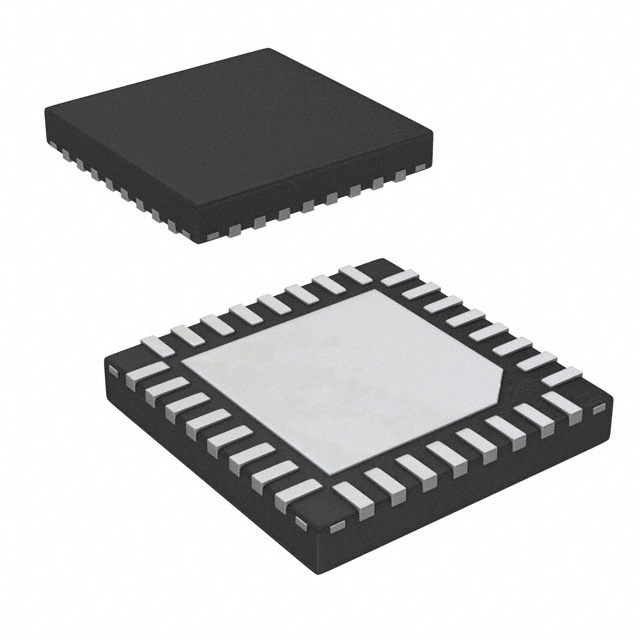
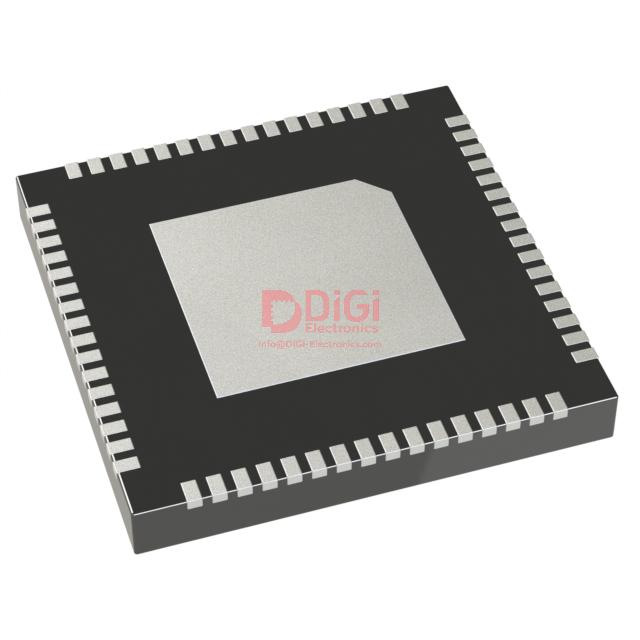
The KSZ9563RNXC-TR utilizes a 64-pin VQFN package with an 8mm x 8mm outline, targeting advanced PCB architectures where component density and spatial efficiency are critical. Its very thin quad flat no-lead construction offers a low Z-height solution, mitigating mechanical interference in multilayer boards and accommodating stringent enclosure constraints often found in embedded, automotive, and industrial applications. The exposed thermal pad design, intrinsic to the VQFN structure, enhances heat dissipation, supporting stable chip operation under heavy networking loads or elevated ambient conditions.
Pin assignment within the KSZ9563RNXC-TR package is optimized for symmetrical signal routing, directly influencing impedance control and high-frequency performance. The no-lead pad configuration also reduces parasitic inductance compared to traditional leaded packages, resulting in improved signal integrity, especially in Gigabit Ethernet switching environments. The minimized package footprint aligns with recent trends toward single-board solutions, enabling the integration of complex networking subsystems without sacrificing available real estate for ancillary circuitry.
Mechanical reliability is achieved through precise pad design and solder-mask definition, which facilitates automated placement and reflow processes. The Microchip-recommended land pattern, accessible via up-to-date online datasheets and CAD models, is indispensable for achieving robust joint quality and optimal thermal interface. Assembly experience shows that careful stencil design and controlled solder paste volume are necessary to prevent voids under the thermal pad, which can degrade device reliability and thermal performance over time.
The lead-free, RoHS-compliant construction addresses regulatory and sustainability demands, while the rugged package design withstands standard JEDEC-level moisture sensitivity and PCB handling stresses. When working with the KSZ9563RNXC-TR, attention to recommended IPC-compliant PCB layout practices, including accurate pad sizing and thermal via placement beneath the exposed pad, is crucial for effective heat spread. Application testing repeatedly demonstrates that leveraging the prescribed mechanical guidelines not only expedites design validation but also extends field performance and longevity of networked systems.
Ultimately, integrating the KSZ9563RNXC-TR within a compact VQFN package supports a convergence of electrical, mechanical, and environmental goals, positioning it as a preferred choice for next-generation embedded switches. A systematic approach to land pattern adherence, soldering process optimization, and thermal management establishes a foundation for reliable production and high-volume deployment, especially where design margins are minimal and operational demands exceed industry baseline standards.
Potential Equivalent/Replacement Models for KSZ9563RNXC-TR
In evaluating potential equivalent or replacement devices for the KSZ9563RNXC-TR Ethernet switch, a thorough assessment of both hardware capabilities and interface compatibility takes precedence. The underlying mechanism centers on balancing switching performance, integrated PHY count, and protocol feature compliance with system-level requirements. Devices within the Microchip KSZ series offer comparative managed switch solutions, but the selection process demands close scrutiny of foundational features such as IEEE 1588v2 Precision Time Protocol support, which underpins precise network synchronization for time-sensitive industrial and automotive systems.
When dissecting device specifications, the integration of multiple physical layer transceivers is critical, influencing port density and overall board layout flexibility. Interface support—spanning RGMII, MII, and RMII—governs compatibility with existing SoCs or MCUs. Experienced practitioners will prioritize seamless electrical integration to mitigate latency and validation overhead, particularly during rapid design iterations or platform transitions. The degree of management protocol support, including mechanisms like 802.1X, VLAN scalability, and QoS frameworks, directly affects network segmentation, security enforcement, and hierarchical traffic prioritization. Attention to the maximum VLAN and multicast group counts distinguishes switches optimized for expansive topologies from those suited for streamlined deployments.
Industrial temperature range coverage often serves as a non-negotiable criterion when deploying in mission-critical environments, ensuring operational integrity across extended ambient conditions. Packaging selection—whether QFN or LFBGA—has a marked impact on manufacturing process compatibility and thermal dissipation considerations, with tighter pitch LFBGA variants frequently facilitating higher-density PCB layouts.
In practical application, iterative design cycles benefit from modular evaluation boards supporting pin- and register-level equivalence, enabling direct benchmarking of link performance and feature interoperability. Subtle variances in switching fabric architecture or power management granularity can manifest in system-level metrics such as latency, jitter, and energy profile, which become decisive in applications prioritizing deterministic behavior and efficient resource utilization. Seasoned analysis emphasizes that while feature parity may suffice at a specification level, empirical validation of real-world throughput and error recovery capabilities invariably informs device suitability.
A nuanced viewpoint suggests structuring the replacement evaluation around the total cost of system integration, weighing not only device-level features but also firmware migration complexity, diagnostic toolchain support, and vendor roadmap stability. By leveraging direct experience with multi-vendor switch deployments, a nuanced selection framework emerges that privileges long-term adaptability and maintainability—even beyond the immediate KPIs of the datasheet. Ultimately, alignment of switching, timing, and power management functions with the idiosyncrasies of the target environment defines optimal component selection for high-reliability, scalable networking platforms.
Conclusion
The KSZ9563RNXC-TR from Microchip Technology stands out as a high-performance, industrial-grade Gigabit Ethernet switch tailored to the demanding requirements of synchronized, secure, and energy-efficient networked systems. At its core, the device integrates IEEE 1588v2 Precision Time Protocol hardware timestamping, enabling nanosecond-level synchronization essential for time-sensitive networking (TSN) and deterministic control in industrial automation and real-time Ethernet applications. The built-in Audio Video Bridging (AVB) support further extends interoperability for low-latency, high-bandwidth streaming, positioning the device as a central enabler of converged data and control traffic.
Comprehensive switch management features address a wide range of operational needs. The KSZ9563RNXC-TR supports dynamic VLAN assignment, Quality of Service (QoS) prioritization, and advanced traffic scheduling, which allow deterministic behavior across complex topologies. Integrated security mechanisms, including hardware-based access control and port-based authentication, serve to reduce attack surfaces, a critical priority given the increasing exposure of industrial networks.
Flexible interfacing is enabled by the device’s broad array of I/O options, including RMII, RGMII, and MII ports, as well as MDIO-based management. This versatility facilitates rapid integration into both legacy and future-oriented platforms. The ultra-low power design, combined with robust packaging rated for operation under harsh environmental conditions, ensures stable performance regardless of deployment scenario—from factory automation lines to field-based distributed control nodes.
Real-world integration experiences highlight the benefit of offloading IEEE 1588v2 processing to hardware: deterministic latency within synchronized sensor-actuator loops remains consistent even under high traffic loads. In practice, adoption of native AVB switching has proved instrumental in reducing integration friction with multi-vendor systems, particularly for incorporating vision or process audio into real-time control flows without excessive configuration overhead. Careful evaluation of KSZ9563RNXC-TR’s feature set alongside ecosystem requirements often reveals latent opportunities for power and cost optimization, especially when replacing legacy fieldbus gateways or software-timestamped switches.
The switch’s capacity for rapid, standards-based reconfiguration plays a pivotal role in supporting future network architectures. As time-sensitive, power-constrained wired networks scale, architectures that leverage hardware-based synchronization and integrated management logic such as those found in the KSZ9563RNXC-TR yield enduring reliability and simplified lifecycle management. In both greenfield deployments and phased migration strategies, this device provides the foundational platform required for resilient, high-performance industrial networking.