



Request Quote
(Ships tomorrow)
PUMB30,115 Equivalent & Substitute Parts
Part Overview
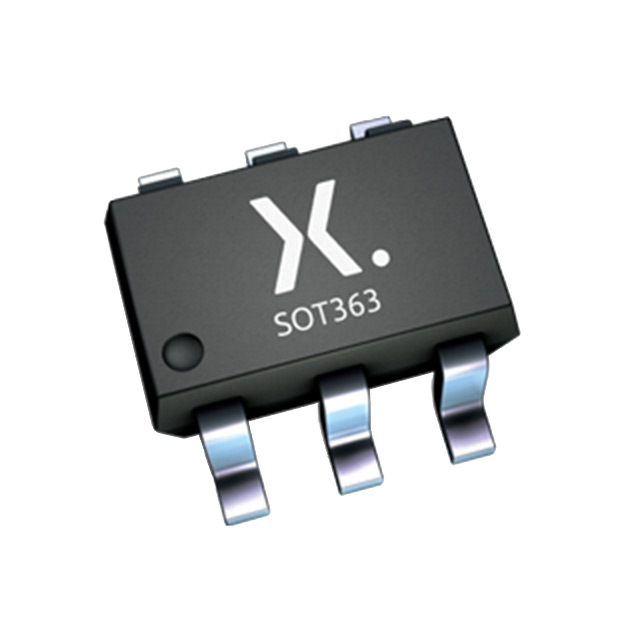
The PUMB30,115 is a pre-biased dual PNP bipolar transistor manufactured by Nexperia USA Inc., designed for surface mount applications in the 6-TSSOP package. This component integrates two PNP transistors with internal biasing resistors, enabling simplified circuit design for switching and amplification applications. The device operates at a maximum collector-emitter voltage of 50V with a maximum collector current of 100mA and power dissipation of 300mW. The part maintains Active product status and carries AEC-Q100 automotive qualification with ROHS3 compliance. Equivalent and substitute parts are identified based on matching electrical specifications, package compatibility, and functional characteristics within the pre-biased dual PNP transistor category.
Substiute Parts
Key Parameters
| Parameter | Value | Unit |
|---|---|---|
| Transistor Type | 2 PNP - Pre-Biased (Dual) | — |
| Current - Collector (Ic) (Max) | 100 | mA |
| Voltage - Collector Emitter Breakdown (Max) | 50 | V |
| Resistor - Base (R1) | 2.2 | kOhms |
| Power - Max | 300 | mW |
| Package / Case | 6-TSSOP, SC-88, SOT-363 | — |
| Mounting Type | Surface Mount | — |
| RoHS Status | ROHS3 Compliant | — |
| Grade | Automotive | — |
| Qualification | AEC-Q100 | — |
Substitute Part Grouping Explanation
Substitute parts for the PUMB30,115 are qualified based on the following criteria:
Electrical Compatibility Requirements:
- Transistor type must be 2 PNP - Pre-Biased (Dual)
- Maximum collector current must be 100mA or greater
- Maximum collector-emitter breakdown voltage must be 50V or greater
- Package must be compatible with 6-TSSOP, SC-88, or SOT-363 footprints
- Surface mount mounting type required
- RoHS3 compliance required
Functional Equivalence Factors:
- Internal base resistor (R1) value determines circuit biasing behavior and application suitability
- Maximum power dissipation capacity must support the intended application
- Saturation voltage characteristics affect switching performance
- Collector cutoff current impacts leakage behavior
The three substitute parts identified—UMB10NTN, UMB11NTN, and UMB2NTN—all meet the core electrical and mechanical requirements. Differentiation between these substitutes is determined by internal resistor configurations (R1 and R2 values), which establish different biasing networks for specific circuit applications.
Parameter Comparison
| Parameter | PUMB30,115 | UMB10NTN | UMB11NTN | UMB2NTN | Unit |
|---|---|---|---|---|---|
| Manufacturer | Nexperia USA Inc. | Rohm Semiconductor | Rohm Semiconductor | Rohm Semiconductor | — |
| Transistor Type | 2 PNP - Pre-Biased (Dual) | 2 PNP - Pre-Biased (Dual) | 2 PNP - Pre-Biased (Dual) | 2 PNP - Pre-Biased (Dual) | — |
| Current - Collector (Ic) (Max) | 100 | 100 | 100 | 100 | mA |
| Voltage - Collector Emitter Breakdown (Max) | 50 | 50 | 50 | 50 | V |
| Resistor - Base (R1) | 2.2 | 2.2 | 10 | 47 | kOhms |
| Resistor - Emitter Base (R2) | — | 47 | 10 | 47 | kOhms |
| DC Current Gain (hFE) (Min) @ Ic, Vce | 30 @ 20mA, 5V | 80 @ 10mA, 5V | 20 @ 5mA, 5V | 68 @ 5mA, 5V | — |
| Vce Saturation (Max) @ Ib, Ic | 150mV @ 500µA, 10mA | 300mV @ 250µA, 5mA | 300mV @ 500µA, 10mA | 300mV @ 500µA, 10mA | mV |
| Current - Collector Cutoff (Max) | 1 | 500 | 500 | 500 | µA / nA |
| Frequency - Transition | — | 250 | 250 | 250 | MHz |
| Power - Max | 300 | 150 | 150 | 150 | mW |
| Package / Case | 6-TSSOP, SC-88, SOT-363 | 6-TSSOP, SC-88, SOT-363 | 6-TSSOP, SC-88, SOT-363 | 6-TSSOP, SC-88, SOT-363 | — |
| Mounting Type | Surface Mount | Surface Mount | Surface Mount | Surface Mount | — |
| RoHS Status | ROHS3 Compliant | ROHS3 Compliant | ROHS3 Compliant | ROHS3 Compliant | — |
| Moisture Sensitivity Level (MSL) | 1 (Unlimited) | 1 (Unlimited) | 1 (Unlimited) | 1 (Unlimited) | — |
| Product Status | Active | Active | Active | Active | — |
Engineering Selection Recommendations
PUMB30,115 (Nexperia USA Inc.)
The PUMB30,115 is the primary reference part with AEC-Q100 automotive qualification. This part is suitable for applications requiring automotive-grade reliability and compliance. The 300mW power rating provides higher thermal headroom compared to substitute options. The 2.2kOhm base resistor configuration establishes a specific biasing network appropriate for particular circuit topologies. This part maintains Active product status with established supply chain availability.
UMB10NTN (Rohm Semiconductor)
The UMB10NTN provides electrical equivalence with matching 2.2kOhm base resistor value, ensuring identical biasing characteristics to the PUMB30,115. This substitute maintains 100mA maximum collector current and 50V breakdown voltage specifications. The addition of a 47kOhm emitter-base resistor (R2) differentiates the internal network. The UMB10NTN operates at 150mW maximum power dissipation, which is lower than the primary part. This substitute is suitable for applications where the lower power rating is acceptable and where the R2 resistor addition does not conflict with circuit requirements. RoHS3 compliance and unlimited MSL rating are maintained. High inventory availability (26,400 pieces) supports production requirements.
UMB11NTN (Rohm Semiconductor)
The UMB11NTN features a 10kOhm base resistor (R1) and 10kOhm emitter-base resistor (R2), establishing a different biasing network than the PUMB30,115. This configuration is suitable for applications requiring higher base resistance values. The part maintains 100mA collector current and 50V breakdown voltage specifications. Maximum power dissipation is 150mW. The DC current gain specification (20 @ 5mA, 5V) differs from the primary part. This substitute is appropriate for circuits designed around the 10kOhm resistor network. RoHS3 compliance and unlimited MSL rating are maintained. Inventory availability is 22,189 pieces.
UMB2NTN (Rohm Semiconductor)
The UMB2NTN incorporates 47kOhm base and emitter-base resistors (R1 and R2), providing the highest base resistance configuration among the substitutes. This part maintains 100mA collector current and 50V breakdown voltage specifications. Maximum power dissipation is 150mW. The DC current gain specification (68 @ 5mA, 5V) reflects the higher resistor values. This substitute is suitable for applications requiring high base resistance biasing. RoHS3 compliance and unlimited MSL rating are maintained. Inventory availability is 5,950 pieces.
Selection Criteria Summary:
All substitute parts maintain Active product status, RoHS3 compliance, and unlimited moisture sensitivity rating. Package compatibility is confirmed across all options. Selection between substitutes depends on circuit biasing requirements determined by internal resistor values. The PUMB30,115 provides the highest power dissipation capacity (300mW) and automotive qualification. Rohm substitutes provide lower power ratings (150mW) with different resistor network configurations. Inventory availability varies across all options.
Frequently Asked Questions (FAQ)
Q: Can UMB10NTN, UMB11NTN, or UMB2NTN be used as direct replacements for PUMB30,115?
A: These parts are functionally equivalent within the pre-biased dual PNP transistor category and share identical package footprints (6-TSSOP, SC-88, SOT-363). However, substitution depends on circuit biasing requirements. The PUMB30,115 uses a 2.2kOhm base resistor without a specified emitter-base resistor. UMB10NTN matches this 2.2kOhm base resistor value but adds a 47kOhm emitter-base resistor. UMB11NTN and UMB2NTN use different base resistor values (10kOhm and 47kOhm respectively). Circuit analysis is required to confirm compatibility with the specific biasing network.
Q: What is the significance of the internal resistor values (R1 and R2)?
A: Internal resistor values establish the biasing network that determines transistor turn-on characteristics and switching behavior. The base resistor (R1) controls the base current path and biasing speed. The emitter-base resistor (R2), when present, affects the transistor's response to input signals. Different resistor configurations are optimized for different circuit applications. Selection must align with the circuit design requirements.
Q: Are all substitute parts automotive-qualified?
A: The PUMB30,115 carries AEC-Q100 automotive qualification. The Rohm substitutes (UMB10NTN, UMB11NTN, UMB2NTN) are listed as Active products with RoHS3 compliance but do not specify AEC-Q100 qualification in the provided parameters. Applications requiring automotive qualification should confirm qualification status with the manufacturer before substitution.
Q: What is the difference in power dissipation between the main part and substitutes?
A: The PUMB30,115 has a maximum power dissipation rating of 300mW. All three Rohm substitutes (UMB10NTN, UMB11NTN, UMB2NTN) have a maximum power dissipation rating of 150mW. Applications operating near the thermal limits of the PUMB30,115 may require circuit redesign if substituting with lower-power-rated parts.
Q: Are the package dimensions identical across all parts?
A: All parts use the 6-TSSOP package designation (also referenced as SC-88 or SOT-363). This ensures PCB footprint compatibility. However, physical dimensions and lead spacing should be verified against manufacturer datasheets for specific assembly requirements.
Q: What inventory considerations apply to these substitutes?
A: The PUMB30,115 has 767 pieces in stock. UMB10NTN has 26,400 pieces available, UMB11NTN has 22,189 pieces, and UMB2NTN has 5,950 pieces. Inventory availability may influence substitution decisions for high-volume production requirements.
Q: Do all parts meet RoHS3 compliance?
A: Yes, the PUMB30,115 and all three substitute parts (UMB10NTN, UMB11NTN, UMB2NTN) are ROHS3 compliant. All parts also have unlimited moisture sensitivity level (MSL 1) ratings.
Q: How do the DC current gain specifications differ?
A: The PUMB30,115 specifies a minimum DC current gain (hFE) of 30 at 20mA collector current and 5V collector-emitter voltage. UMB10NTN specifies 80 @ 10mA, 5V; UMB11NTN specifies 20 @ 5mA, 5V; and UMB2NTN specifies 68 @ 5mA, 5V. These differences reflect the different internal resistor configurations and measurement conditions. Circuit performance may vary based on these gain characteristics.
Q: What is the significance of transition frequency specifications?
A: The PUMB30,115 does not specify a transition frequency. All three Rohm substitutes specify 250MHz transition frequency. This parameter indicates the frequency at which the transistor's current gain drops to unity. Higher transition frequency generally indicates faster switching capability, though this specification is not provided for the primary part.
Alternative Parts

SJ6012L2TP
Littelfuse Inc.
6 Alternative Parts

JMK107BBJ476MA-RE
Taiyo Yuden
10 Alternative Parts

GMK107BBJ475MA-T
Taiyo Yuden
5 Alternative Parts
SJ6020N2ARP
Littelfuse Inc.
3 Alternative Parts
SJ6025R2ATP
Littelfuse Inc.
4 Alternative Parts

2474-05L
API Delevan Inc.
1 Alternative Parts

4590R-684K
API Delevan Inc.
1 Alternative Parts

CM6560R-334
API Delevan Inc.
1 Alternative Parts

CM6460-104
API Delevan Inc.
1 Alternative Parts

5526-12
API Delevan Inc.
1 Alternative Parts