


Request Quote
(Ships tomorrow)
F5D1B Infrared Emitter 880nm Equivalent & Substitute Parts
Part Overview
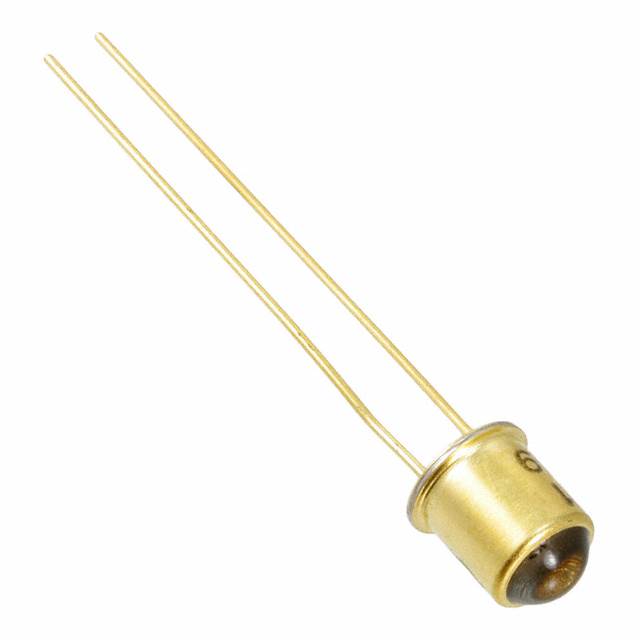
The F5D1B is an infrared (IR) emitter manufactured by onsemi, designed for 880nm wavelength applications with a maximum forward current of 100mA and typical forward voltage of 1.7V. The device features a TO-46-2 lens top metal can package with a 16° viewing angle and operates across the temperature range of -65°C to 125°C. The F5D1B is classified as obsolete, making equivalent and substitute parts necessary for ongoing system support and new design implementations.
Substiute Parts
Key Parameters
| Parameter | F5D1B Specification |
|---|---|
| Manufacturer | onsemi |
| Type | Infrared (IR) Emitter |
| Wavelength | 880nm |
| Current - DC Forward (If) Max | 100mA |
| Voltage - Forward (Vf) Typical | 1.7V |
| Viewing Angle | 16° |
| Package / Case | TO-46-2 Lens Top Metal Can |
| Mounting Type | Through Hole |
| Operating Temperature | -65°C ~ 125°C (TA) |
| Product Status | Obsolete |
| Moisture Sensitivity Level (MSL) | 1 (Unlimited) |
Substitute Part Grouping Explanation
Substitution eligibility for the F5D1B is determined by the following critical parameters: package type (TO-46-2 Lens Top Metal Can), mounting method (Through Hole), maximum forward current (100mA), operating temperature range compatibility, and wavelength proximity. All substitute parts listed maintain identical package and mounting specifications. Wavelength variations are grouped by proximity to the original 880nm specification, with acceptable substitutes ranging from 850nm to 935nm. Forward voltage and viewing angle variations are documented to enable circuit-level compatibility assessment. All substitute parts are active products with current manufacturing status and RoHS3 compliance, providing long-term availability advantages over the obsolete F5D1B.
Parameter Comparison
| Part Number | Manufacturer | Wavelength | Vf (Typ) | If (Max) | Viewing Angle | Operating Temp | Product Status | RoHS Status |
|---|---|---|---|---|---|---|---|---|
| F5D1B | onsemi | 880nm | 1.7V | 100mA | 16° | -65°C ~ 125°C | Obsolete | REACH Unaffected |
| OP231 | TT Electronics/Optek Technology | 890nm | 2V | 100mA | 18° | -65°C ~ 125°C | Active | ROHS3 Compliant |
| OP232 | TT Electronics/Optek Technology | 890nm | 2V | 100mA | 18° | -65°C ~ 125°C | Active | ROHS3 Compliant |
| OP233 | TT Electronics / Optek Technology | 890nm | 2V | 100mA | 18° | -65°C ~ 125°C | Active | ROHS3 Compliant |
| OP234 | TT Electronics/Optek Technology | 850nm | 2V | 100mA | 60° | -65°C ~ 125°C | Active | ROHS3 Compliant |
| OP235 | TT Electronics/Optek Technology | 850nm | 1.55V | 100mA | 18° | -65°C ~ 125°C | Active | ROHS3 Compliant |
| OP236TX | TT Electronics / Optek Technology | 890nm | 1.55V | 100mA | 18° | -55°C ~ 125°C | Active | ROHS3 Compliant |
| OP130 | TT Electronics/Optek Technology | 935nm | 1.75V | 100mA | 18° | -65°C ~ 125°C | Active | ROHS3 Compliant |
Engineering Selection Recommendations
All substitute parts maintain the TO-46-2 package and 100mA maximum forward current specification of the F5D1B. Selection among substitutes depends on wavelength requirements and circuit design constraints.
For applications requiring wavelength closest to the original 880nm specification, OP231, OP232, and OP233 operate at 890nm with 2V typical forward voltage. These three parts are functionally equivalent and differ only in inventory availability. OP236TX provides 890nm wavelength operation at 1.55V typical forward voltage, offering reduced power dissipation compared to the 2V alternatives, though with a narrower operating temperature range (-55°C to 125°C versus -65°C to 125°C).
For 850nm wavelength applications, OP234 and OP235 are available. OP234 features a 60° viewing angle compared to the F5D1B's 16°, suitable for wide-angle illumination. OP235 maintains an 18° viewing angle with 1.55V typical forward voltage, providing closer voltage matching to the original F5D1B specification.
OP130 operates at 935nm wavelength with 1.75V typical forward voltage and 18° viewing angle, appropriate for longer-wavelength IR applications.
All substitute parts carry active product status and ROHS3 compliance, ensuring long-term availability and regulatory alignment. The F5D1B's obsolete status makes transition to an active substitute part necessary for production continuity.
Frequently Asked Questions (FAQ)
Q: Can OP231, OP232, and OP233 be used interchangeably with the F5D1B?
A: OP231, OP232, and OP233 share identical electrical specifications (890nm wavelength, 2V typical forward voltage, 100mA maximum current, 18° viewing angle) and package type (TO-46-2). The 10nm wavelength difference from the F5D1B's 880nm specification and 2V forward voltage (versus 1.7V) require circuit-level compatibility assessment. These parts are functionally equivalent to each other and differ only in inventory levels.
Q: What is the impact of forward voltage differences between the F5D1B and substitute parts?
A: The F5D1B operates at 1.7V typical forward voltage. Substitute parts range from 1.55V (OP235, OP236TX) to 2V (OP231, OP232, OP233, OP234). Forward voltage differences affect current-limiting resistor calculations and power dissipation. Circuits designed for the F5D1B's 1.7V specification require recalculation when using 2V substitutes to maintain equivalent LED current and brightness.
Q: Are there wavelength restrictions for substitution?
A: All substitute parts operate within the near-infrared spectrum (850nm to 935nm). Wavelength selection depends on application requirements. The F5D1B's 880nm specification is most closely matched by OP231, OP232, OP233 (890nm), and OP236TX (890nm). Longer wavelengths (OP130 at 935nm) and shorter wavelengths (OP234, OP235 at 850nm) are suitable only for applications tolerant of wavelength variation.
Q: What is the significance of the viewing angle parameter?
A: The F5D1B features a 16° viewing angle. Most substitutes (OP231, OP232, OP233, OP235, OP130, OP236TX) maintain an 18° viewing angle, providing comparable beam concentration. OP234 features a 60° viewing angle, suitable for wide-angle illumination but not for narrow-beam applications. Viewing angle selection affects optical system design and detector field-of-view requirements.
Q: Does the operating temperature range affect substitution decisions?
A: The F5D1B operates from -65°C to 125°C. All substitute parts except OP236TX maintain this identical range. OP236TX operates from -55°C to 125°C, restricting use in applications requiring operation below -55°C. For standard industrial and consumer applications within the -55°C to 125°C range, OP236TX is suitable.
Q: Why is RoHS3 compliance important for the substitute parts?
A: All substitute parts carry ROHS3 compliance, ensuring compliance with current environmental and regulatory standards. The F5D1B's REACH Unaffected status indicates no regulatory restriction, but active substitute parts with ROHS3 compliance provide assurance of long-term availability and regulatory alignment for new designs and production continuity.
Alternative Parts

SJ6012L2TP
Littelfuse Inc.
6 Alternative Parts

JMK107BBJ476MA-RE
Taiyo Yuden
10 Alternative Parts

GMK107BBJ475MA-T
Taiyo Yuden
5 Alternative Parts
SJ6020N2ARP
Littelfuse Inc.
3 Alternative Parts
SJ6025R2ATP
Littelfuse Inc.
4 Alternative Parts

2474-05L
API Delevan Inc.
1 Alternative Parts

4590R-684K
API Delevan Inc.
1 Alternative Parts

CM6560R-334
API Delevan Inc.
1 Alternative Parts

CM6460-104
API Delevan Inc.
1 Alternative Parts

5526-12
API Delevan Inc.
1 Alternative Parts