


Request Quote
(Ships tomorrow)
DXTP58100CFDB-7 Equivalent & Substitute Parts
Part Overview
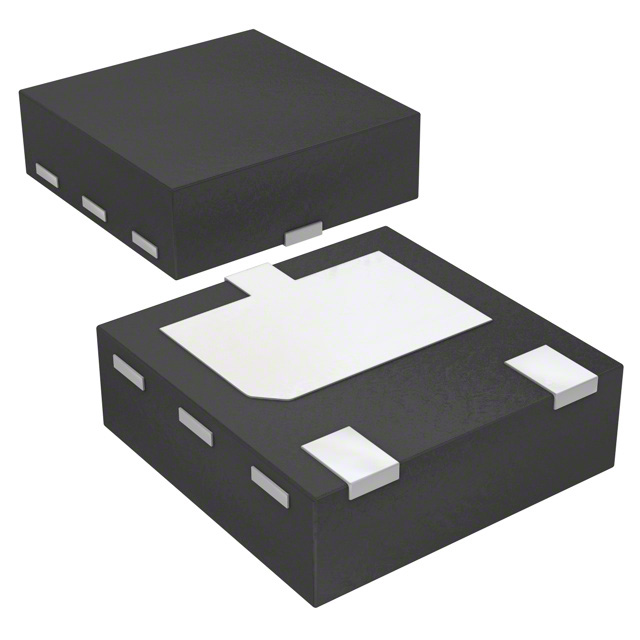
The DXTP58100CFDB-7 is an active PNP bipolar junction transistor manufactured by Diodes Incorporated, designed for surface mount applications in the 3-UDFN Exposed Pad package. This component operates at maximum collector current of 2 A and collector-emitter breakdown voltage of 100 V, with a maximum power dissipation of 690 mW. The part is ROHS3 compliant and carries unlimited moisture sensitivity level (MSL 1), making it suitable for standard manufacturing environments. Equivalent and substitute parts are identified to support design flexibility, inventory management, and supply chain continuity for applications requiring PNP transistor functionality within specified electrical and mechanical parameters.
Substiute Parts
Key Parameters
| Parameter | Value | Unit |
|---|---|---|
| Transistor Type | PNP | — |
| Current - Collector (Ic) (Max) | 2 | A |
| Voltage - Collector Emitter Breakdown (Max) | 100 | V |
| Power - Max | 690 | mW |
| Frequency - Transition | 135 | MHz |
| Operating Temperature Range | -55 to 150 | °C |
| Mounting Type | Surface Mount | — |
| Package / Case | 3-UDFN Exposed Pad | — |
| RoHS Status | ROHS3 Compliant | — |
| Product Status | Active | — |
Substitute Part Grouping Explanation
Substitution of the DXTP58100CFDB-7 is determined by electrical and mechanical compatibility within the PNP bipolar junction transistor category. The primary substitution criteria are:
Electrical Parameters:
- Transistor polarity must remain PNP
- Maximum collector current (Ic) must equal or exceed 2 A
- Maximum collector-emitter breakdown voltage (VCEO) must equal or exceed 100 V
- Maximum power dissipation must support the application requirements
- Operating temperature range must encompass -55°C to 150°C
Mechanical Parameters:
- Surface mount mounting type
- 3-pin UDFN package with exposed pad configuration
- Tape & Reel packaging for automated assembly
The substitute part 2SAR567F3TR from Rohm Semiconductor meets these criteria with enhanced electrical specifications (2.5 A collector current, 120 V breakdown voltage, 1 W power dissipation) while maintaining package compatibility and surface mount configuration. Both parts are active products with ROHS3 compliance and unlimited moisture sensitivity level.
Parameter Comparison
| Parameter | DXTP58100CFDB-7 (Diodes Inc.) | 2SAR567F3TR (Rohm Semiconductor) | Compatibility |
|---|---|---|---|
| Transistor Type | PNP | PNP | Match |
| Current - Collector (Ic) (Max) | 2 A | 2.5 A | Substitute exceeds requirement |
| Voltage - Collector Emitter Breakdown (Max) | 100 V | 120 V | Substitute exceeds requirement |
| Power - Max | 690 mW | 1 W | Substitute exceeds requirement |
| Frequency - Transition | 135 MHz | 220 MHz | Substitute exceeds requirement |
| Operating Temperature (Max) | 150°C | 150°C | Match |
| Mounting Type | Surface Mount | Surface Mount | Match |
| Package / Case | 3-UDFN Exposed Pad | 3-UDFN Exposed Pad | Match |
| RoHS Status | ROHS3 Compliant | ROHS3 Compliant | Match |
| Product Status | Active | Active | Match |
Engineering Selection Recommendations
Both the DXTP58100CFDB-7 and 2SAR567F3TR are active products with ROHS3 compliance and REACH unaffected status, suitable for current production designs. The DXTP58100CFDB-7 is the primary component specified for this application. The 2SAR567F3TR serves as a qualified substitute when supply constraints or design requirements necessitate an alternative source.
Selection between these parts should be based on:
Primary Part (DXTP58100CFDB-7): Use when design specifications are optimized for the 100 V breakdown voltage, 2 A collector current, and 690 mW power dissipation. This part is the original design choice and carries the full design validation history.
Substitute Part (2SAR567F3TR): Use when the application can accommodate higher electrical ratings (120 V, 2.5 A, 1 W) and when supply availability of the primary part is constrained. The enhanced specifications provide additional design margin in high-current or high-voltage stress conditions.
Both parts maintain identical surface mount package configuration (3-UDFN Exposed Pad), identical moisture sensitivity level (MSL 1), and identical maximum operating temperature (150°C), ensuring direct mechanical and thermal compatibility in PCB assembly processes.
Frequently Asked Questions (FAQ)
Q: Can the 2SAR567F3TR directly replace the DXTP58100CFDB-7 in existing designs?
A: Yes. The 2SAR567F3TR meets or exceeds all electrical parameters of the DXTP58100CFDB-7 (collector current, breakdown voltage, power dissipation, and frequency response) while maintaining identical package configuration (3-UDFN Exposed Pad) and surface mount characteristics. No PCB layout modifications are required.
Q: Are there any electrical parameter differences that affect circuit performance?
A: The 2SAR567F3TR provides higher electrical ratings across all parameters: 2.5 A versus 2 A collector current, 120 V versus 100 V breakdown voltage, 1 W versus 690 mW power dissipation, and 220 MHz versus 135 MHz transition frequency. These differences represent design margin enhancements and do not degrade circuit performance when substituting into designs specified for the DXTP58100CFDB-7.
Q: Do both parts require identical PCB footprints?
A: Yes. Both the DXTP58100CFDB-7 and 2SAR567F3TR use the 3-UDFN Exposed Pad package configuration, requiring identical PCB footprints and assembly processes. No design modifications are necessary for package compatibility.
Q: What is the moisture sensitivity level for both parts?
A: Both parts carry MSL 1 (Unlimited), indicating no moisture sensitivity restrictions. Standard surface mount assembly processes and storage conditions apply without special moisture control requirements.
Q: Are both parts compliant with current environmental regulations?
A: Yes. Both the DXTP58100CFDB-7 and 2SAR567F3TR are ROHS3 compliant and REACH unaffected, meeting current environmental and regulatory requirements for electronic component manufacturing and distribution.
Q: What is the maximum operating temperature for both parts?
A: Both parts operate at a maximum junction temperature (TJ) of 150°C, providing identical thermal performance characteristics and thermal design considerations.
Alternative Parts

SJ6012L2TP
Littelfuse Inc.
6 Alternative Parts

JMK107BBJ476MA-RE
Taiyo Yuden
10 Alternative Parts

GMK107BBJ475MA-T
Taiyo Yuden
5 Alternative Parts
SJ6020N2ARP
Littelfuse Inc.
3 Alternative Parts
SJ6025R2ATP
Littelfuse Inc.
4 Alternative Parts

2474-05L
API Delevan Inc.
1 Alternative Parts

4590R-684K
API Delevan Inc.
1 Alternative Parts

CM6560R-334
API Delevan Inc.
1 Alternative Parts

CM6460-104
API Delevan Inc.
1 Alternative Parts

5526-12
API Delevan Inc.
1 Alternative Parts